136 posters, 2 topics, 27 sessions, 339 authors, 88 institutions
ePostersLive by SciGen Technologies S.A. All rights reserved.
2024 ACP Annual Session
NOVEMBER 6-9, 2024 | MARCO ISLAND, FL JW MARRIOT

186
Maxillary Osteomyelitis Induced by Mucormycosis: Rehabilitation Using a Swing-Lock Partial Denture Design with Dental Implants
Poster Presenter
Authors
Affiliations
Part of Topic
Case Presentation
Title: Maxillary Osteomyelitis Induced by Mucormycosis: Rehabilitation Using an Obturator with a Swing-Lock Partial Denture Design with Dental Implants
Introduction:
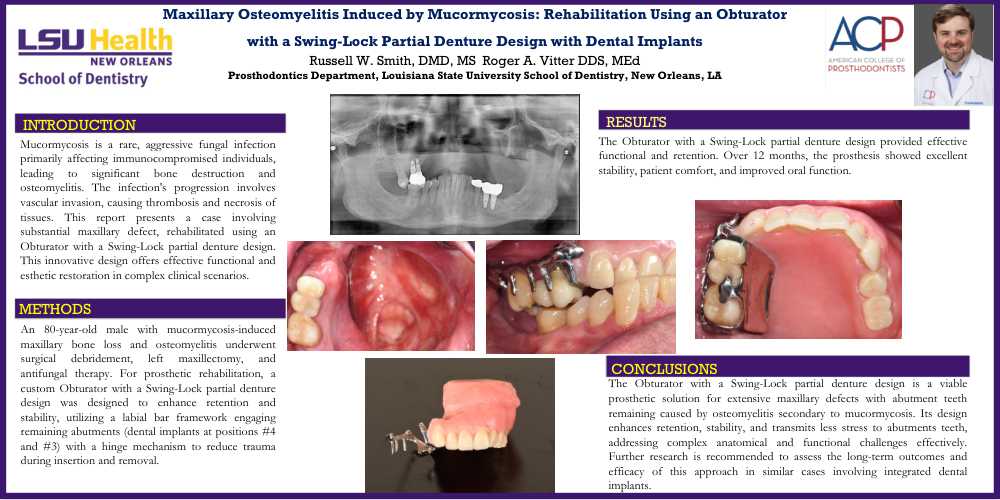
Mucormycosis is a rare, aggressive fungal infection primarily affecting immunocompromised individuals, leading to significant bone destruction and osteomyelitis. The infection's progression involves vascular invasion, causing thrombosis and necrosis of tissues. This report presents a case involving substantial maxillary defect, rehabilitated using an Obturator with a Swing-Lock partial denture design. This innovative design offers effective functional and esthetic restoration in complex clinical scenarios.
Methods:
An 80-year-old male with mucormycosis-induced maxillary bone loss and osteomyelitis underwent surgical debridement, left maxillectomy, and antifungal therapy. For prosthetic rehabilitation, a custom Obturator with a Swing-Lock partial denture design was designed to enhance retention and stability, utilizing a labial bar framework engaging remaining abutments (dental implants at positions #4 and #3) with a hinge mechanism to reduce trauma during insertion and removal.
Results:
The Obturator with a Swing-Lock partial denture designprovided effective functional and retention. Over 12 months, the prosthesis showed excellent stability, patient comfort, and improved oral function.
Conclusion:
The Obturator with a Swing-Lock partial denture design is a viable prosthetic solution for extensive maxillary defects with abutment teeth remaining caused by osteomyelitis secondary to mucormycosis. Its design enhances retention, stability, and transmits less stress to abutments teeth, addressing complex anatomical and functional challenges effectively. Further research is recommended to assess the long-term outcomes and efficacy of this approach in similar cases involving integrated dental implants.