136 posters, 2 topics, 27 sessions, 339 authors, 88 institutions
ePostersLive by SciGen Technologies S.A. All rights reserved.
2024 ACP Annual Session
NOVEMBER 6-9, 2024 | MARCO ISLAND, FL JW MARRIOT

181
Use of a Digital Facebow in the Fabrication of a 3D-Printed Occlusal Guard
Poster Presenter
Authors
Affiliations
Part of Topic
Case Presentation
Objective
Digital impressions provide an accurate and effective method of record making for well-fitting occlusal guards. The current digital workflows do not incorporate a facebow transfer. This poster utilizes a digital facebow solution for the purpose.
Introduction
One of the greatest drawbacks of the use of CAD-CAM in dentistry is the inability to easily incorporate an accurate facebow and move back and forth between digital and conventional workflow. Currently the use of facial scans with appliances or merging with a CBCT has been advocated (1). Other appliances, digital photos, and cumbersome tracking devices have also been used (2). In this poster a simple adapter to a SAM facebow has been used, the Axioprisa.
Materials and Methods
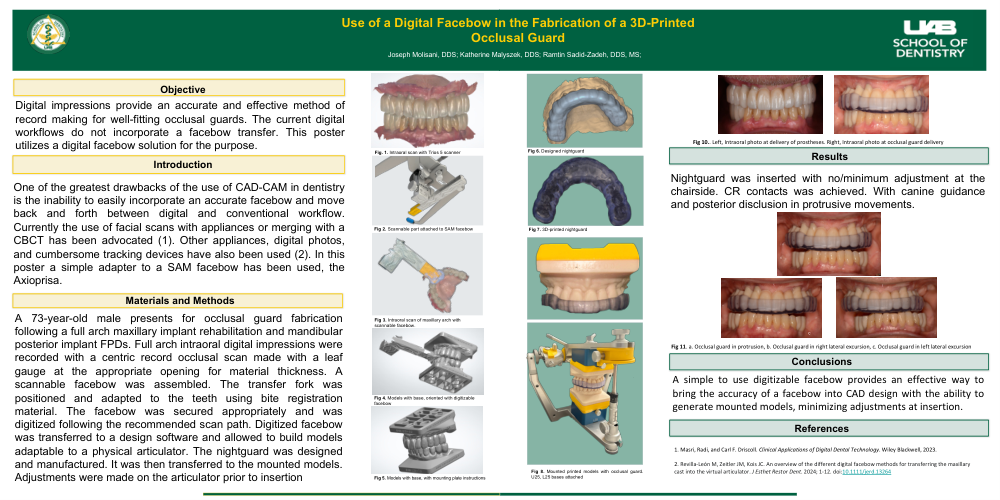
A 73-year-old male presents for occlusal guard fabrication following a full arch maxillary implant rehabilitation and mandibular posterior implant FPDs. Full arch intraoral digital impressions were recorded with a centric record occlusal scan made with a leaf gauge at the appropriate opening for material thickness. A scannable facebow was assembled. The transfer fork was positioned and adapted to the teeth using bite registration material. The facebow was secured appropriately and was digitized following the recommended scan path. Digitized facebow was transferred to a design software and allowed to build models adaptable to a physical articulator. The nightguard was designed and manufactured. It was then transferred to the mounted models. Adjustments were made on the articulator prior to insertion
Results
Nightguard was inserted with no/minimum adjustment at the chairside. CR contacts was achieved. With canine guidance and posterior disclusion in protrusive movements.
Conclusions
A simple to use digitizable facebow provides an effective way to bring the accuracy of a facebow into CAD design with the ability to generate mounted models, minimizing adjustments at insertion.