136 posters, 2 topics, 27 sessions, 339 authors, 88 institutions
ePostersLive by SciGen Technologies S.A. All rights reserved.
2024 ACP Annual Session
NOVEMBER 6-9, 2024 | MARCO ISLAND, FL JW MARRIOT

174
Positioning Jig for Accurate Veneer Bonding
Poster Presenter
Authors
Affiliations
Part of Topic
Case Presentation
Laminate Veneers Insertion Jig- A clinical technique
Introduction:
Laminate veneer insertion, particularly in no-preparation and
window prep designs, often encounters challenges in achieving
precise seating and alignment. Misalignment during cementation
can compromise aesthetics, function, and biology. This poster
presents a novel solution using a CAD/CAM-designed seating jig to
address these clinical issues.
Purpose:
The aim is to ensure accurate veneer alignment by replicating their
Ideal placement from the master cast to the patient’s mouth,
minimizing human error and enhancing precision during
cementation.
Methodology:
•Using the scanned scan of prepared teeth & the STL files of the veneers were merged using
CAD software (Dental Designer; 3Shape c) to design and fabricate a seating jig.
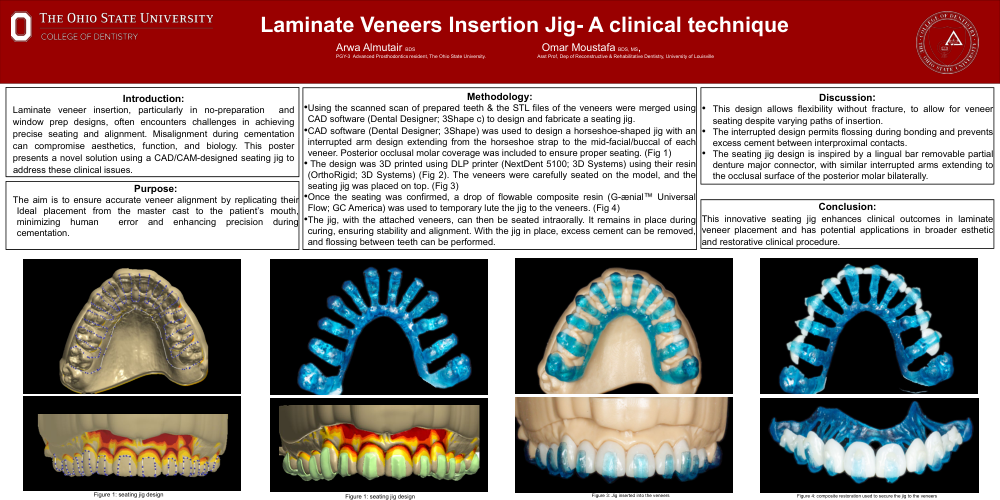
•CAD software (Dental Designer; 3Shape) was used to design a horseshoe-shaped jig with an
interrupted arm design extending from the horseshoe strap to the mid facial/buccal of each
veneer. Posterior occlusal molar coverage was included to ensure proper seating. (Fig 1)
• The design was 3D printed using DLP printer (NextDent 5100; 3D Systems) using their resin
(OrthoRigid; 3D Systems) (Fig 2). The veneers were carefully seated on the model, and the
seating jig was placed on top. (Fig 3)
•Once the seating was confirmed, a drop of flowable composite resin (G-ænial Universal
Flow; GC America) was used to temporary lute the jig to the veneers. (Fig 4)
•The jig, with the attached veneers, can then be seated intraorally. It remains in place during
curing, ensuring stability and alignment. With the jig in place, excess cement can be removed,
and flossing between teeth can be performed.
Discussion:
• This design allows flexibility without fracture to allow for veneer
seating despite varying paths of insertion.
• The interrupted design permits flossing during bonding and prevents
excess cement between interproximal contacts.
• The seating jig design is inspired by a lingual bar removable partial
denture major connector, with similar interrupted arms extending to
the occlusal surface of the posterior molar bilaterally.
Conclusion:
This innovative seating jig enhances clinical outcomes in laminate
veneer placement and has potential applications in broader esthetic
and restorative clinical procedure.