136 posters, 2 topics, 27 sessions, 339 authors, 88 institutions
ePostersLive by SciGen Technologies S.A. All rights reserved.
2024 ACP Annual Session
NOVEMBER 6-9, 2024 | MARCO ISLAND, FL JW MARRIOT

171
Synergy of analog and digital approaches in a full mouth prosthetic reconstruction: implants and teeth supported restorations.
Poster Presenter
Authors
Paola Jarvis, Jack Piermatti, Carmen Pena, Daniel Feit, Alexander Bendayan, Niranjan Joshi
Affiliations
Part of Topic
Case Presentation
Introduction
Digital technology is rapidly improving; while not long ago, dental impressions needed to be performed with impression materials, trays, and stone dies, since CAD/CAM (computer-aided design/computer-aided manufacturing) technology was developed this reality has changed.
Traditionally, full mouth rehabilitations relied heavily on manual impressions and stone dies. However, the development of CAD/CAM technology has transformed the process, allowing for more precise and efficient treatment outcomes. In this case, a combination of analog occlusal wax-ups and digital scanning was utilized to achieve an optimal prosthetic result.
Purpose
This case highlights the integration of digital and analog workflows in the full mouth rehabilitation of a patient, demonstrating the significant advancements in dental technology. The case underscores the importance of combining traditional methods with cutting-edge digital technology to enhance accuracy, predictability, and patient satisfaction in complex prosthodontic treatments.
Workflow
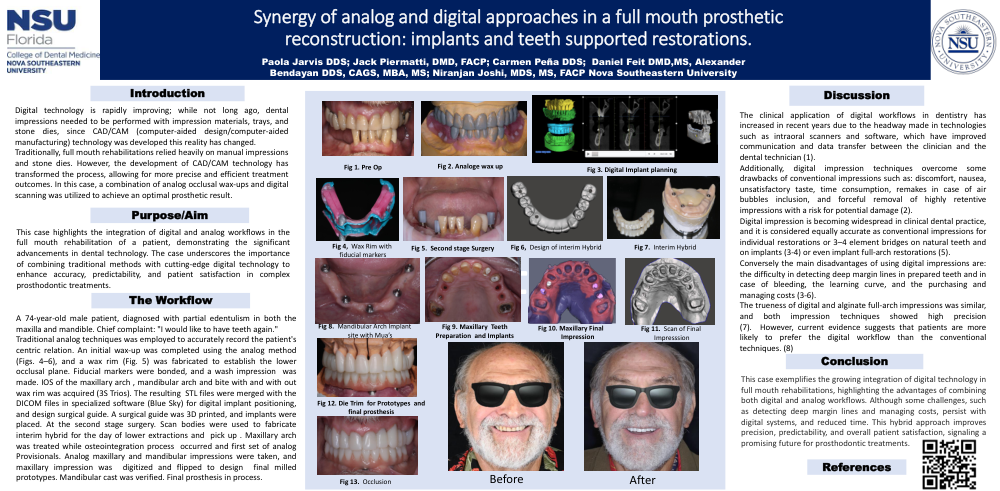
A 74-year-old male patient, diagnosed with partial edentulism in both the maxilla and mandible. Chief complaint: "I would like to have teeth again."
Traditional analog techniques was employed to accurately record the patient's centric relation. An initial wax-up was completed using the analog method (Figs. 4–6), and a wax rim (Fig. 5) was fabricated to establish the lower occlusal plane. Fiducial markers were bonded, and a wash impression was made. IOS of the maxillary arch , mandibular arch and bite with and with out wax rim was acquired (3S Trios). The resulting STL files were merged with the DICOM files in specialized software (Blue Sky) for digital implant positioning, and design surgical guide. A surgical guide was 3D printed, and implants were placed. At the second stage surgery. Scan bodies were used to fabricate interim hybrid for the day of lower extractions and pick up . Maxillary arch was treated while osteointegration process occurred and first set of analog Provisionals. Analog maxillary and mandibular impressions were taken, and maxillary impression was digitized and flipped to design final milled prototypes. Mandibular cast was verified. Final prosthesis in process.
Discussion
The clinical application of digital workflows in dentistry has increased in recent years due to the headway made in technologies such as intraoral scanners and software, which have improved communication and data transfer between the clinician and the dental technician (1).
Additionally, digital impression techniques overcome some drawbacks of conventional impressions such as: discomfort, nausea, unsatisfactory taste, time consumption, remakes in case of air bubbles inclusion, and forceful removal of highly retentive impressions with a risk for potential damage (2).
Digital impression is becoming widespread in clinical dental practice, and it is considered equally accurate as conventional impressions for individual restorations or 3–4 element bridges on natural teeth and on implants (3-4) or even implant full-arch restorations (5).
Conversely the main disadvantages of using digital impressions are: the difficulty in detecting deep margin lines in prepared teeth and in case of bleeding, the learning curve, and the purchasing and managing costs (3-6).
The trueness of digital and alginate full-arch impressions was similar, and both impression techniques showed high precision (7). However, current evidence suggests that patients are more likely to prefer the digital workflow than the conventional techniques. (8)
Conclusion
This case exemplifies the growing integration of digital technology in full mouth rehabilitations, highlighting the advantages of combining both digital and analog workflows. Although some challenges, such as detecting deep margin lines and managing costs, persist with digital systems, and reduced time. This hybrid approach improves precision, predictability, and overall patient satisfaction, signaling a promising future for prosthodontic treatments.
Reference
1. Joda, T.; Zarone, F.; Ferrari, M. The complete digital workflow in fixed prosthodontics: A systematic review. BMC Oral Health 2017, 17, 124
2. Albdour, E.A.; Shaheen, E.; Vranckx, M.; Mangano, F.G.; Politis, C.; Jacobs, R. A novel in vivo method to evaluate trueness of digital impressions. BMC Oral Health 2018, 18, 117.
3. Mangano, F.; Gandolfi, A.; Luongo, G.; Logozzo, S. Intraoral scanners in dentistry: A review of the current literature. BMC Oral Health 2017, 17, 149
4. Imburgia, M.; Logozzo, S.; Hauschild, U.; Veronesi, G.; Mangano, C.; Mangano, F.G. Accuracy of four intraoral scanners in oral implantology: A comparative in vitro study. BMC Oral Health 2017, 17, 92.
5. Pesce, P.; Pera, F.; Setti, P.; Menini, M. Precision and accuracy of a digital impression scanner in full-arch implant rehabilitation. Int. J. Prosthodont. 2018, 31, 171–175.
6. Zhao, X.; Qiao, S.C.; Shi, J.Y.; Uemura, N.; Arai, K.; Lai, H.C. Evaluation of the clinical and aesthetic outcomes of Straumann® Standard Plus implants supported single crowns placed in non-aug-mented healed sites in the anterior maxilla: A 5–8 years retrospective study. Clin. Oral Implant. Res. 2016, 27, 106–112
7. Kong L, Li Y, Liu Z. Digital versus conventional full-arch impressions in linear and 3D accuracy: a systematic review and meta-analysis of in vivo studies. Clin Oral Investig. 2022 Sep;26(9)
8. Reis INRD, Chamma-Wedemann CN, Silva IAO, Spin-Neto R, Sesma N, da Silva EVF. Clinical outcomes of digital scans versus conventional impressions for implant-supported fixed complete arch prostheses: A systematic review and meta-analysis. J Prosthet Dent. Published online October 19, 2023.