136 posters, 2 topics, 27 sessions, 339 authors, 88 institutions
ePostersLive by SciGen Technologies S.A. All rights reserved.
2024 ACP Annual Session
NOVEMBER 6-9, 2024 | MARCO ISLAND, FL JW MARRIOT

157
Optimizing Outcome with Palatally placed Implant in the esthetic zone: A Clinical Case
Poster Presenter
Part of Topic
Case Presentation
Optimizing Outcome with Palatally placed Implant in the esthetic zone: A Clinical Case
Introduction
Proper implant placement in the esthetic zone is essential for achieving optimal functional and esthetic results. Implants positioned too palatal can lead to esthetic concerns such as poor buccal contour or functional deficits.
Aim
To address the challenges and solutions involved in restoring a dental implant placed too palatal in the esthetic zone.
Case Presentation
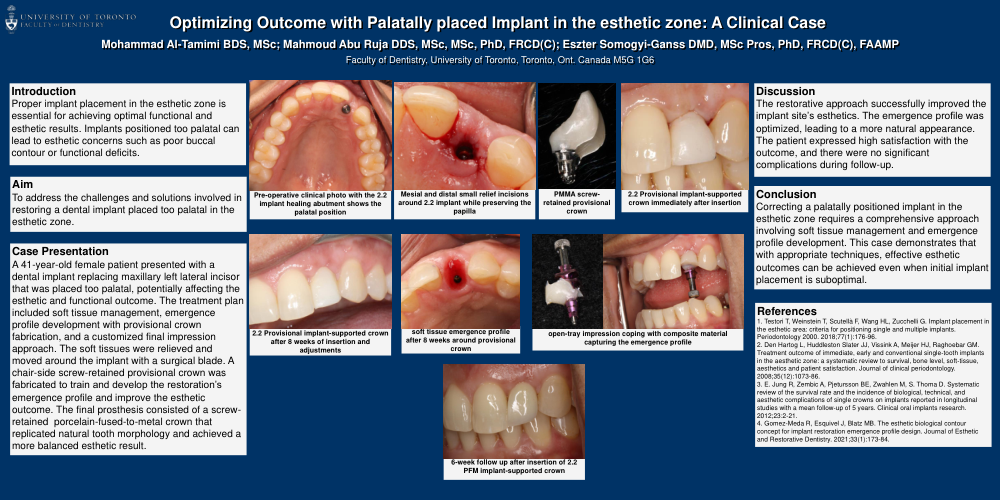
A 41-year-old female patient presented with a dental implant replacing maxillary left lateral incisor that was placed too palatal, potentially affecting the esthetic and functional outcome. The treatment plan included soft tissue management, emergence profile development with provisional crown fabrication, and a customized final impression approach. The soft tissues were relieved and moved around the implant with a surgical blade. A chair-side screw-retained provisional crown was fabricated to train and develop the restoration’s emergence profile and improve the esthetic outcome. The final prosthesis consisted of a screw-retained porcelain-fused-to-metal crown that replicated natural tooth morphology and achieved a more balanced esthetic result.
Discussion
The restorative approach successfully improved the implant site’s esthetics. The emergence profile was optimized, leading to a more natural appearance. The patient expressed high satisfaction with the outcome, and there were no significant complications during follow-up.
Conclusion
Correcting a palatally positioned implant in the esthetic zone requires a comprehensive approach involving soft tissue management and emergence profile development. This case demonstrates that with appropriate techniques, effective esthetic outcomes can be achieved even when initial implant placement is suboptimal.