136 posters, 2 topics, 27 sessions, 339 authors, 88 institutions
ePostersLive by SciGen Technologies S.A. All rights reserved.
2024 ACP Annual Session
NOVEMBER 6-9, 2024 | MARCO ISLAND, FL JW MARRIOT

152
Optimizing Implant-supported Fixed Complete Dentures Repairs with Reverse Scan Bodies and CAD Boolean Tools: A Case Study
Poster Presenter
Part of Topic
Case Presentation
Optimizing Implant-supported Fixed Complete Dentures Repairs with Reverse Scan Bodies
and CAD Boolean Tools: A Case Study
Introduction:
Implant-supported fixed complete dentures (IFCDs) are a well-accepted treatment modality for edentulous patients, offering high patient satisfaction and improved quality of life. Several clinical studies have demonstrated high prosthetic survival rates for IFCDs. However, some major complications associated with IFCDs require prosthetic removal for laboratory repair, which can be expensive and time-consuming. Therefore, it is important to identify the most efficient workflow for managing IFCD complications.
Method:
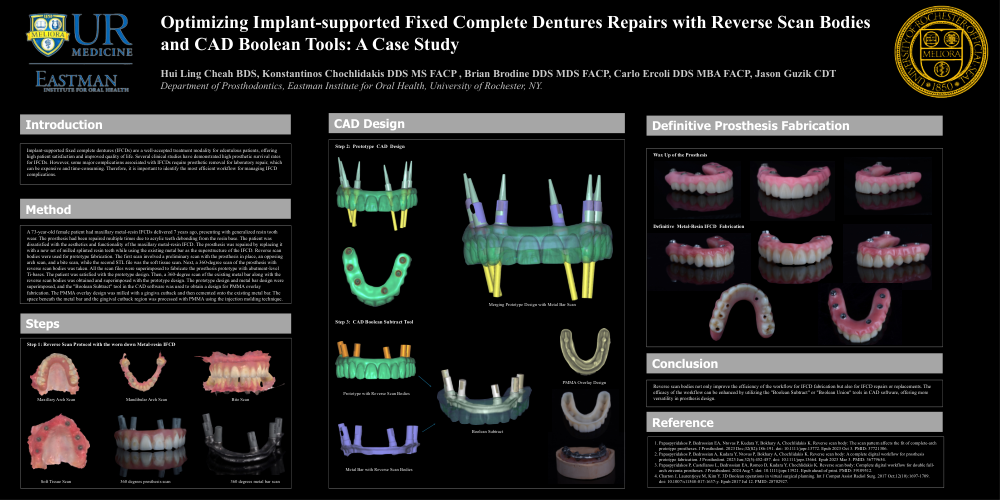
A 73-year-old female patient had maxillary metal-resin IFCDs delivered 7 years ago, presenting with generalized resin tooth wear. The prosthesis had been repaired multiple times due to acrylic teeth debonding from the resin base. The patient was dissatisfied with the aesthetics and functionality of the maxillary metal-resin IFCD. The prosthesis was repaired by replacing it with a new set of milled splinted resin teeth while using the existing metal bar as the superstructure of the IFCD. Reverse scan bodies were used for prototype fabrication. The first scan involved a preliminary scan with the prosthesis in place, an opposing arch scan, and a bite scan, while the second STL file was the soft tissue scan. Next, a 360-degree scan of the prosthesis with reverse scan bodies was taken. All the scan files were superimposed to fabricate the prosthesis prototype with abutment-level Ti-bases. The patient was satisfied with the prototype design. Then, a 360-degree scan of the existing metal bar along with the reverse scan bodies was obtained and superimposed with the prototype design. The prototype design and metal bar design were superimposed, and the "Boolean Subtract" tool in the CAD software was used to obtain a design for PMMA overlay fabrication. The PMMA overlay design was milled with a gingiva cutback and then cemented onto the existing metal bar. The space beneath the metal bar and the gingival cutback region was processed with PMMA using the injection molding technique.
Conclusion:
Reverse scan bodies not only improve the efficiency of the workflow for IFCD fabrication but also for IFCD repairs or replacements. The efficacy of the workflow can be enhanced by utilizing the "Boolean Subtract" or "Boolean Union" tools in CAD software, offering more versatility in prosthesis design.