136 posters, 2 topics, 27 sessions, 339 authors, 88 institutions
ePostersLive by SciGen Technologies S.A. All rights reserved.
2024 ACP Annual Session
NOVEMBER 6-9, 2024 | MARCO ISLAND, FL JW MARRIOT

144
To present a digitally designed metal-based RPD against a maxillary zirconia implant retained prosthesis and discuss the advantages and considerations for treating partially edentulous.
Poster Presenter
Authors
Affiliations
Part of Topic
Case Presentation
A Wear-Resistant RPD Design to Be Used Against a Zirconia Prosthesis
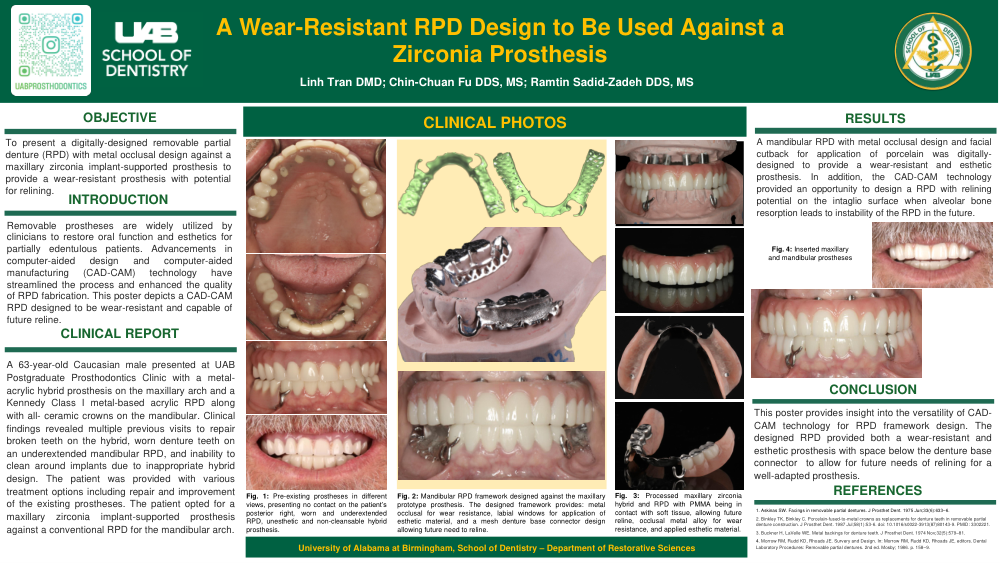
Objective: To present a digitally-designed removable partial denture (RPD) with metal occlusal design against a maxillary zirconia implant-supported prosthesis to provide a wear-resistant prosthesis with potential for relining.
Introduction: Removable prostheses are widely utilized by clinicians to restore oral function and esthetics for partially edentulous patients. Advancements in computer-aided design and computer-aided manufacturing (CAD-CAM) technology have streamlined the process and enhanced the quality of RPD fabrication. This poster depicts a CAD-CAM RPD designed to be wear-resistant and capable of future reline.
Clinical Report: A 63-year-old Caucasian male presented at UAB Postgraduate Prosthodontics Clinic with a metal-acrylic hybrid prosthesis on the maxillary arch and a Kennedy Class I metal-based acrylic RPD along with all- ceramic crowns on the mandibular. Clinical findings revealed multiple previous visits to repair broken teeth on the hybrid, worn denture teeth on an underextended mandibular RPD, and inability to clean around implants due to inappropriate hybrid design. The patient was provided with various treatment options including repair and improvement of the existing prostheses. The patient opted for a maxillary zirconia implant-supported prosthesis against a conventional RPD for the mandibular arch.
Results: A mandibular RPD with metal occlusal design and facial cutback for application of porcelain was digitally-designed to provide a wear-resistant and esthetic prosthesis. In addition, the CAD-CAM technology provided an opportunity to design a RPD with relining potential on the intaglio surface when alveolar bone resorption leads to instability of the RPD in the future.
Conclusion: This poster provides insight into the versatility of CAD-CAM technology for RPD framework design. The designed RPD provided both a wear-resistant and esthetic prosthesis with space below the denture base connector to allow for future needs of relining for a well-adapted prosthesis.