136 posters, 2 topics, 27 sessions, 339 authors, 88 institutions
ePostersLive by SciGen Technologies S.A. All rights reserved.
2024 ACP Annual Session
NOVEMBER 6-9, 2024 | MARCO ISLAND, FL JW MARRIOT

121
Clinical Applications of a Digital Workflow in Complete Denture Fabrication.
Poster Presenter
Authors
Affiliations
Part of Topic
Case Presentation
Clinical Applications of a Digital Workflow in Complete Denture Fabrication
Introduction:
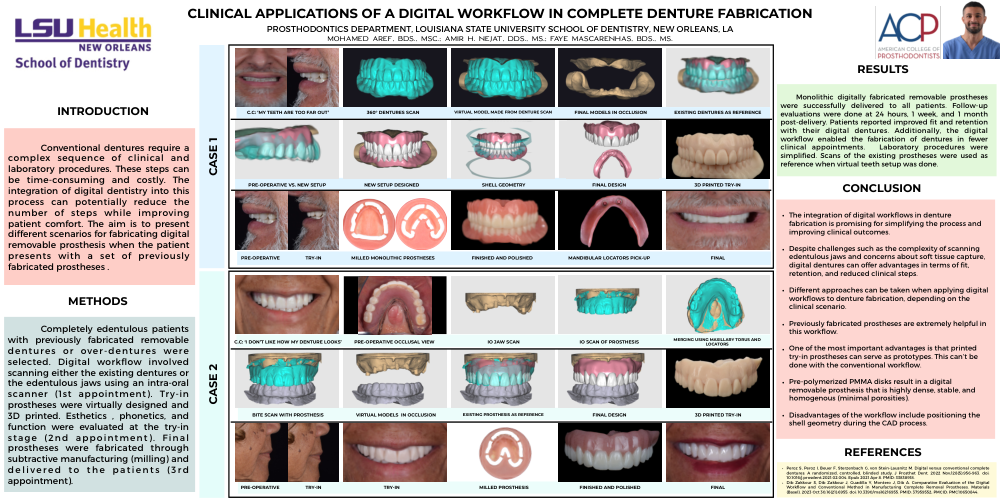
Conventional dentures require a complex sequence of clinical and laboratory procedures. These steps can be time-consuming and costly. The integration of digital dentistry into this process can potentially reduce the number of steps while improving patient comfort. The aim is to present different scenarios for fabricating digital removable prosthesis when the patient presents with a set of previously fabricated prostheses .
Methods:
Completely edentulous patients with previously fabricated removable dentures or over-dentures were selected. Digital workflow involved scanning either the existing dentures or the edentulous jaws using an intra-oral scanner (1st appointment). Try-in prostheses were virtually designed and 3D printed. Esthetics , phonetics, and function were evaluated at the try-in stage (2nd appointment). Final prostheses were fabricated through subtractive manufacturing (milling) and delivered to the patients (3rd appointment).
Results:
Monolithic digitally fabricated removable prostheses were successfully delivered to all patients. Follow-up evaluations were done at 24 hours, 1 week, and 1 month post-delivery. Patients reported improved fit and retention with their digital dentures. Additionally, the digital workflow enabled the fabrication of dentures in fewer clinical appointments. Laboratory procedures were simplified. Scans of the existing prostheses were used as reference when virtual teeth setup was done.
Conclusion:
- The integration of digital workflows in denture fabrication is promising for simplifying the process and improving clinical outcomes.
- Despite challenges such as the complexity of scanning edentulous jaws and concerns about soft tissue capture, digital dentures can offer advantages in terms of fit, retention, and reduced clinical steps.
- Different approaches can be taken when applying digital workflows to denture fabrication, depending on the clinical scenario.
- Previously fabricated prostheses are extremely helpful in this workflow.
- One of the most important advantages is that printed try-in prostheses can serve as prototypes. This can’t be done with the conventional workflow.
- Pre-polymerized PMMA disks result in a digital removable prosthesis that is highly dense, stable, and homogenous (minimal porosities).
- Disadvantages of the workflow include positioning the shell geometry during the CAD process.