136 posters, 2 topics, 27 sessions, 339 authors, 88 institutions
ePostersLive by SciGen Technologies S.A. All rights reserved.
2024 ACP Annual Session
NOVEMBER 6-9, 2024 | MARCO ISLAND, FL JW MARRIOT

112
Using a Digital Approach for Guided Bone Regeneration and Titanium Mesh Fabrication: A Case Report
Poster Presenter
Authors
Affiliations
Part of Topic
Case Presentation
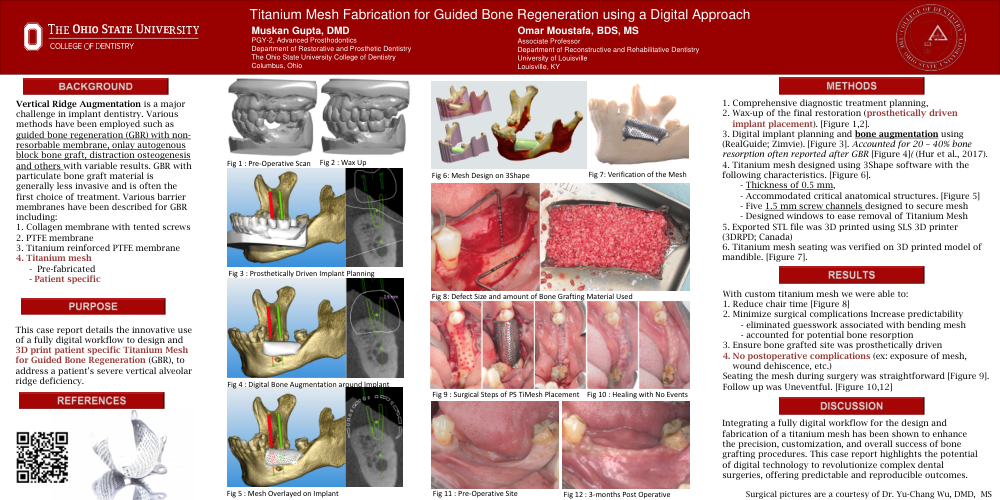
BACKGROUND: Vertical Ridge Augmentation is a major challenge in implant dentistry. Various methods have been employed such as guided bone regeneration (GBR) with non-resorbable membrane, onlay autogenous block bone graft, distraction osteogenesis, and others with variable results. GBR with particulate bone graft material is generally less invasive and is often the first choice of treatment. Various barrier membranes have, been described for GBR including:
- Pre-fabricated
- Patient specific
PURPOSE: This case report details the innovative use of a fully digital workflow to design and 3D print patient specific Titanium Mesh for Guided Bone Regeneration (GBR), to address a patient's severe vertical alveolar ridge deficiency.
METHODS:
3. Digital implant planning and bone augmentation using (RealGuide; Zimvie).. Accounted for 20 – 40% bone resorption often reported after GBR (Hur et al., 2017).
4. Titanium mesh designed using 3Shape software with the following characteristics.
- Thickness of 0.5 mm,
- Accommodated critical anatomical structures.
- Five 1.5 mm screw channels designed to secure mesh
- Designed windows to ease removal of Titanium Mesh
5. Exported STL file was 3D printed using SLS 3D printer (3DRPD; Canada)
6. Titanium mesh seating was verified on 3D printed model of mandible.
RESULTS:
With custom titanium mesh we were able to:
- eliminated guesswork associated with bending mesh
- accounted for potential bone resorption
Seating the mesh during surgery was straightforward. Follow-up images demonstrated minimal complications.
DISCUSSION:
Integrating a fully digital workflow for the design and fabrication of a titanium mesh has been shown to enhance the precision, customization, and overall success of bone grafting procedures. This case report highlights the potential of digital technology to revolutionize complex dental surgeries, offering predictable and reproducible outcomes.