136 posters, 2 topics, 27 sessions, 339 authors, 88 institutions
ePostersLive by SciGen Technologies S.A. All rights reserved.
2024 ACP Annual Session
NOVEMBER 6-9, 2024 | MARCO ISLAND, FL JW MARRIOT

109
Robotically guided full arch dental implant placement and bone reduction assisted by haptic technology.
Poster Presenter
Authors
Jose Briceno Ibraim, Alexander Bendayan, Sathish Palayan, Niranjan Joshi
Affiliations
Part of Topic
Case Presentation
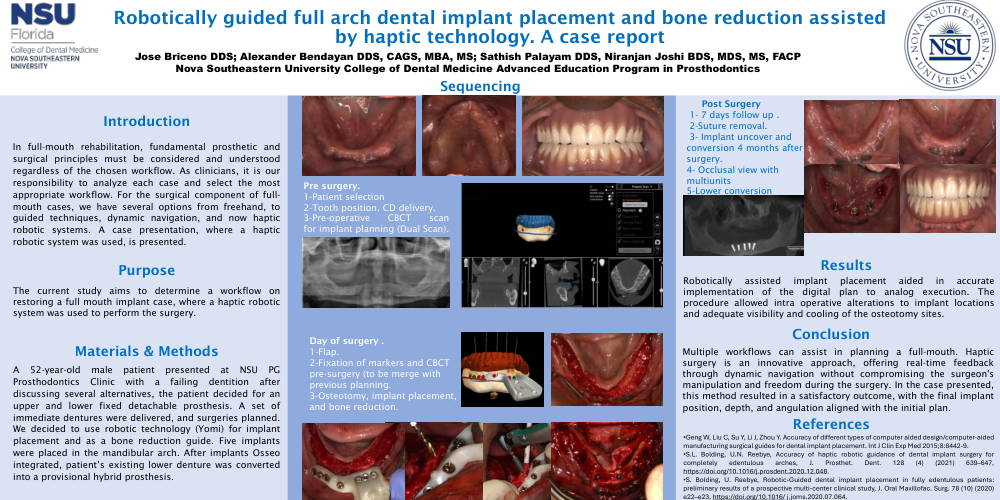
-Introduction:In full-mouth rehabilitation, fundamental prosthetic and surgical principles must be considered and understood regardless of the chosen workflow. As clinicians, it is our responsibility to analyze each case and select the most appropriate workflow. For the surgical component of full-mouth cases, we have several options from freehand, to guided techniques, dynamic navigation, and now haptic robotic systems. A case presentation, where a haptic robotic system was used, is presented.
-Purpose: The current study aims to determine a workflow on restoring a full mouth implant case, where a haptic robotic system was used to perform the surgery.
-Materials/methods: A 52-year-old male patient presented at NSU PG Prosthodontics Clinic with a failing dentition after discussing several alternatives, the patient decided for an upper and lower fixed detachable prosthesis. A set of immediate dentures were delivered, and surgeries planned. We decided to use robotic technology (Yomi) for implant placement and as a bone reduction guide. Five implants were placed in the mandibular arch. After implants Osseo integrated, patient’s existing lower denture was converted into a provisional hybrid prosthesis.
-Results: Robotically assisted implant placement aided in accurate implementation of the digital plan to analog execution. The procedure allowed intra operative alterations to implant locations and adequate visibility and cooling of the osteotomy sites.
-Conclusion: Multiple workflows can assist in planning a full-mouth. Haptic surgery is an innovative approach, offering real-time feedback through dynamic navigation without compromising the surgeon's manipulation and freedom during the surgery. In the case presented, this method resulted in a satisfactory outcome, with the final implant position, depth, and angulation aligned with the initial plan.
References
•Geng W, Liu C, Su Y, Li J, Zhou Y. Accuracy of different types of computer aided design/computer-aided manufacturing surgical guides for dental implant placement. Int J Clin Exp Med 2015;8:8442-9.
•S.L. Bolding, U.N. Reebye, Accuracy of haptic robotic guidance of dental implant surgery for completely edentulous arches, J. Prosthet. Dent. 128 (4) (2021) 639–647, https://doi.org/10.1016/j.prosdent.2020.12.048.
•S. Bolding, U. Reebye, Robotic-Guided dental implant placement in fully edentulous patients: preliminary results of a prospective multi-center clinical study, J. Oral Maxillofac. Surg. 78 (10) (2020) e22–e23, https://doi.org/10.1016/ j.joms.2020.07.064.