136 posters, 2 topics, 27 sessions, 339 authors, 88 institutions
ePostersLive by SciGen Technologies S.A. All rights reserved.
2024 ACP Annual Session
NOVEMBER 6-9, 2024 | MARCO ISLAND, FL JW MARRIOT

105
“Prosthodontic Treatment Options for Growing Patients with Cleft Lip and Palate”
Poster Presenter
Authors
Affiliations
Part of Topic
Case Presentation
Prosthodontic Treatment Options for Growing Patients with Cleft Lip and Palate
Matilde Beraja, DDS; Rafiullah Bashiri, DDS, MDS, FACP; Amara Abreu, DDS, MSD, FACP
Introduction
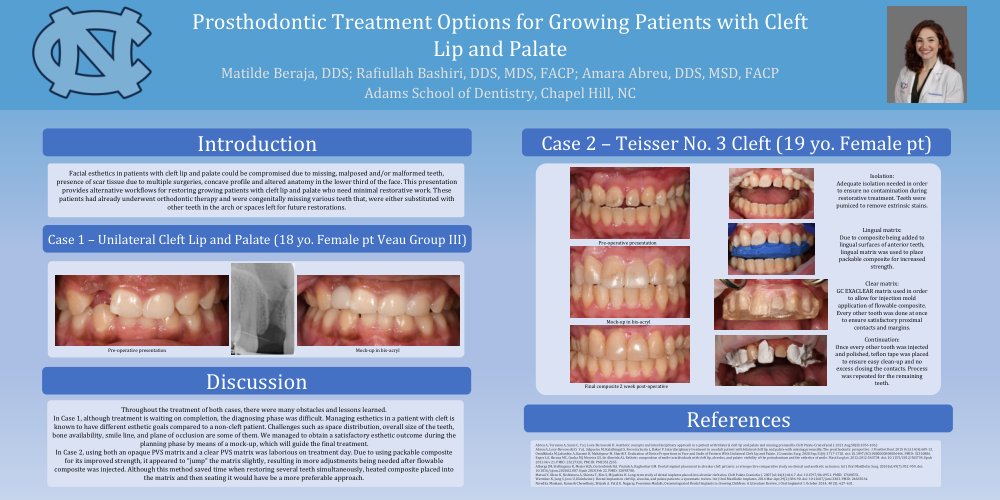
Facial esthetics in patients with cleft lip and palate could be compromised due to missing, malposed and/or malformed teeth, presence of scar tissue due to multiple surgeries, concave profile and altered anatomy in the lower third of the face. This presentation provides alternative workflows for restoring growing patients with cleft lip and palate who need minimal restorative work. These patients had already underwent orthodontic therapy and were congenitally missing various teeth that, were either substituted with other teeth in the arch or spaces left for future restorations.
Conclusions/lessons learned
Throughout the treatment of both cases, there were many obstacles and lessons learned from treatment.
In Case 1, although treatment is waiting on completion, managing esthetics in a patient with cleft is known to have different esthetic goals compared to a non-cleft patient. Challenges such as space distribution, overall size of the teeth, bone availability, smile line, and plane of occlusion are some of them. We managed to obtain a satisfactory esthetic outcome during the planning phase by means of a mock-up, which will guide the final treatment.
In Case 2, using both an opaque PVS matrix and a clear PVS matrix was a challenge on treatment day. Due to using packable composite for its improved strength, it appeared to “jump” the matrix slightly, resulting in more adjustments being needed after flowable composite was injected. Although this method saved time when restoring 6 teeth, heated composite placed into the matrix and then seating it would have be a more preferable approach.
Case 2
Isolation:
Adequate isolation needed in order to ensure no contamination during restorative treatment. Teeth were pumiced to remove extrinsic stains.
Lingual matrix:
Due to composite being added to lingual surfaces of anterior teeth, lingual matrix was used to place packable composite for increased strength.
Clear matrix:
GC EXACLEAR matrix used in order to allow for injection mold application of flowable composite. Every other tooth was done at once to ensure satisfactory proximal contacts and margins.
Continuation:
Once every other tooth was injected and polished, teflontape was placed to ensure easy clean-up and no excess closing the contacts. Process was repeated for the remaining teeth.