127 posters, 10 topics, 20 sessions, 127 authors
ePostersLive by SciGen Technologies S.A. All rights reserved.
UCSF 2024 Inquiry Symposium
Conference ePosters

P092
Women's Health and Wikipedia
Poster Presenter
Authors
Part of Topic
Education Science
Title:
Women’s Health and Wikipedia
Introduction:
Wikipedia is a free, online, and open-access encyclopedia used by millions across the world to learn about innumerable topics, including health and medicine. Though regarded in its earlier years as unreliable, rigorous standards now govern the dissemination of scientific and medical information throughout Wikipedia. Despite this progress, health-related articles within Wikipedia are of variable quality, with many areas still in need of improvement. Paralleling medicine as a whole, the nuances of sex differences in pathophysiology of disease within these articles are often similarly neglected. This project seeks to improve the quality of a series of medical articles within Wikipedia, with an emphasis on women’s health and sex-specific pathophysiology, in order to better inform patients, doctors, and any other curious readers.
Purpose:
To improve the quality of medical information regarding women’s health and sex-specific pathophysiology on the world’s most heavily used health information platform: Wikipedia.
Aims:
- Identify high-importance but low-quality Wikipedia articles on female-specific health conditions, as well as those which affect both sexes.
- Acquire and learn relevant material from reputable sources.
- Synthesize this information in order to make substantial edits to these chosen Wikipedia articles, by
- updating them with new information,
- improving the quality of preexisting material within, and
- correcting any erroneous information, if present.
- updating them with new information,
Methods:
WikiProjects are communities of editors dedicated to improving articles within a given subject. Each WikiProject has developed extensive standards for ranking an article’s Quality (ranging from Featured Article to Stub) and Importance (ranging from Top to Low). Examples include Wikiproject Medicine, which has identified and ranked over 68,000 articles, and Wikiproject: Women’s Health, which has over 3,000. In order to maximize potential impact for future readers, articles chosen for improvement in this Deep Explore project were identified by both Wikiprojects as being of High to Moderate importance and Low to Stub quality.
In response to a growing movement, the nonprofit Wiki Education has developed an online dashboard to facilitate Wikipedia-editing in higher education settings. This dashboard allows participants to track their individual and group contributions to selected articles, as well as the web traffic the articles have received both before and after editing by students. These metrics can be used to infer relative impact of an editor’s work over time.
To ensure that the chosen articles are aligned with current medical understanding, citation guidelines for WikiprojectMedicine discourage use of primary sources, and instead recommend textbooks, systematic or literature reviews, and/or medical society practice guidelines. For this project, I conducted extensive literature searches, primarily through PubMed and Google Scholar. Clinical practice and medical society guidelines were drawn from UptoDate, Cochrane, and the CDC. I then selected only the highest quality articles that reflected current understanding to include on Wikipedia. Whenever possible, open-access materials were used to allow for transparency in sourcing.
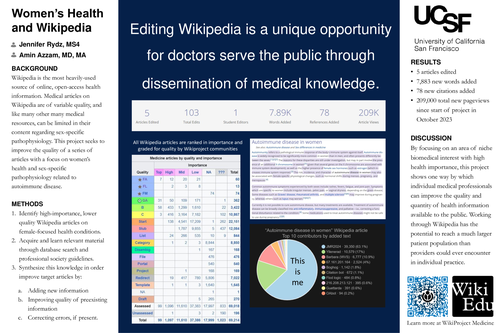
In total, I worked on 5 different Wikipedia articles. Chosen articles fell into two major categories: those whose main theme was presentation of specific diseases in women; and those whose focus was on diseases that affect both sexes, albeit with variance in the epidemiology and pathophysiology between them.
Results:
In total, my edits to all five articles comprised 7883 words, with 78 new citations added, and over 209,000 total new pageviews since completion of the project in December 2023. This latter number will continue to grow over time as more readers access these articles.
My most substantial contributions were to “Autoimmune disease in women”. Comprising 76% of the total article length. I added 7604 words to this article, The Causes section was expanded with new subsections discussing the role of sex hormones, evolutionary pressures, and pregnancy. Two tables were added comparing the sex ratios of the most commonly described autoimmune diseases and their associated biomarkers. The Treatment section, which previously had referenced only complementary and alternative therapies, was edited to remove poorly-sourced claims and to add subsections discussing mainstay medical therapies. Other articles, including “Autoimmune disease”, “Primary biliary cholangitis”, “Autoimmunity” and “Microchimerism”, were improved by clarifying prevalence between the sexes and, where applicable, describing differences between the sexes in manifestation of disease and possible reasons for these disparities.
Discussion/Conclusion:
This project unites two different yet complementary themes: Wikipedia-editing in medical education, and my longstanding interest in sex differences in medicine and physiology.
Despite women comprising half of the human population, the nuances of sex-specific presentation in different diseases have been historically neglected. By now, the variation in “typical” chest pains felt by men and women during heart attacks is well-established in the literature. Countless other examples of such differences exist within every organ system and are equally deserving of our attention, yet are still not widely known. Neglect of these realities can have profound consequences for women’s health,our understanding of it, and more importantly our abilities to serve female patients
Medical education has made great strides in embracing Wikipedia-editing as a teaching and learning strategy. Since 2010, Wiki Education has sponsored 175 courses for “Students in the Health Professions.” In aggregate, 2,700 students have added 2.91 million words, 316 images, and 34,800 references to 1,840 health-related Wikipedia pages. Since student contributions, those pages have been viewed 96.4 million times. Throughout this project, I encountered many articles edited by health professional students at other institutions, who were also using the Wiki Education dashboard to track their progress. A typical course may take place for around four weeks, wherein multiple students are each assigned to one article. My project shows a different strategy, by which one motivated editor can dive even deeper into a niche topic of interest over a much longer period of time. Both are reasonable approaches for improving the quality and quantity of health-related information available to the public. Being a doctor requires a desire to learn, as well as to serve; this project is a template for how one can do both.
Additional consideration should be given to the impact of Artificial Intelligence (AI) and Large Language Models (LLMs) on medical education and editing of Wikipedia. Currently, there is not a firm consensus on the role of
AI-generated content on this platform. Questions surrounding authorship and copyright aside, the current versions of these LLMs are notorious for generating errors and confabulations. LLMs rely on data from the entire open Internet, including Wikipedia; therefore, reckless use of AI could propagate a misinformation spiral, leading to real medical consequences for the misinformed. Despite these risks, this technology has astounding potential to increase our understanding of medicine, and to educate others. Thoughtful discussion should be undertaken before considering use of AI for contributing to Wikipedia; but as the technology continues to be refined, there is reason to be optimistic. Especially since LLMs include Wikipedia as a portion of their training datasets, improving the breadth, quality, and accuracy of health-content on Wikipedia may increasingly be an essential task for health professionals.