127 posters, 10 topics, 20 sessions, 127 authors
ePostersLive by SciGen Technologies S.A. All rights reserved.
UCSF 2024 Inquiry Symposium
Conference ePosters

P052
Developing a New Curriculum for Communication Training in Child Neurology
Poster Presenter
Authors
Part of Topic
Education Science
Title:
Developing a New Curriculum for Communication Training in Child Neurology
Introduction:
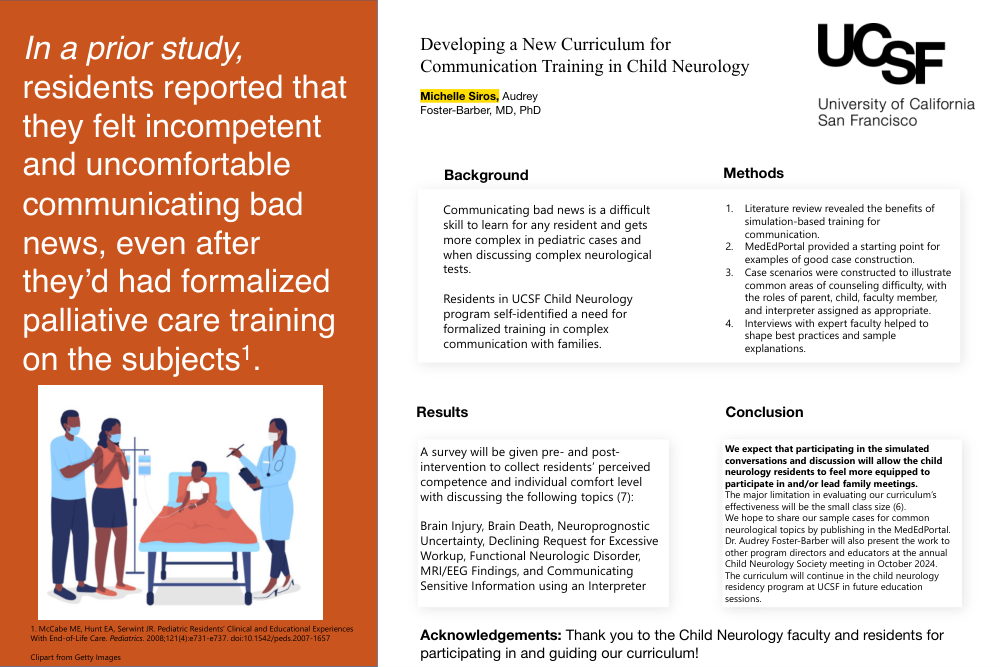
Residents in the child neurology program at UCSF have identified a gap in education in communication skills teaching. Communicating difficult news to families is a challenging experience for residents in all medical specialties and is especially complex in pediatric cases due to added layers of emotions between parents and children, and the often-unexpected nature of childhood illness. Neurologic conditions can be complex, and testing is technical and nuanced. Explaining an abnormal neurologic test result in a way that is meaningful to a particular family adds an additional challenge. Few studies exist in the past decade that examine whether pediatric or pediatric neurology programs have adequate formal training in communication skills during difficult family meetings. While data in the subject is sparse, a 2008 study found that pediatric residents at Johns Hopkins Children’s Center reported that even in areas of palliative care in which residents had received formal training they felt neither comfortable nor confident providing care1.
Hypothesis:
The implementation of a new, simulation-based communication training program will increase the confidence of child neurology residents have in their own communication skills.
Curriculum Goal:
Understand and practice communication skills and techniques to employ in a family meeting designed to deliver and explain bad news or complex testing results to a pediatric neurology patient and their family.
Project Design/Methods:
For this project, I worked with Dr. Audrey Foster-Barber, the program director of the pediatric neurology residency program at UCSF. The curricular objectives were guided by the residents, who identified the need for formalized training surrounding delivering difficult news or complicated neurologic concepts to families. The main objective is to increase residents’ comfort level in leading these difficult conversations with patient families. Curricular design was initially informed by literature review which revealed the benefits of a simulation approach to the training. There exist published cases in medical training curriculum through MedEdPortal for use in simulation that we used as a starting point for topic selection and case construction23 . Then, we selected our final list of topics with input from expert faculty in Neonatal Neurology, Hospital-based Child Neurology, and other General Child Neurology attendings. For these topics, we held structured interviews and discussed common phrasing and pitfalls when explaining these topics to families. Case scenarios were constructed to illustrate common areas of counseling difficulty, with the roles of parent, child, faculty member, and interpreter assigned as appropriate. This curriculum with simulated conversations being demonstrated by residents, faculty and this author will be presented at the Child Neurology Department Retreat in May 2024. We will evaluate resident response to the curriculum using a pre- and post-intervention survey structure to assess self-perceived competence in the various communication topics.
Results:
The curriculum effectiveness will be evaluated using data from the following chart which will be collected pre- and post-intervention. Rank from 1-5 (1 = none, 2 = minimal, 3 = moderate, 4 = good, 5 = exceptional) your training, experience, competence, and confidence in explaining the topics listed.

Conclusion:
We expect that participating in the simulated conversations and discussion will allow the child neurology residents to feel more equipped to participate in and/or lead family meetings. The major limitation in evaluating our curriculum’s effectiveness will be the small class size (6). We hope to share our sample cases for common neurological topics by publishing in the MedEdPortal. Dr. Audrey Foster-Barber will also present the work at the Program Directors and Educators in Child Neurology PECN Meeting at the annual Child Neurology Society meeting in October of 2024. Further, the developed curriculum is expected to continue in the child neurology residency program at UCSF in future education sessions.
1 McCabe ME, Hunt EA, Serwint JR. Pediatric Residents’ Clinical and Educational Experiences With End-of-Life Care. Pediatrics. 2008;121(4):e731-e737. doi:10.1542/peds.2007-1657
2 Brock K, Cohen H, Sourkes B, et al. Teaching Pediatric Fellows Palliative Care Through Simulation and Video Intervention: A Practical Guide to Implementation. MedEdPORTAL. 11:10284. doi:10.15766/mep_2374-8265.10284
3 Cowfer B, McGrath C, Trowbridge A. Teaching Pediatric Palliative Care Communication Skills to Fourth-Year Medical Students Through Role-Play. MedEdPORTAL. 16:10991. doi:10.15766/mep_2374-8265.10991