127 posters, 10 topics, 20 sessions, 127 authors
ePostersLive by SciGen Technologies S.A. All rights reserved.
UCSF 2024 Inquiry Symposium
Conference ePosters

P055
Trauma Informed Care: Medical Student Training on Responding to Sexual Assault Disclosures
Poster Presenter
Authors
Part of Topic
Education Science
Title:
Trauma Informed Care: Medical Student Training on Responding to Sexual Assault Disclosures
Introduction:
Sexual violence affects individuals of all demographics, with alarming prevalence rates indicating 1 in 6 women and 1 in 33 men experiencing attempted or completed rape. Underreporting is common, with an estimated 80% of cases going unreported to law enforcement. Survivors often suffer from mental health issues such as PTSD, depression, and anxiety, yet many do not seek or receive appropriate help due to barriers like reluctance to disclose their assault and inadequate medical care. Despite efforts to integrate trauma-informed care (TIC) into medical education, specific training in responding to sexual assault disclosures remains lacking. To address this gap, a specialized curriculum focusing on enhancing students' confidence and comfort in communicating with survivors of sexual assault is proposed, aiming to better support survivors and improve healthcare delivery. Hypothesis or question: A novel curriculum in responding to sexual assault disclosures will increase learner comfort in communicating with sexual assault survivors.
Aims:
1. Increase self-perceived medical student comfort and confidence in providing sexual assault care.
2. Create a long-lasting sexual assault, trauma-informed care curriculum.
Project Design/Methods:
Participants were recruited through email, online flyering, and snowball recruitment. A curriculum for self-paced study was designed, which included a didactics session on the history, statistics, and implications on sexual assault in the United States today. They were also be given a framework on how to appropriately respond to sexual assault disclosures. They were given five paper cases with solutions to work through and reflect on. Students were assessed on comfort with working with sexual assault survivors through a retrospective pre-and post-training survey. Students were allowed to complete the survey whether or not they completed all of the materials provided to them. The survey featured questions that assessed student comfort with various aspects of trauma-informed care on a 5-point Likert scale (1 = very uncomfortable, 5 = very comfortable). The results of the student Likert scores were analyzed by hypothesis testing in SPSS.
Results/Product:
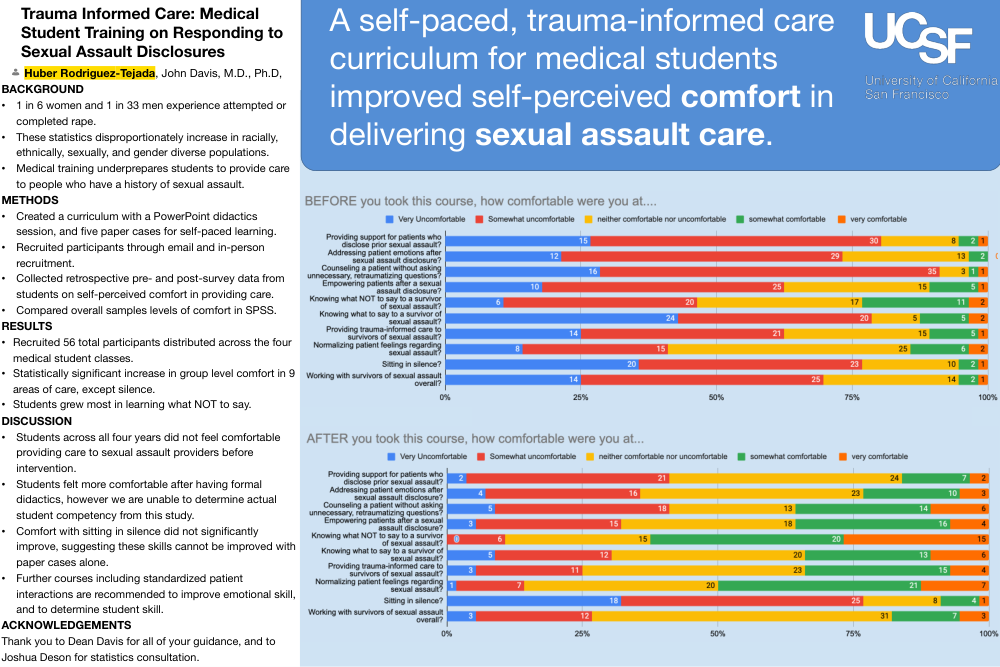
A sample of 56 medical students were recruited by email, online flying, and snowball recruitment and completed a questionnaire that measured their comfort with providing sexual assault care. A majority of the sample (52%) were MS4s, followed by MS3s (23%), MS2s (18%), and MS1s (7%). Overall, when asked about general levels of comfort providing support, there was a statistically significant difference in responses when comparing overall means pre- (M = 2.00, SD = .85) and post- (M = 2.75, SD = .86) curriculum (t = -4.64, p < .001). When asked about comfort in providing emotional support, there was a statistically significant difference in responses when comparing overall means pre- (M = 2.09, SD = .80) and post- (M = 2.85, SD = .98) curriculum (t = -4.61, p < .001). When asked about comfort in counseling patients without retraumatization, there was a statistically significant difference in responses when comparing overall means pre- (M = 1.85, SD = .74) and post- (M = 2.96, SD = 1.17) curriculum (t = -5.95, p < .001). When asked about comfort in empowering patients, there was a statistically significant difference in responses when comparing overall means pre- (M = 2.32, SD = .93) and post- (M = 3.05, SD = .93) curriculum (t = -3.93, p < .001). When asked about comfort in knowing what not to say, there was a statistically significant difference in responses when comparing overall means pre- (M = 2.69, SD = 1.02) and post- (M = 3.79, SD = .96) curriculum (t = -5.78, p < .001). When asked about comfort in knowing what to say to patients, there was a statistically significant difference in responses when comparing overall means pre- (M = 1.94, SD = 1.10) and post- (M = 3.06, SD = 1.11) curriculum (t = -5.28, p < .001). When asked about comfort in providing trauma-informed care, there was a statistically significant difference in responses when comparing overall means pre- (M = 2.25, SD = 1.00) and post- (M = 3.10, SD = .99) curriculum (t = -4.58, p < .001). When asked about comfort in normalizing patient feelings, there was a statistically significant difference in responses when comparing overall means pre- (M = 2.62, SD = .98) and post- (M = 3.46, SD = .98) curriculum (t = -4.63, p < .001). When asked about comfort sitting in silence, there was not a statistically significant difference in responses when comparing overall means pre- (M = 1.94, SD = .92) and post- (M = 2.01, SD = .96) curriculum (t = -4.01, p = 0.69). When asked about comfort in working with sexual assault survivors, there was a statistically significant difference in responses when comparing overall means pre- (M = 2.12, SD = .89) and post- (M = 2.94, SD = .92) curriculum (t = -4.78, p < .001). There was an increase in the overall means for every question.
Discussion/Conclusion:
Results suggest that students were uncomfortable providing care to survivors of sexual assault before taking this course. While our findings regarding the difference in pre- and post-comfort with our various areas of interest were statistically significant, the mean level differences were still relatively small, and without much applied significance. This suggests that though web-based curricula helped our sample to build comfort, there is still ample opportunity to create larger improvements in comfort in providing care to survivors of sexual assault. Additionally, comfort in sitting in silence did not significantly improve, suggesting these skills cannot be improved with paper cases alone. Ultimately, this study was unable to test student competency through assessment of clinical skills. Taken all together, more curricular work and future research should be performed to further improve student comfort and competence in trauma informed assault care. An avenue of further inquiry would be the benefits of implementing standardized patient encounters, either in student groups or individually, over web based curricula.