127 posters, 10 topics, 20 sessions, 127 authors
ePostersLive by SciGen Technologies S.A. All rights reserved.
UCSF 2024 Inquiry Symposium
Conference ePosters

P033
Learning-On-the-Fly: How Residents Become Clinical Teachers
Poster Presenter
Authors
Part of Topic
Education Science
Learning On-the-Fly: How Residents Become Clinical Teachers
Manuella Djomaleu1 , Bansri Doshi1 , John Quinn, MD2 , Karen E. Hauer, MD, PhD1 , Jack Penner, MD1 1 Department of Medicine, School of Medicine, University of California, San Francisco 2 Department of Emergency Medicine, School of Medicine, University of California, San Francisco
Current word count: 300
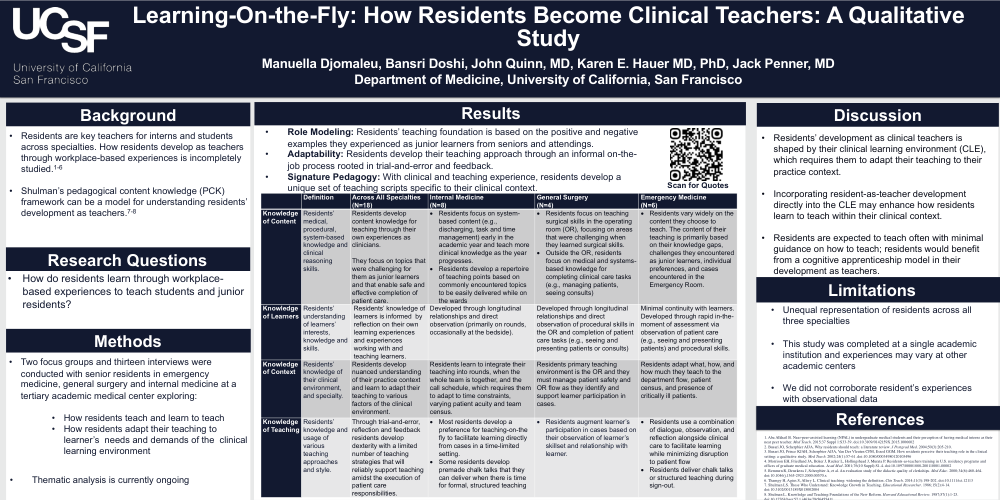
Research Statement: We aim to explore how residents’ workplace experiences influence their development as clinical teachers. Background: Residents play a prominent teaching role in the clinical learning environment (CLE) (1-6). However, how residents develop their knowledge for teaching through workplacebased experiences remains incompletely studied. Shulman’s pedagogical content knowledge (PCK) connects teachers’ content knowledge to their teaching practice; PCK can be a model for understanding how residents’ workplace experiences support their development as teachers. This understanding could enhance resident-as-teacher programs (7-8).
Methods: This ongoing qualitative study uses semi-structured interviews and focus groups with senior residents in internal medicine, emergency medicine and general surgery at one institution. Interviews and focus groups query how residents teach, learn to teach, and adapt their teaching to learners’ needs and the demands of the CLE. We are using thematic analysis, with PCK as a sensitizing concept.
Results: We have conducted two focus group and thirteen interviews with seventeen total participants. Thematic analysis is ongoing. Preliminarily, residents describe learning to teach as an on-the-job process of trial-and-error. Reflection on prior experiences as students and interns and direct feedback from attendings also inform and refine their teaching. From these experiences, residents describe developing several domains of PCK: content knowledge (clinical knowledge, communication skills, health-system knowledge); teaching strategies (teaching during rounds, structured chalk talks, role modeling); strategies for assessing learners’ knowledge gaps (probing questions, learner check-ins) and tailoring teaching to multiple learner levels. Residents apply and adapt their teaching in an often spontaneous, but occasionally planned, ways based on patient cases, perceptions of learners’ needs and their readiness to learn, and the demands of the CLE (time constraints, other clinical tasks).
Conclusion: Residents’ workplace experiences play a critical role in their development as clinical teachers. Incorporating resident-as-teacher development directly into the CLE and supporting increased reflection and feedback may enhance how residents learn to teach.
References: 1. Aba Alkhail B. Near-peer-assisted learning (NPAL) in undergraduate medical students and their perception of having medical interns as their near peer teacher. Med Teach. 2015;37 Suppl 1:S33-39. doi:10.3109/0142159X.2015.1006602 2. Busari JO, Scherpbier AJJA. Why residents should teach: a literature review. J Postgrad Med. 2004;50(3):205-210. 3. Busari JO, Prince KJAH, Scherpbier AJJA, Van Der Vleuten CPM, Essed GGM. How residents perceive their teaching role in the clinical setting: a qualitative study. Med Teach. 2002;24(1):57-61. doi:10.1080/00034980120103496 4. Morrison EH, Friedland JA, Boker J, Rucker L, Hollingshead J, Murata P. Residents-asteachers training in U.S. residency programs and offices of graduate medical education. Acad Med. 2001;76(10 Suppl):S1-4. doi:10.1097/00001888-200110001-00002 5. Remmen R, Denekens J, Scherpbier A, et al. An evaluation study of the didactic quality of clerkships. Med Educ. 2000;34(6):460-464. doi:10.1046/j.1365-2923.2000.00570.x 6. Thampy H, Agius S, Allery L. Clinical teaching: widening the definition. Clin Teach. 2014;11(3):198-202. doi:10.1111/tct.12113 7. Shulman LS. Those Who Understand: Knowledge Growth in Teaching. Educational Researcher. 1986;15(2):4-14. doi:10.3102/0013189X015002004 8. Shulman L. Knowledge and Teaching:Foundations of the New Reform. Harvard Educational Review. 1987;57(1):1-23. doi:10.17763/haer.57.1.j463w79r56455411