127 posters, 10 topics, 20 sessions, 127 authors
ePostersLive by SciGen Technologies S.A. All rights reserved.
UCSF 2024 Inquiry Symposium
Conference ePosters

P029
A Novel Sustainability Curriculum for Surgical Residents
Poster Presenter
Authors
Part of Topic
Education Science
DEEP EXPLORE ABSTRACT
TITLE
A Novel Sustainability Curriculum for Surgical Residents
INTRODUCTION
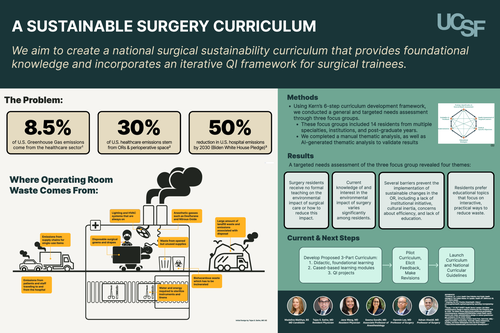
The healthcare sector accounts for almost 10% of U.S. greenhouse gas emissions, of which almost a vast majority comes from the operating room. As a result, there is renewed interest in decarbonizing the operating room and surgical care. However, surgical trainees are not routinely educated on the environmental impact of surgery and how to mitigate it. AIMS This project aims to conduct a structured needs-assessment focused on topics within environmentally sustainable surgery, as well as develop the proposed goals, objectives, and educational strategies for a novel surgical education curriculum.
AIMS
This project aims to conduct a structured needs-assessment focused on topics within environmentally sustainable surgery, as well as develop the proposed goals, objectives, and educational strategies for a novel surgical education curriculum.
METHODS
As part of Kern’s Six-Step Framework for medical curriculum development, we conducted a needs assessment via three focus groups with surgical residents. These groups assessed the current state of surgical sustainability curricula in surgical training programs, barriers to sustainable practice, and the preferred educational methods and topics within sustainability education. All focus groups were recorded, and thematic analysis was performed using anonymized transcripts. Following this needs assessment, we identified goals and objectives for a sustainability curriculum and mapped educational strategies to the objectives. Stakeholders at our institution involved in peri-operative sustainability efforts are evaluating these goals, objectives, and strategies, and our team is iteratively developing the curricular framework using their feedback.
RESULTS
The needs assessment analysis revealed four themes. First, surgery residents receive no formal teaching on the environmental impact of surgical care or how to reduce this impact. Second, the knowledge base and interest regarding the environmental impact of surgery varies significantly among residents. Third, a lack of institutional initiative and education, as well as concerns about cultural inertia and workflow efficiency, are as barriers to implementing sustainable practices in the operating room. Finally, residents expressed preference that educational efforts focus on practical ways to reduce waste. Overall, residents favored more hands-on learning such as participation in quality improvement initiatives, although there was interest in utilizing didactic education to establish foundational knowledge. Taking these themes into account, the resultant proposed curriculum design has three-part, iterative structure, as described in Table 1.
CONCLUSIONS
Given the importance of surgical sustainability in the context of the climate crisis, there is an urgent need for formal resident education on this topic. This needs assessment provides a valuable foundation for future sustainability curriculum development. Our proposed novel surgical sustainability curriculum will only empower surgical trainees with the knowledge to improve sustainability and will also allow for progressive levels of engagement depending on each resident’s bandwidth and interest. By merging didactics, interactive case studies, and handson QI initiatives, this curriculum represents a pioneering model for surgical resident education and will foster a culture of environmental responsibility and shared learning within the surgical community. Future directions include designing and piloting didactic modules and case study discussions in small groups to obtain feedback and refine educational content.
Table 1: Educational modalities for curriculum delivery and associated description within proposed sustainability curriculum.
