127 posters, 10 topics, 20 sessions, 127 authors
ePostersLive by SciGen Technologies S.A. All rights reserved.
UCSF 2024 Inquiry Symposium
Conference ePosters

P084
Teaching Each Other with Stories: Peer-Assisted Learning in Early Medical School
Poster Presenter
Authors
Part of Topic
Education Science
Teaching Each Other with Stories: Peer-Assisted Learning in Early Medical School Background/Purpose
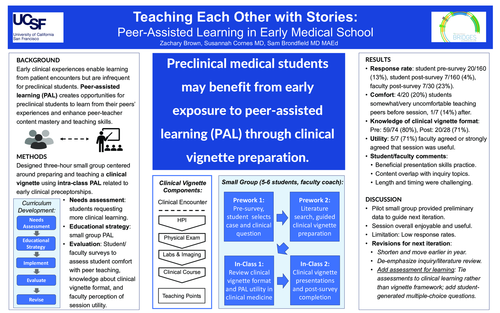
Early clinical experiences enable learning from patient encounters, but are often infrequent for preclinical students. Creating opportunities for preclinical students to share lessons from these experiences might allow their peers to learn while enhancing peer-teaching skills. Peer-assisted learning (PAL) enhances learner academic performance and peer-teacher content mastery. Although prior studies have investigated inter-class PAL, less is known about the perceptions and utility of intra- class PAL, wherein students from the same class teach each other. We hypothesized that preclinical students would enjoy and learn from intra-class PAL related to early clinical preceptorships.
Methods
At our medical school, we piloted a 3-hour PAL small group (5-6 students and 1 faculty facilitator) at the end of year 1. For pre-work, students reflected on a patient encounter from one of their preceptorships, chose a relevant clinical question, performed a targeted literature search, and developed a 10-minute informal presentation with clinical teaching points. Pre-reading and in-class discussion introduced brief clinical vignettes as peer teaching tools. During the session, each student informally presented their clinical case in a brief vignette format (“the story”) with associated teaching points (“the moral”). Students completed an optional pre/post survey assessing their comfort with peer teaching and their knowledge about the clinical vignette format (4 multiple choice questions). Faculty were surveyed about the session’s utility. Surveys invited open- ended feedback.
Results
Twenty of 160 (13%) students completed the pre-survey. Seven (4%) completed the post-survey. Seven of 30 (23%) faculty completed the survey. Four of 20 (20%) students were somewhat or very uncomfortable teaching their peers before the session, compared to 1 out of 7 (14%) afterwards. Students answered the knowledge questions about PAL via vignettes correctly 80% of the time (59 of 74 answers correct) before and 71% (20 of 28) after the session. Student comments highlighted enjoyment of hearing about other students’ learning, helpfulness of peer teaching, a suggestion to shift the timing of the session away from examinations, and a request for guidance around what vignette to choose. Five of 7 (71%) faculty agreed or strongly agreed that the session was useful. Faculty comments highlighted the beneficial presentation skills practice but noted the session length and timing at the end of the year were challenging.
Discussion
This pilot provided preliminary data to guide the next iteration. Though response rates were low, survey data supported the session as enjoyable and useful. For the next iteration, session length should be shortened, timing optimized relative to other activities, and clearer guidance provided. Assessments tied to the specific clinical learning occurring in each small group may be more beneficial than those tied to the clinical vignette framework.