127 posters, 10 topics, 20 sessions, 127 authors
ePostersLive by SciGen Technologies S.A. All rights reserved.
UCSF 2024 Inquiry Symposium
Conference ePosters

P082
Evaluation of PsychSnaps: An Online Case-Based Curriculum to Improve Outpatient Mental Health Care
Poster Presenter
Authors
Part of Topic
Education Science
Project Title:
Evaluation of PsychSnaps: An Online Case-Based Curriculum to Improve Outpatient Mental Health Care
Introduction:
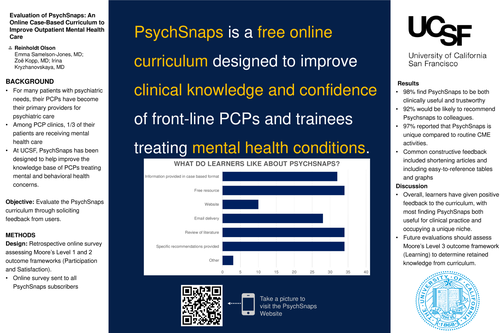
For many patients with psychiatric needs, their PCPs have become their primary providers for psychiatric care. Among PCP clinics, approximately 1/3 of their patients are receiving mental health care [1]. At UCSF, a curriculum has been designed to help educate front-line PCPs on basic psych topics important for primary care. This curriculum, which has been active since Jan 2023, aims to educate PCPs through a series of short 5-minute articles developed by a small team of one psychiatrics and two PCPs, one of which with expertise in addiction medicine. This current project seeks to drive collaboration between the curriculum developers and PCPs through enabling PsychSnaps subscribers to provide feedback on the curriculum.
Aims:
The aim of this study is to evaluate the PsychSnaps curriculum by soliciting feedback from PsychSnaps subscribers.
Project Design/Methods:
To obtain feedback, we conducted a retrospective study to assess Moore’s Level 1 and 2 outcome frameworks (Participation and Satisfaction) with CME activities (Moore, 2009). The evaluation was conducted through two separate sets of online Qualtrics survey sent by email in June 2023 and February 2024 (Only the data from February 2024 is included in results and discussion).
Inclusion criteria will include all those who have subscribed to PsychSnaps. This survey sought to obtain both quantitative (Likert scaling to assess feedback on usefulness for clinical decision making, trustworthiness, and uniqueness compared to other CME activities) as well as qualitative data (Open-ended questions to obtain feedback on how to improve PsychSnaps and suggested
topics for future articles).
Results:
Out of 356 total Psychsnaps subscribers, 42 responded to the survey. The majority (78%) of respondents were MDs; almost all respondents work in California. A majority (58%) work at UCSF. 98% of participants find PsychSnaps to be both clinically useful and trustworthy, 79% refer to PsychSnaps for clinical decision making. 92% reported they would be likely to
recommend PsychSnaps to a colleague. Almost all (97%) reported that PsychSnaps is unique compared to routine CME activities.
Regarding feedback related to how to improve PsychSnaps, common themes included shortening the articles and including easy-to-reference tables and graphs. Common suggested future topics for PsychSnaps include Geriatrics, ADHD, Bipolar, and Psychedelic therapy.
Discussion:
The majority of respondents responded positively to the PsychSnaps curriculum, with most
describing it as clinically useful for their practice and unique compared to other CME activities.
This evaluation was limited by the small response rate of PsychSnaps subscribers, potentially
introducing response bias to the results; future evaluations should seek to address this potential bias through increasing respondent percentage. Additionally, we can consider further evaluating the curriculum using Moore’s Level 3 Outcome Framework (Learning) to assess whether subscribers are retaining knowledge from PsychSnaps articles.
References
Moore Jr, Donald E., Joseph S. Green, and Harry A. Gallis. "Achieving desired results and
improved outcomes: integrating planning and assessment throughout learning activities." Journal of continuing education in the health professions 29.1 (2009): 1-15.