127 posters, 10 topics, 20 sessions, 127 authors
ePostersLive by SciGen Technologies S.A. All rights reserved.
UCSF 2024 Inquiry Symposium
Conference ePosters

P081
Establishing the Validity of Surveys to Assess a novel Pathology-Patient Education Tool: Understanding a Breast Pathology Report
Poster Presenter
Authors
Part of Topic
Education Science
Title – Establishing the Validity of Surveys to Assess a novel Pathology-Patient Education Tool: Understanding a Breast Pathology Report
Abiana Adamson, Kristie White, Diane Heditsian, Carmen Aaronson, Anna Northrop, Carol Simmons, Ron Balassanian
Abstract Body (2,500-character limit including spaces)
Background
Passage of the 21st Century Cures Act gave patients easier access to their pathology reports. However, the pathology report can cause confusion and anxiety for patients. A series of 5 videos was created to educate patients about breast pathology titled “Understanding a Breast Pathology Report”. We created and pilot tested pre and post-test surveys to establish the validity of this novel pathology educational tool.
Design
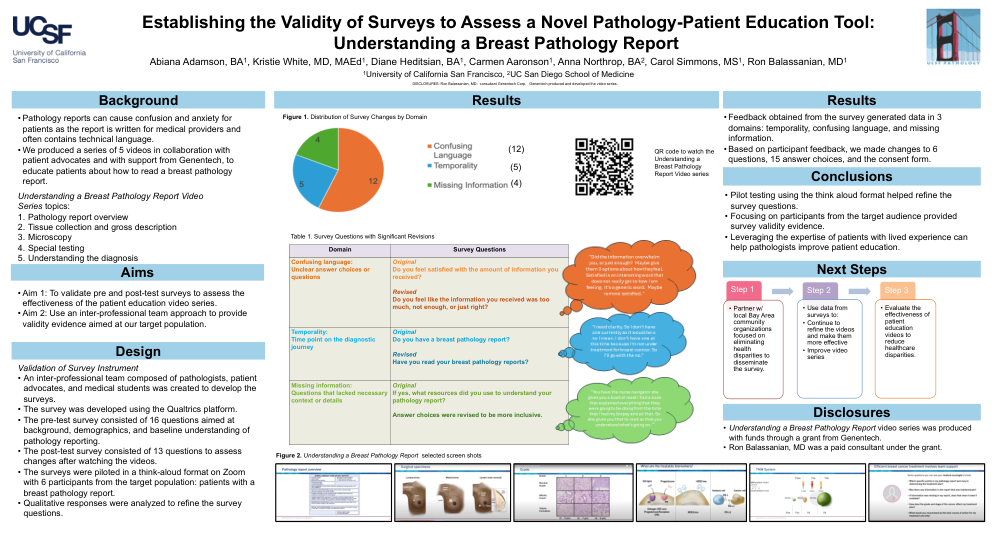
The videos cover 5 topics: 1.) pathology report overview, 2.) tissue collection and gross description, 3.) microscopy 4.) special testing 5.) understanding the diagnosis. Scripts were written for the 5 educational topics by an interprofessional team, consisting of a pathologist (RB), patient advocate (CS) and a research intern (AN). A video production company assembled the videos. A team of pathologists and patient advocates were consulted to develop survey questions using Qualtrics to measure the effectiveness of the videos. The pre-test survey consisted of 16 questions aimed at background, demographic, and baseline understanding of pathology reporting. The post-test survey consisted of 13 questions to assess changes from baseline in understanding pathology reporting. The surveys were piloted in a think-aloud format with 6 participants from the target population, patients with a breast pathology report, to provide validity evidence. Feedback was obtained, and the survey questions were refined.
Results
The videos are published on YouTube with nearly 600 views to date and 29 subscribers to the channel. Feedback obtained from the survey focused on 3 domains – temporality, confusing language, and missing information. The temporality domain was concerned with which time point on the diagnostic journey to answer questions, confusing language referenced unclear answer choices or questions, and missing information focused on questions and answer choices that lacked necessary context or details. We summarized participant feedback and then made changes to 6 questions, 15 answer choices, and the consent form which directly addressed the issues raised.
Conclusion
Using an interprofessional team that prioritizes patient lived experience to refine our surveys and improve tools for patient education is imperative. Creating educational videos in
collaboration with patients enables accessible, useful tools to improve patients’ understanding of their pathology reports.