127 posters, 10 topics, 20 sessions, 127 authors
ePostersLive by SciGen Technologies S.A. All rights reserved.
UCSF 2024 Inquiry Symposium
Conference ePosters

P078
Fragmentation of care is associated with lower rates of receiving guideline concordant treatment in locally advanced cervical cancer
Poster Presenter
Authors
Part of Topic
Systems Science
Title: Fragmentation of care is associated with lower rates of receiving guideline concordant treatment in locally advanced cervical cancer
Authors: Audrey Mvemba, Jessica Liang, Megan Swanson, MD, MPH, Emi Yoshida, MD, Katherine Fuh MD, PhD, Lee-may Chen, MD, Stephanie Ueda, MD, Stephanie Cham, MD
Introduction:
Fragmentation of care wherein patients receive care at multiple facilities is a healthcare disparity that is increasingly a barrier to access to high-quality cancer care. The treatment of locally advanced cervical cancer is complex due to the frequency of treatment and need for coordination across multiple subspecialties.
Aims:
The purpose of this project is to characterize fragmented care, determine its association with the receipt of guideline-concordant treatment (GC tx), and understand the impact of geographic social vulnerability index (SVI).
Methods:
A single-institution retrospective study (2003-2023) was conducted of patients with locally advanced cervical cancer (stage IB3 - IVA) who underwent chemoradiation. The primary exposure, fragmented care, was defined as receiving any part of chemoradiation at an outside facility. The primary outcome, receipt of GC tx, was defined as a composite of: 1) completion of treatment within 56 days, 2) completion of vaginal brachytherapy, and 3) receipt of concurrent chemotherapy. Demographic and treatment data were collected including SVI, a census-tract measure of disadvantage. Univariate, multivariate, and stratified analyses were performed.
Results:
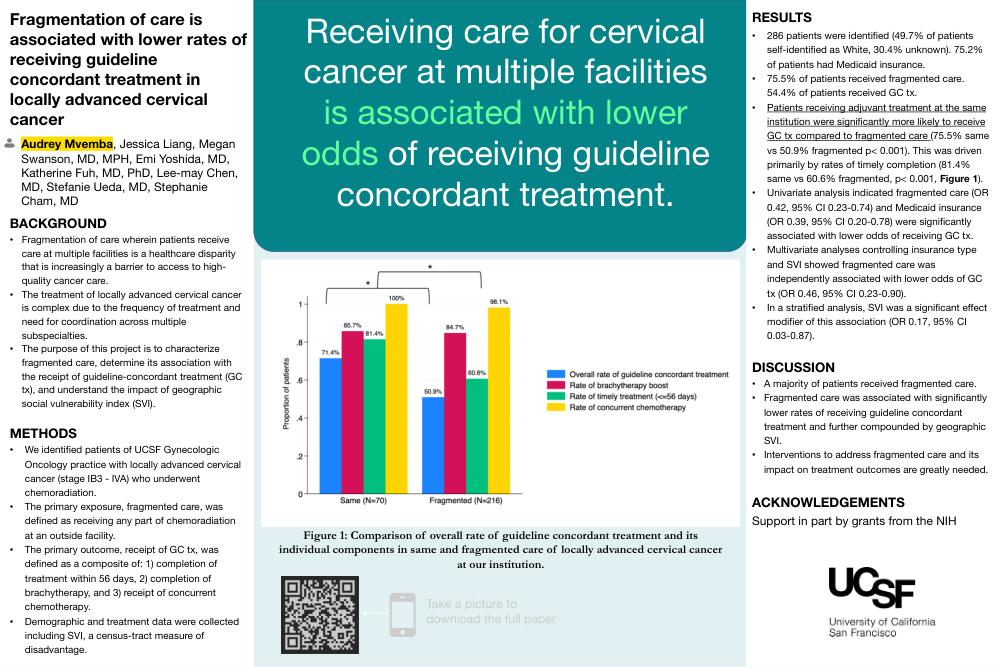
286 patients were identified. 75.5% of patients received fragmented care. Patients receiving adjuvant treatment at the same institution were significantly more likely to receive GC tx compared to fragmented care (75.5% same vs 50.9% fragmented p< 0.001). This was driven primarily by rates of timely completion (81.4% same vs 60.6% fragmented, p< 0.001, Figure 1). Univariate analysis indicated fragmented care (OR 0.42, 95% CI 0.23-0.74) and Medicaid insurance (OR 0.39, 95% CI 0.20-0.78) were significantly associated with lower odds of receiving GC tx. Multivariate analyses controlling insurance type and SVI showed fragmented care was independently associated with lower odds of GC tx (OR 0.46, 95% CI 0.23-0.90). In a stratified analysis, SVI was a significant effect modifier of this association (OR 0.17, 95% CI 0.03-0.87).
Discussions:
A majority of patients received fragmented care which was associated with significantly lower rates of GC tx and further compounded by geographic SVI. Interventions to address fragmented care and its impact on treatment outcomes are greatly needed.
Character count: 1996 (max 2000)

Figure 1: Comparison of overall rate of guideline concordant treatment and its individual components in same and fragmented care of locally advanced cervical cancer at our institution. Overall rate of guideline concordant treatment and rate of timely treatment within 56 days were significantly different (p<0.001), while rate of receipt vaginal brachytherapy and concurrent chemotherapy were not.