127 posters, 10 topics, 20 sessions, 127 authors
ePostersLive by SciGen Technologies S.A. All rights reserved.
UCSF 2024 Inquiry Symposium
Conference ePosters

P046
Evaluation of a Joint Heart Failure and Addiction Medicine Contingency Management for Patients With Stimulant-associated Cardiomyopathy
Poster Presenter
Authors
Part of Topic
Systems Science
Title Evaluation of a Joint Heart Failure and Addiction Medicine Contingency Management for Patients With Stimulant-associated Cardiomyopathy
Introduction/ Hypothesis or question (if applicable)/ Aims
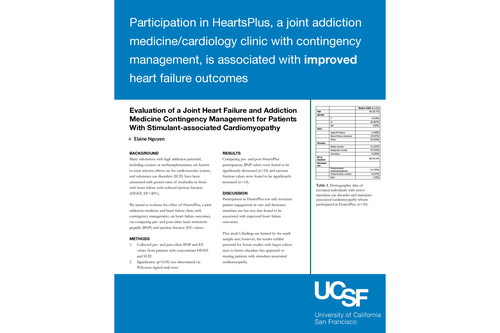
Many substances with high addiction potential, such as cocaine, alcohol, and methamphetamine, are known to exert adverse effects on the cardiovascular system, and substance-use disorders have been associated with greater rates of morbidity in those with heart failure (EF<40%). While medication-directed heart failure therapy and stimulant abstinence have been both shown to improve mortality outcomes in patients with stimulant-associated cardiomyopathy, cardiovascular care and addiction care services are typically offered independent of one another, which can make it difficult for this patient population to access as they generally tend to have lower engagement in outpatient care. HeartsPlus, a multidisciplinary addiction/cardiology clinic with contingency management for patients with stimulant-associated cardiomyopathy, has been found to increase patient engagement in care, decrease stimulant use, and encourage regular medication use. Building off the qualitative findings of the HeartsPlus Clinic pilot study, we aim to evaluate the effect of the clinic on quantifiable heart failure outcomes, such as basic natriuretic peptide (BNP) and ejection fraction (EF). We hypothesize that participation in HeartsPlus will significantly improve BNP and EF values.
Project Design/Methods
Patients with concomitant heart failure with reduced ejection fraction (<40%) and stimulant use disorder were recruited to participate in HeartsPlus, a 12-week joint addiction medicine and cardiology clinic with contingency management. Pre- and post-clinic BNP and ejection fraction values from 3 cohorts (2021, early 2022, and late 2022) were collected, and significance (p<0.05) was determined via a Wilcoxon signed rank test.
Results/Product
Of 30 patient participants, 24 patients had both pre- and post-clinic BNP values available while only 10 patients had both pre- and post-clinic ejection fraction values available. Within these respective subgroups, BNP was found to be significantly decreased (p=0.0457) and ejection fraction was found to be significantly increased (p=0.0391).
Discussion/Conclusion
Participation in HeartsPlus, a joint addiction/cardiology clinic with contingency management, was found to be associated with improved heart failure outcomes. This study’s findings are limited by the small sample size; however, the results exhibit potential for future studies with larger cohort sizes to better elucidate this approach to treating patients with stimulant-associated cardiomyopathy