127 posters, 10 topics, 20 sessions, 127 authors
ePostersLive by SciGen Technologies S.A. All rights reserved.
UCSF 2024 Inquiry Symposium
Conference ePosters

P016
Use of Professional Interpreters for Patients With Limited English Proficiency Undergoing Surgery
Poster Presenter
Authors
Part of Topic
Systems Science
Title: Use of Professional Interpreters for Patients With Limited English Proficiency Undergoing Surgery
Introduction: Disparities in surgical care among patients with limited English proficiency (LEP) are becoming increasingly well documented.1-3 This is especially concerning given that, as of 2021, 22% of the US population spoke a language other than English at home.4 Access to professional interpreters has been shown to increase surgical patients’ understanding of the indications and risks of their operation and discharge medication.5 Little is known, however, about factors within this vulnerable population that may affect which patients ultimately receive adequate access to perioperative interpretation.
Question: Are there factors within the LEP population that influence who ultimately receives adequate access to perioperative interpretation, thereby informing strategies to further optimize their care equitably?
Aims: 1) Evaluate several measures of perioperative professional interpreters documented throughout surgical admission for LEP patients undergoing common general surgical operation. 2) Identify LEP patient characteristics (if any) that may influence who ultimately receives access to perioperative interpretation.
Project Design/Methods: The study used electronic health record (EHR) data of patients aged 18 years or older who self-identified as having a preferred language other than English and were admitted for laparoscopic and/or open appendectomy, cholecystectomy, or colectomy at an urban academic center from 2019 to 2020. These data were a subset of data from our prior study6 using the same exclusion criteria, as well as those with missing data on covariates or outcomes. The institutional review board provided a waiver of participant consent because data were deidentified, in accordance with 45 CFR §46. This study followed STROBE reporting guidelines. The primary outcomes included documentation of interpreter usage within the first 24 hours of hospital encounter, interpreter usage at discharge, interpreter usage ever during this admission, and the provision of language-concordant discharge forms. Of note, interpreter documentation includes both in-person and telehealth, which are documented identically. Primary variables chosen a priori according to prior literature6 were self-identified race and ethnicity and language, gender, age, and insurance status. Data were analyzed from May to October 2021 using univariate analysis with Stata statistical software version 16.1 (StataCorp). Significance was set at 2-sided P < .05.
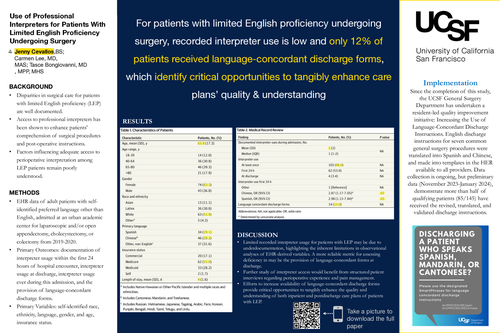
Results/Product: Of the 130 patients with LEP, the analytical cohort included 117 patients (74 female [63.3%]; mean [SD] age, 64 [17.3] years). Languages included Chinese (Cantonese, Mandarin, and Toishanese) languages (46 patients [39.3%]) and Spanish (34 patients [29.1%]), with the remaining 37 (31.6%) categorized as other, comprising 13 additional languages (Table 1).
Results on interpreter usage showed that 103 patients (88.3%) had interpreter use documented at least once throughout their length of stay (LOS), with 62 (53.0%) showing interpreter use within the first 24 hours and 4 (3.4%) at discharge. Overall, the study population had a mean (SD) of 1 (2) (median [IQR], 1 [1-2]) interpreter uses documented throughout their LOS. Only 14 patients with LEP (12.0%) were provided with language-concordant discharge forms (Table 2).
Patients speaking Spanish or Chinese languages were approximately 3 times more likely than those speaking another language to have an interpreter used in the first 24 hours (Spanish, odds ratio, 2.87; 95% CI, 1.17-7.05, P = .02; Chinese language, odds ratio, 2.98; 95% CI, 1.13-7.84; P = .03), but these differences were not observed for any other of the assessed primary outcomes. Race and ethnicity, gender, age, and insurance status were not associated with interpreter use in univariate analyses (Table 2).

Discussion/Conclusion: The findings of this cohort study indicate limited recorded interpreter usage for patients with LEP, suggesting the potential underutilization of available services. However, the inherent limitations in observational analyses of EHR- derived variables highlight the likelihood that actual interpreter usage exceeds documented instances. To establish a more reliable metric for assessing deficiency in language-concordant care, we propose examining the provision of language-concordant forms at discharge, which exist in the EHR only when provided to patients,
and we found the rate to be exceptionally low. We also acknowledge the susceptibility of our study to self-reporting bias of language preference, because patients may underreport LEP on the basis of perceptions or social desirability. Further study of interpreter access would benefit from structured patient interviews regarding perioperative experience and pain management. In the interim*, efforts to increase availability of language-concordant discharge forms provide critical opportunities to tangibly enhance the quality and understanding of both inpatient and postdischarge care plans of patients with LEP.

*Of note, since the completion of this study, the UCSF General Surgery Department has undertaken a resident-led quality improvement initiative: Increasing the Use of Language-Concordant Discharge Instructions. English discharge instructions for seven common general surgery procedures were translated into Spanish and Chinese, and made into templates in the electronic health record available to all providers. Data collection is ongoing, but preliminary data (November 2023- January 2024), demonstrate more than half of qualifying patients (85/145) have received the revised, translated, and validated discharge instructions.
Publication: Cevallos J, Lee C, Bongiovanni T. Use of Professional Interpreters for Patients With Limited English Proficiency Undergoing Surgery. JAMA Netw Open. 2024;7(2):e2355014. doi:10.1001/jamanetworkopen.2023.55014
References:
- Castro MRH, Schwartz H, Hernandez S, et al. The association of limited English proficiency with morbidity and mortality after trauma.J Surg Res. 2022;280:326-332. doi:10.1016/j.jss.2022.07.044
- Luan-Erfe BM, Erfe JM, DeCaria B, Okocha O. Limited English proficiency and perioperative patient-centered outcomes: a systematic review. Anesth Analg. 2023;136(6):1096-1106. doi:10.1213/ANE.0000000000006159
- Schwartz HEM, Matthay ZA, Menza R, et al. Inequity in discharge pain management for trauma patients with limited English proficiency.J Trauma Acute Care Surg. 2021;91(5):898-902. doi:10.1097/TA. 0000000000003294
- US Census Bureau. DP02: Selected social characteristics in the United States. Accessed September 18, 2023. https://data.census.gov/table?tid=ACSDP5Y2021.DP02&g=040XX00US06&hidePreview=true
- Kwan M, Jeemi Z, Norman R, Dantas JAR. Professional interpreter services and the impact on hospital care outcomes: an integrative review of literature. Int J Environ Res Public Health. 2023;20(6):5165. doi:10.3390/ ijerph20065165 JAMA Network Open | Equity, Diversity, and Inclusion Use of Professional Interpreters for Patients With LEP Undergoing Surgery JAMA Network Open. 2024;7(2):e2355014. doi:10.1001/jamanetworkopen.2023.55014 (Reprinted) February 6, 2024 3/4 Downloaded from jamanetwork.com by UCSF LIBRARY, Jenny Cevallos on 03/25/2024
- Lee C, Rusoja E, Ward K, Auerbach A, Wick E, Bongiovanni T. Pain control guidance reduces opioid disparities but not prescriber flexibility. Ann Emerg Med. 2023;82(4):S123. doi:10.1016/j.annemergmed.2023.08.302