127 posters, 10 topics, 20 sessions, 127 authors
ePostersLive by SciGen Technologies S.A. All rights reserved.
UCSF 2024 Inquiry Symposium
Conference ePosters

P003
Integration of Medical Legal Services into a Hospital-Based Violence Intervention Program: A Survey and Interview-Based Provider Needs Assessment
Poster Presenter
Authors
Part of Topic
Systems Science
Integration of Medical Legal Services into a Hospital-Based Violence Intervention
Program: A Survey and Interview-Based Provider Needs Assessment
Jake Sonnenberg, JD1; Ariana Metchick, MD2; Caitlin Schille, MPH3; Prashati Bhatnagar, JD, MPH3; Lisa Kessler, MBA3; Deborah Perry, PhD3; Vicki Girard, JD3; Belinda Taylor, JD3; Erin Hall, MD, MPH, FACS2, 4
ABSTRACT
Introduction: Violent injury among trauma surgery patients is strongly associated with exposure to harmful social determinants of health and negative long-term health outcomes. Medical-legal partnerships (MLPs) in other settings successfully provide patients with legal services to address similar health-harming legal needs and may offer a promising model for the care of violentlyinjured patients.
Hypothesis: Clinicians and staff affiliated with a hospital-based violence intervention program (HVIP) can identify unmet health-harming legal needs among the violently-injured population that could be addressed through innovative MLPs.
Aims: Identify HVIP clinician and staff perceptions of the health-harming legal needs among their violently-injured patients to guide the design of HVIP-MLP collaborations.
Project Design: An electronic survey tool was distributed to clinicians and staff affiliated with the HVIP at a single urban level one trauma center. Semi-structured follow up interviews were conducted with participants, and interviews were coded using thematic analysis and grounded theory.
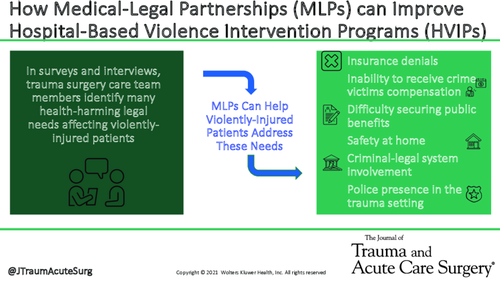
Results: Participants reported many health-harming legal needs among their violently injured patients. The most commonly-identified needs were: health insurance denials (62.5%); difficulty accessing crime victims compensation funds (56.3%); trouble accessing official documents (50%); and problems with non-SSDI public benefits (50%). Participants reported inconsistent methods for learning about and responding to patients’ health-harming legal needs. The most common barriers to addressing these needs included: lack of awareness that a lawyer could help with the issue (68.8%); prioritization of other needs (68.8%); previous negative legal experiences (62.5%); and cost (62.5%). Identified needs encompass issues traditionally-addressed by MLPs as well as more novel challenges faced by violent injury survivors.
1 University of California, San Francisco, School of Medicine, 513 Parnassus Avenue, San Francisco, CA
2 Department of Surgery, Georgetown University School of Medicine, 3900 Reservoir Road, NW, Washington, DC
3 Georgetown University Health Justice Alliance, Georgetown University School of Law, 600 New Jersey Avenue NW, Washington, DC
4 Department of Surgery, MedStar Washington Hospital Center, 110 Irving Street NW, Washington, DC
Discussion: This survey and interview-based study identifies complex health-harming legal needs present among violently-injured trauma surgery patients. MLPs specially-designed for the setting of violent injury appear well-suited to meet these needs, potentially reducing risk of violent re-injury, long-term negative health outcomes, and healthcare system costs.