127 posters, 10 topics, 20 sessions, 127 authors
ePostersLive by SciGen Technologies S.A. All rights reserved.
UCSF 2024 Inquiry Symposium
Conference ePosters

P006
Analysis of a Collaborative Care Model for Perinatal Mental Health Care
Poster Presenter
Authors
Part of Topic
Systems Science
Title: Analysis of a Collaborative Care Model for Perinatal Mental Health Care
Introduction: Perinatal mental health disorders have a significant impact on maternal and fetal outcomes, with suicide being a leading cause of maternal mortality. Perinatal collaborative care models have been shown to improve screening and treatment recommendations for obstetric patients with depression and/or anxiety, however there is a need for data demonstrating the impact of collaborative care programs on mental health outcomes once incorporated into the obstetric setting.
Hypothesis: It is hypothesized that there is a statistically significant association between treatment through CORP and positive mental health outcomes, and that there is no difference in outcomes based on race/ethnicity or insurance type.
Aims: This study aims to evaluate the impact of the University of California, San Francisco (UCSF) Collaborative Care Obstetric Resource Program (CORP), a primarily virtual collaborative care model, on mental health outcomes in perinatal patients and determine whether there is a difference in outcomes based on race/ethnicity and insurance type.
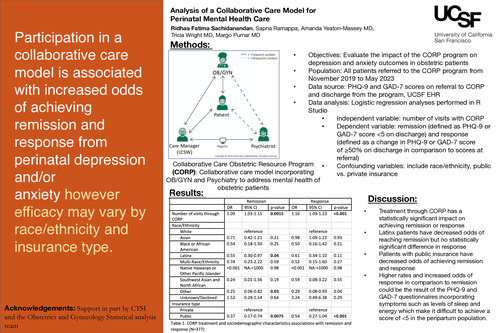
Methods: This descriptive cohort study analyzed data collected from UCSF’s electronic health record through a combination of computer-based system queries and manual queries. Additional data was collected from a database in RedCap containing obstetric information regarding a subset of patients that had been previously collected for research purposes. Data was analyzed for all pregnant and postpartum patients who were referred to CORP between 11/2020-5/2023. The independent variable analyzed in this study was the number of visits a patient had with CORP. The primary outcomes were remission, defined as PHQ-9 or GAD-7 score <5, and response, defined as a change in PHQ-9 or GAD-7 score of ≥50%. Simple logistic regression and multivariable logistic regression analyses were performed to determine the effects of treatment through CORP on remission and response, and differences in outcomes for patient race/ethnicity as well as public versus private insurance status.
Results: Out of 377 patients, 43.2% of patients reached remission and 48.5% reached response. There is a statistically significant association between the number of visits with CORP and remission (OR 1.09 CI 1.03-1.15, p-value <0.05) as well as response (OR 1.16, CI 1.09-1.23, p <0.001). Latinx patients have decreased odds of achieving remission (OR 0.546, CI 0.30-0.97, p <0.05) while patients who used the “Other” race/ethnicity category have reduced odds of achieving remission and response. Patients with public insurance had decreased odds of remission (OR 0.37, CI 0.17-0.74, p <0.05) but there was not a statistically significant effect of insurance type on response. On multivariable regression analysis, none of the factors analyzed had a statistically significant impact on remission or response except for pregnancy status (i.e., postpartum vs. pregnant) which had a statistically significant impact on remission (p < 0.05).
Discussion: Treatment through the CORP program has a statistically significant impact on achieving remission and response for peripartum patients experiencing depression and/or anxiety. Data analysis shows that Latinx and “Other” patients are the only race/ethnicity subgroups that have decreased odds of achieving remission and/or response; however limitations of this study include low sample sizes for certain race/ethnicity subgroups, which may impact the accuracy of this finding. Notably, having public insurance is associated with decreased odds of remission and response, thus it is worth considering the impact of socioeconomic status on patients and how the program can be modified to provide adequate support for them. Higher rates and increased odds of response in comparison to remission could be the result of the PHQ-9 and GAD-7 questionnaires incorporating symptoms such as levels of sleep and energy, which make it difficult to achieve a score of <5 in the peripartum population.