127 posters, 10 topics, 20 sessions, 127 authors
ePostersLive by SciGen Technologies S.A. All rights reserved.
UCSF 2024 Inquiry Symposium
Conference ePosters

P072
San Joaquin Valley High School Healthcare Careers and Pathways Exposure
Poster Presenter
Authors
Part of Topic
Education Science
San Joaquin Valley High School Healthcare Careers and Pathways Exposure
Jacob Perez-Stringer
Introduction
The San Joaquin Valley (SJV) is one of the least healthy, fastest growing, and poorest regions in California which also has the lowest number of physicians, advanced practice providers, and nurses per 100,000 people of any region in California. Various incentive strategies have been employed to increase the workforce; despite these strategies the healthcare workforce shortage still persists. Previous studies have shown that healthcare workers tend to practice in the region they were raised in, and that high school students are deterred from pursuing healthcare careers because of limited awareness of options, lack of social support, and limited understanding of pathways to healthcare careers. Fostering the SJV pre-healthcare pipeline targeting these deterrents may be a potential strategy to combat the workforce shortage.
Hypothesis
Hosting a Healthcare Careers Fair event at a SJV high school to foster the
pre-healthcare pipeline will increase students’ awareness of healthcare career options, increase students’ understanding of pathways to healthcare careers, and increase students’ interest in pursuing healthcare careers.
Aims
Aim 1.) To raise awareness of healthcare career options among SJV high school students.
Aim 2.) To improve SJV high school student understanding of pathways to healthcare career options.
Aim 3.) To raise interest in pursuing healthcare careers among SJV high school students.
Project Design
A Healthcare Careers Fair event was orchestrated for SJV high school students that included seminar speakers, hands-on activities, and informational tables. Students were separated into small groups and attended seminars from healthcare professionals in various professions (MD, MS, PA, NP, PT, RN) discussing their profession and pathways to obtaining their positions. Students were allowed to participate in
medically-related hands-on activities including ultrasound, suturing, intubation, and more taught by medical professionals. Informational tables from various educational, health-care related, and resource organizations were hosted for students to browse and discuss. Students were provided pre-fair and post-fair questionnaires to answer questions on a 1-10 Likert scale with anchors.
Results
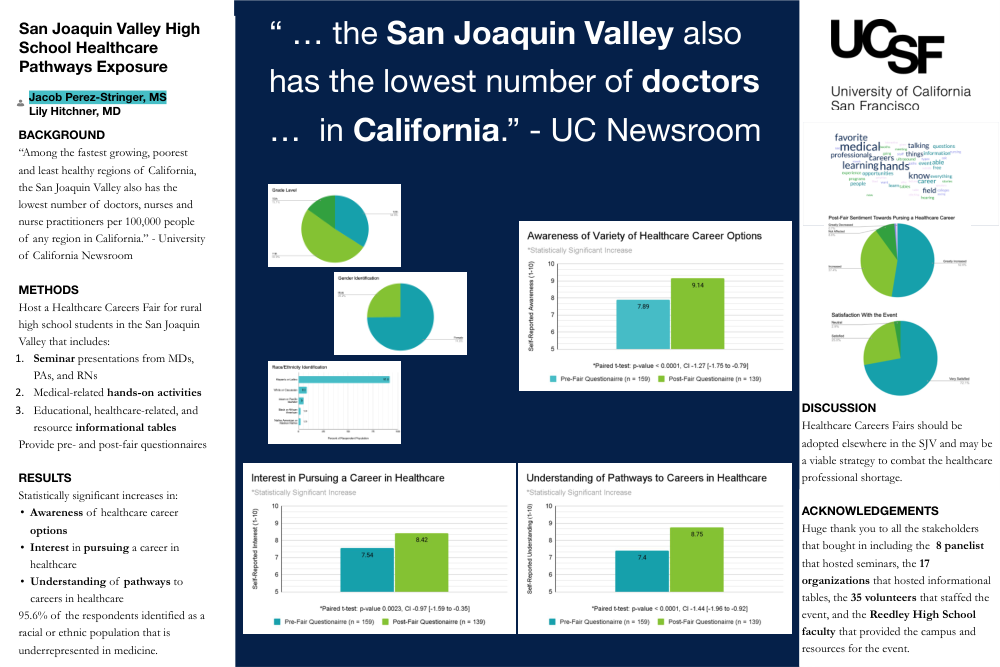
Over 200 students were invited to the event, 159 students completed the pre-fair questionnaire, and 139 students completed the post-fair questionnaire. Of the pre-fair respondents, 50.9% were in 11th grade, 74.8% identified as female, and 91.8% identified as Latino or Hipanic.
Paired t-tests comparing pre-fair questionnaire responses and post-fair questionnaire responses showed:
1.) A statistically significant increase in awareness of healthcare career options (p-value < 0.0001, CI -1.27 [-1.75 to -0.79]).
2.) A statistically significant increase in understanding of pathways to healthcare career options (p-value 0.0023, CI -0.97 [-1.59 to -0.35]).
3.) And a statistically significant increase in interest in pursuing a healthcare career (p-value < 0.0001, CI -1.44 [-1.96 to -0.92]).
Discussion
Healthcare Careers Fairs successfully increase awareness of healthcare career options, understanding of healthcare career pathways, and interest in pursuing healthcare careers; these events should be adopted elsewhere in the SJV and may be a viable strategy to combat the healthcare professional shortage. This study will not be able to determine how many of the students involved ultimately became healthcare professionals that practice in the SJV.