127 posters, 10 topics, 20 sessions, 127 authors
ePostersLive by SciGen Technologies S.A. All rights reserved.
UCSF 2024 Inquiry Symposium
Conference ePosters

P069
Characterizing safety triggers for high-risk medical device recalls, 2022
Poster Presenter
Authors
Part of Topic
Systems Science
Title: Characterizing safety triggers for high-risk medical device recalls, 2022
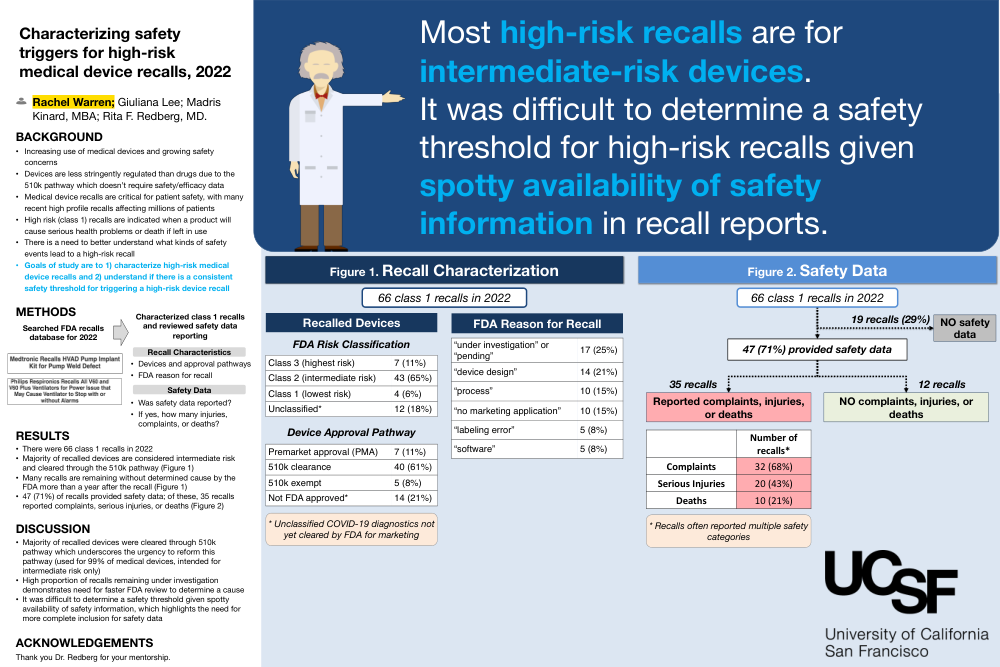
Introduction: Increasing use of medical devices and recent device recalls impacting millions of patients highlight the need for rigorous attention to premarket and postmarket safety data. The timing of device recalls relative to the number of reported safety events, such as injuries, malfunctions, and deaths, is an important issue for patient safety. Recalls are a critical component of post-marketing safety regulation, and, according to the FDA, Class 1 (high-risk) recalls are initiated when a product will cause serious health problems or death if left in use. Prior studies have characterized Class 1 recalls based on the types of recalled devices, device approval pathways, and reasons for recall. However, little research has been done to broadly assess the consistency and adequacy of safety data reporting in high-risk recalls.
Hypothesis and Aims: We sought to characterize the frequency and reason for high-risk medical device recalls from 2022 and analyze the reported safety data. Additionally, we sought to understand if there is a consistent safety threshold for triggering a high-risk device recall.
Methods: Class 1 recall reports submitted to the FDA’s device recall database from January 1, 2022 to December 31, 2022 were reviewed and consolidated into distinct device recall events (given that a single recall may be associated with multiple database entries). Recall notices posted on the FDA’s website were also reviewed, if available. Recalls were characterized based on device characteristics, reason for recall, and presence of adverse events safety information (including number of complaints, injuries, or deaths received).
Results: There were 66 class 1 recalls in 2022, with 7 (11%) recalls for class 3 devices (highest risk) and 43 (65%) recalls for class 2 devices (intermediate risk). Additionally, 12 recalls were for unclassified COVID-19 diagnostics that were not yet cleared by the FDA for marketing. Only 7 (11%) recalls were for devices approved through the premarket approval pathway (which is the most stringent and affects ~1% of medical devices), while 40 (61%) recalls were for devices cleared through 510k pathway, which is utilized for most medical devices. FDA-determined reasons for recall were “under investigation” or “pending” (17, 25%), “device design” (14, 21%), “process” (10, 15%), “no marketing
application” (10, 15%), “labeling error” (5, 8%), and “software” (5, 8%). Safety data was provided in 47 (71%) recalls, specifically, information on receipt of complaints, injuries, or deaths. Of the 47 recalls that provided safety data, 32 (68%) reported complaints, 20 (43%) reported serious injuries, and 10 (21%) reported deaths associated with the recall (recalls often reported multiple categories). Twelve recalls (18%) reported receiving no complaints, injuries, or deaths. Recalls varied in the number of reported complaints from 0 to 1,553 (mean 102.9, median 5.5), serious injuries from 0 to 60 (mean 7.3,
median 0), and deaths from 0 to 23 (mean 0.9, median 0).
Discussion: Most high-risk recalls are for devices classified as intermediate-risk by the FDA and cleared through the 510k pathway, which does not require clinical data. There was no safety data reported in just under one-third of recall notices. Furthermore, it was difficult to determine a consistent safety threshold for recalls given the spotty availability of safety information published in recalls. This study demonstrates the need for more complete inclusion of safety data in high-risk device recalls to better understand the safety risks. These findings highlight opportunities for improved dissemination of information about these high- risk safety events to better protect patients. Additionally, the high proportion of devices with high-risk recalls cleared through 510k, which is for intermediate-risk devices, underscores the urgency for further reforms, as 510k is utilized for 99% of medical devices. The significant proportion of high-risk recalls remaining without a determined cause by the FDA after at least a year since the recall suggests the need for faster and improved review of these serious safety concerns.