127 posters, 10 topics, 20 sessions, 127 authors
ePostersLive by SciGen Technologies S.A. All rights reserved.
UCSF 2024 Inquiry Symposium
Conference ePosters

P050
Academic-community partnerships to promote safety and linkage to care for ED patients experiencing intimate partner violence
Part of Topic
Systems Science
Academic-community partnerships to promote safety and linkage to care for ED patients experiencing intimate partner violence
Alice Lu MSL, Elizabeth Raby BS, Eva Kitlen BS, Stephanie Lawless BS, Caroline Burke MD, Leigh Kimberg MD, Theresa Cheng MD JD, Christopher Peabody MD MPH
Introduction: While national data is sparse, individual hospitals’ recent data estimates that Intimate Partner Violence (IPV) affected between 3-21% of female Emergency Department (ED) patients in the last 12 months. Connecting survivors with access to advocacy and other legal and psychosocial resources is critical as it can help prevent future IPV victimization, but the success rates for ED based referrals resulting in patients connecting with services after discharge have been estimated to be as low as 7-12%. The ACEP 2019 Policy Statement on Domestic Family Violence encourages “partnering with [...] local social services [...] to provide confidential counseling and assistance, in accordance with the patient’s wishes.” However, to our knowledge, there is limited literature documenting the process of establishing such partnerships and the survivor-centered best practices gleaned from them. Many of the 17 local community based organizations (CBOs) we contacted for preliminary research on this topic discussed feeling disconnected with the hospital systems and were eager to partner with a safety net hospital and the city’s only level 1 trauma center.
Aims: The primary aim of this project was to convene a community advisory council (CAC) to identify survivor-centered best practices for EDs, in order to improve the acceptability of ED based referrals for IPV survivors to relevant outpatient services. By articulating these best practices, this body of work aims to raise the standards of care for ED patients experiencing IPV using community endorsed approaches that are low-cost, low-tech, and widely adoptable. The secondary aim is to document the process of establishing this CAC, including challenges and resources that contributed to a mutually beneficial academic-community partnership. In convening a CAC to inform our intervention, we anticipate being able to create a lasting academic-community partnership for the betterment of services for ED patients experiencing IPV.
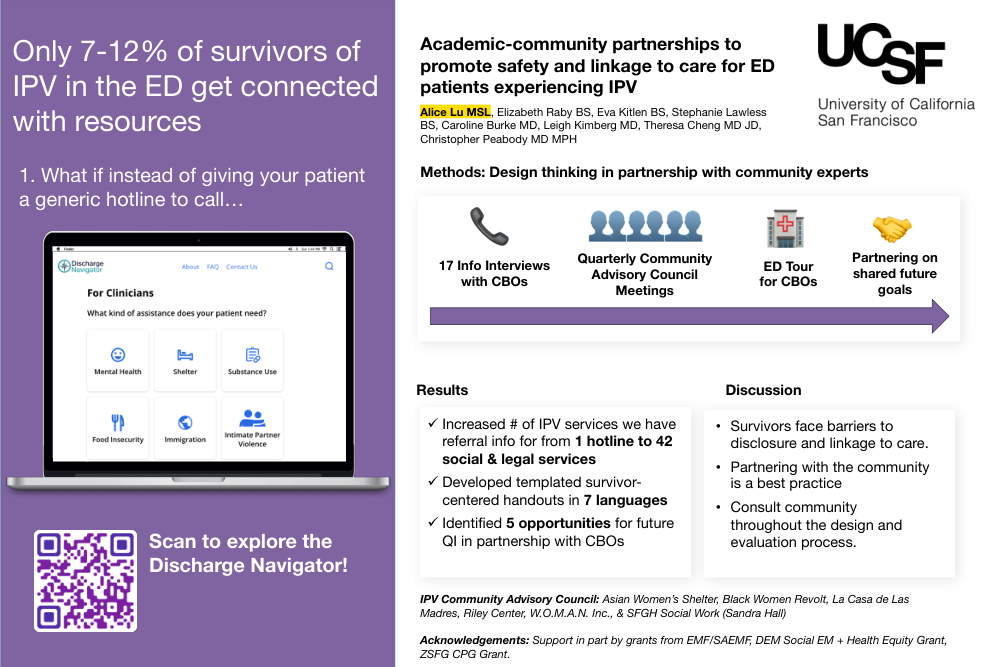
Project Design: The San Francisco General Hospital (SFGH) Emergency Department is an academic-affiliated level 1 trauma center and safety net hospital that sees a diverse patient population. To reflect the diversity of the patient population, five initial CBOs were approached using purposive sampling from a larger pool of 17 local CBOs that serve survivors of IPV in the local community. All five partners agreed to take part in the CAC: Asian Women’s Shelter, Black Women Revolt, La Casa de Las Madres, Riley Center, W.O.M.A.N. Inc. They represent the main 24/7 hotlines and emergency shelters available in San Francisco, while also spanning a wide range of other services and expertise in working with underserved populations. The internal project team consisted of medical students and residents at the UCSF Acute Care Innovation Center, ED attendings and social workers with subject matter expertise, as well as the SFDPH IPV Prevention Coordinator who provided content and relational expertise in the realm of community partnerships. Other resources included funding support from hospital leadership in the Department of Emergency Medicine, as well as technical support and translation services from the non-profit ShelterTech. The methodology was a design thinking approach: journey mapping and empathizing with the experience of an IPV survivor going through the ED, defining key areas for improvement especially around ED referrals to CBOs, ideating and prototyping two initial products, and then testing and implementing the final products. The CAC was involved early and often throughout this design thinking process, driving the needs assessment and providing continuous feedback on the ongoing ED quality improvement initiatives as well as future opportunities for collaboration.
Product: Regarding the primary aim, the CAC reviewed the current state of ED-based care and outpatient referrals for survivors of IPV through virtual meetings and an in-person ED walkthrough. In mapping the ideal patient journey, the CAC identified 7 key themes for future opportunities for quality improvement: (1) survivor accompaniment, (2) communication training, (3) de-escalation training, (4) adjusting the physical environment, (5) building trust and communicating safety, (6) partnering to create warmer hand-offs, and (7) increasing awareness and accessibility of services available upon discharge. The CAC also provided feedback on two prototypes aimed at theme 7: (1) development of a clinician-facing digital tool to help identify tailored social service referrals for IPV survivors and (2) a thoughtfully designed patient-facing informational pamphlet that would be safer for survivors to take home and accessible in 7 languages. Regarding the second aim, our team held three SFGH IPV CAC meetings (May 15, 2023, September 25, 2023, January 26, 2024) with a fourth planned for Spring 2024 and future plans to continue these meetings on a quarterly basis. The CAC has prioritized a continued list of gaps and potential solutions to prototype and test in the ED setting.
Discussion: Two prototypes were ultimately completed and implemented in the ED, and included multiple survivorcentered best practices including tailoring referrals to survivor needs and demographics as well as developing more discreet patient handouts that would be safe to take home. However, limitations of these two products included a lack of available referrals tailored to certain populations including Black or African American and American Indian or Alaska Native, due to a lack of freely accessible community resources for IPV survivors that were identified prior to launch. Another limitation was that although these prototypes address some existing gaps in the ED, they do not inherently promote universal education about IPV, nor address the other six themes for areas of improvement identified by the CAC. These are areas active for further investigation. Future work on these two prototypes will include evaluating their efficacy in increasing referrals and successful linkages to care, which can be measured by surveying staff who are utilizing the prototypes as well as establishing a closed-loop referral data collection process that is de-identified and possibly provided as aggregate sums from the CBOs. As for the process of forming the academic-community partnership, we found the partnership worked well when structured utilizing a community-engaged approach with a “medium level” of community involvement, defined as “assisting with implementation of a researcher-designed study including [...] providing feedback on aspects of study design or findings”, as CBOs wanted to participate but were already stretched thin and endorsed that “having [UCSF] drive this partnership is self-care for the rest of us”. In keeping with community engagement best practices, we secured funding so that community partners were compensated to provide their expert input on ED-based processes to help IPV survivors connect with CBOs, to increase their safety. Barriers included ability to find meeting times that worked for such a large group, as well as being able to balance the feedback and opinions from a diverse group with the realities of resource limitations regarding staffing and environment in the ED. Continuing to document and share how this academic-community partnership functions could improve how healthcare and community IPV services interface to result in improved patient services.
Acknowledgements: Huge appreciation to the inaugural SFGH IPV Community Advisory Council members, without whom this work would not have been possible.