127 posters, 10 topics, 20 sessions, 127 authors
ePostersLive by SciGen Technologies S.A. All rights reserved.
UCSF 2024 Inquiry Symposium
Conference ePosters

P067
A Systems Analysis of Skilled Nursing Facility discharges at Zuckerberg San Francisco General Hospital Using A3-Thinking
Poster Presenter
Authors
Part of Topic
Systems Science
Title: A Systems Analysis of Skilled Nursing Facility discharges at Zuckerberg San Francisco General Hospital Using A3-Thinking
Introduction:
The complex transition from hospital to Skilled Nursing Facilities (SNF) involves multiple stakeholders and contains many potential barriers to timely and effective discharge, with negative downstream effects including increased hospital length of stay (LOS), increased costs, worse patient outcomes, and
decreased patient and provider satisfaction. Zuckerberg San Francisco General (ZSFG) is an academic public hospital which cares for a diverse population (13% black, 42% Hispanic, 20% Asian, 16% white)
with high rates of publicly insured patients (59% Medicaid, 33% Medicare). ZSFG serves as the only acute hospital in San Francisco with 24-hour psychiatric emergency services and the only Level 1 trauma center in San Francisco. Hospital providers and staff have informally observed the presence of various barriers in the transition of patients to Skilled Nursing Facilities (SNF); however, there lacks a comprehensive and systematic evaluation of this process, limiting the ability to create targeted metrics and propose
countermeasures to improve the process.
Questions/Aims
This project was designed to better understand the current state of transitioning patients from ZSFG to SNF. We aimed to 1) quantify demographic and socioeconomic characteristics of patients discharged
from ZSFG to SNF, such as race and primary form of insurance, as well as hospital related data including admitting diagnoses and lengths of stay; 2) systematically map the process of transitioning patients to SNF from ZSFG; and 3) qualitatively evaluate barriers to discharge to SNF.
Methods:
This project used a sequential mixed-methods design grounded in an A3-quality improvement
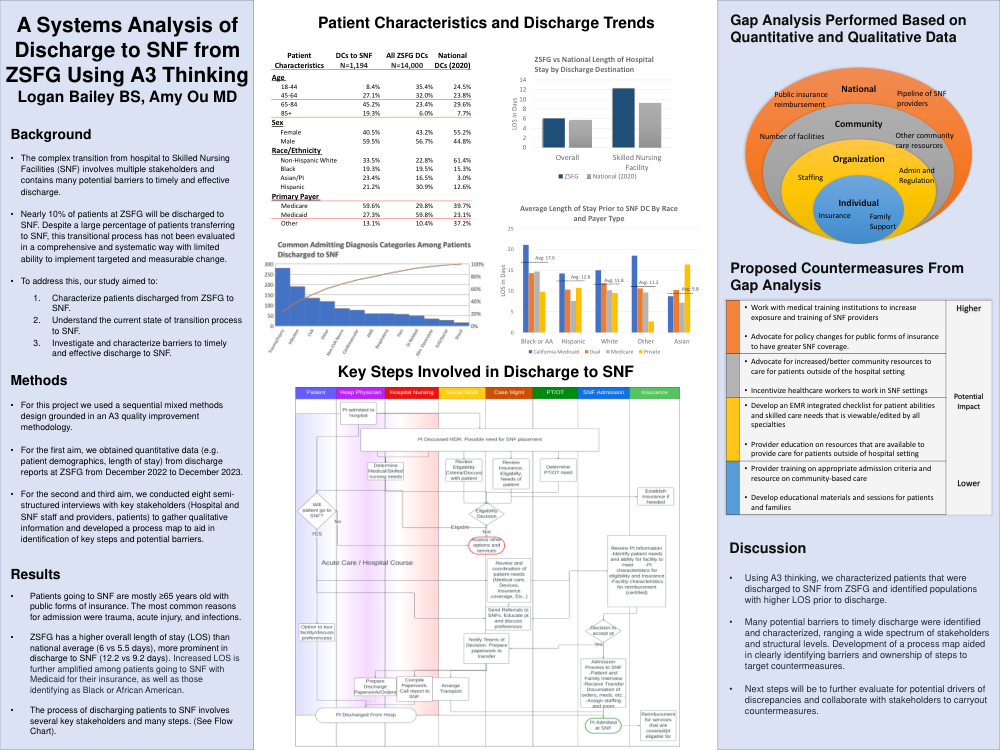
methodology. We first obtained patient characteristics including age, sex, race, ethnicity, and primary payer, as well as discharge data such total length of stay, primary diagnosis, and discharge location for all patients admitted to ZSFG from December 2022 to December 2023.
We conducted eight semi-structured interviews with key stakeholders to obtain qualitative information related to the key steps and barriers involved in the process of transitioning patients to SNF. We identified individual stakeholders through snowball sampling and included hospital providers and staff, patients, and SNF providers. Using information obtained via interviews, we developed a process map to better visualize the steps necessary for the transition process.
Results:
From December 2022 – December 2023, 1194 patients were discharged to SNF from ZSFG, representing
~9% of all discharges. Individuals discharged to SNF primarily had public forms of insurance (38% Dual Medicare-Medicaid, 30% Medicaid, 22% Medicare), and identified as White (34%), Asian (23%) Hispanic(21%), and Black or African American(19%).
The average hospital LOS for patients discharged from ZSFG to SNF was 12.2 days (Median 8 days IQR: 5 - 15) versus a national average LOS prior to SNF discharge of 9.2 days. The average hospital LOS at ZSFG
prior to discharge to SNF was higher for individuals that were identified as Black or African American (17 days) and for those with Medicaid (14.8 days).
Eight stakeholders across various roles in both hospital and SNF settings identified many barriers and contributors to the increased LOS that were grouped according to structural level in the healthcare
ecosystem. Key contributors at an individual level included patient factors such as a patient’s choice of
SNF not available, as well as staff or provider factors such as decreased comfort in discharging patient to other setting. Examples at the hospital and facility level included delays in completing discharge orders or paperwork and inefficiencies in communications among healthcare teams. Common themes at the national level included complex policies and regulations governing SNF procedures and reimbursement.
Development of a process map aided in visualizing key steps and stakeholders’ roles, and highlighted barriers existing in many layers of the overall healthcare system.
Discussion:
Many individuals are discharged to SNF at ZSFG, with higher LOS than national averages. Transitioning from acute hospital to SNF care is a complex process, amplified by ZSFG being a public hospital, with
many barriers existing both inside and outside of the hospital ecosystem. By developing a process map, it is easier to visualize and standardize the complex steps needed to transition patients to SNFs. This allows for generation of a more clear and comprehensive gap analysis with stakeholder input. Countermeasures can then be proposed with stakeholder engagement that are more feasible and within the locus of control of the hospital system.