127 posters, 10 topics, 20 sessions, 127 authors
ePostersLive by SciGen Technologies S.A. All rights reserved.
UCSF 2024 Inquiry Symposium
Conference ePosters

P064
Combining Electronic Health Record Based Automation and Machine Learning to Improve Heart Failure Outcomes, Increase Equity and Retain at Risk Funding in a Safety Net Health System
Poster Presenter
Authors
Part of Topic
Systems Science
Title
Combining Electronic Health Record Based Automation and Machine Learning to Improve Heart Failure Outcomes, Increase Equity and Retain at Risk Funding in a Safety Net Health System
Introduction
Providing comprehensive and equitable heart failure (HF) care in public, safety net healthcare systems (SNH) is challenging. Patient populations who tend to rely on SNHs often face numerous social determinants of poor health outside of and within the hospital walls, and SNHs often do not possess resources to address these specific needs. As a result, many SNHs experience elevated readmission rates and increased mortality. Beyond the impact to patients, poor outcomes put SNHs at risk of not meeting government pay for performance metrics, compounding their inability to invest in care improvement. Hospitals with the greatest need for funding are disproportionately penalized, and there is a paucity of successful efforts to reduce readmissions and retain funding at SNHs. HF is the greatest contributor to unplanned readmission, yet, targeting this diagnosis comes with additional challenges: low readmission rate often comes at the expense of elevated mortality, and system level interventions can exacerbate existing gaps in demographic equity in outcome. In 2018, a comprehensive HF care improvement program was formed at ZSFGH, a publicly funded SNH, to combat high readmission and mortality rates and inequities in care. This program systematically identified and addressed key barriers to high quality HF care and combined electronic health record (EHR) based automation with machine learning to build a clinical decision support tool called a carepath. The HF carepath improved medication management, and streamlined referral processes, enhancing resource allocation to the neediest patients.
Hypothesis/Question
Did the HF improvement program successfully reduce overall risk of unplanned 30-day readmission, without increasing mortality rate or worsening inequities in risk of readmission?
Aims
1) Compare risk of 30-day readmission at our SNH after program initiation to internal historical controls and five external SNHs in California over the same time-period.
2) Compare survival after program initiation to internal historical controls.
Project Design/Methods
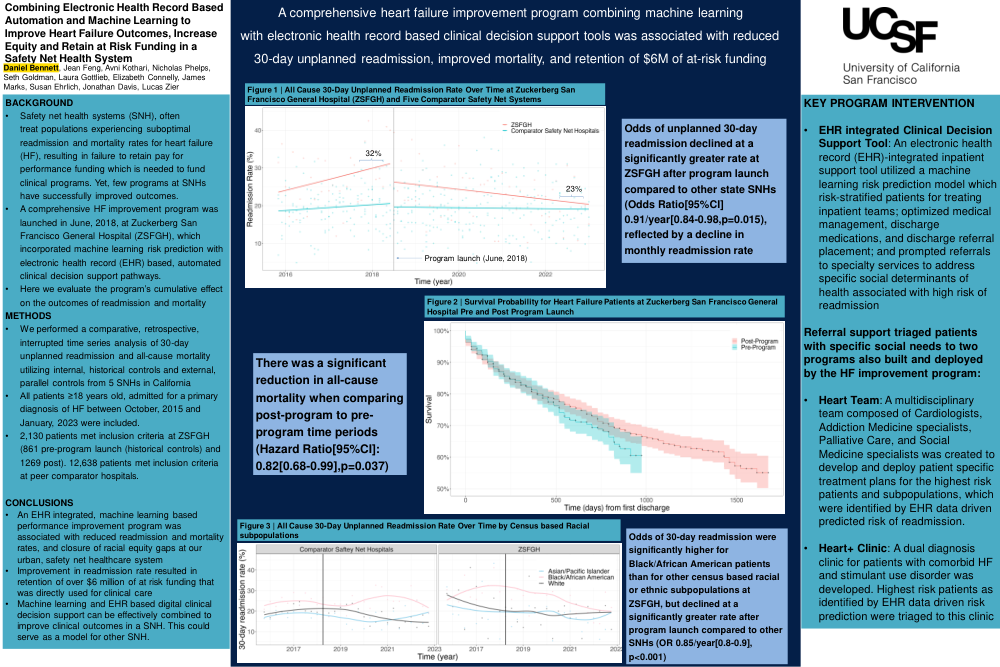
At 55 months post program launch, we conducted a retrospective comparative analysis of 30-day all-cause readmission rates and survival with both internal historical controls and external parallel controls from five other urban public healthcare systems in California. All patients ≥18 years old and admitted for a principal diagnosis of heart failure (ICD 10 150.01-150.9) between October, 2015 and January, 2023 at our SNH, Zuckerberg San Francisco General Hospital (ZSFGH), or one of the five additional SNHs were included. All data was collected and reported by a third party, Vizient. We utilized mixed-effects logistic time series analyses to evaluate readmission rates and multivariate Cox proportional hazard regression to evaluate for survival.
All models were adjusted for age, sex, and Charlson comorbidity index.
Results
Over the 86-month study period at ZSFGH, 2,130 patients met inclusion criteria, with 861 patients in the pre-program initiation control group (October 2015-June 2018) and 1,269 patients in the post-program initiation group (June 2018-January 2023). A total of 12,638 patients met inclusion criteria at comparator hospitals. The odds of 30-day readmission decreased at a significantly faster rate at ZSFGH after the formation of the HF improvement program compared to patients in other systems (OR 0.91/year, 95% CI: 0.84-0.98, p-value = 0.015), reflected by a decline in mean±sd overall monthly readmission rate from 32%±7% the year before program initiation (2017), to 23%±9% over the last year of the study period (2022). Odds of 30-day readmission was higher for patients identifying as Black/African American (B/AA) than other census based racial or ethnic subpopulations (White, Asian, Hispanic, non-Hispanic) within ZSFGH (OR 1.5, 95%CI: 1.1-2.0, p-value=0.005) and was higher for B/AA patients at ZSFGH than for B/AA patients within other hospital systems (OR 1.56, 95%CI:1-2.3, p-value=0.02).
However, odds of readmission declined at a significantly higher rate for B/AA patients at ZSFGH compared to those at other hospital systems following formation of the HF improvement program (OR 0.85/year, 95%CI:0.8-0.9, p<0.001). Survival analysis conducted in the ZSFGH HF population demonstrated a reduction in all-cause mortality in the post-program period (HR 0.82, 95% CI: 0.68-0.99, p-value = 0.037). Improvement in readmission rates enabled the health system to retain $6M of at risk pay for performance funding over the 5 years following program formation.
Conclusions
An automated, machine learning based EHR decision support tool in conjunction with a comprehensive HF program was associated with reduced readmission risk and all-cause mortality, closed equity gaps in care and helped retain at risk pay-for-performance funding at an urban, SNH. While there is a small number of programs that have reduced readmission in a SNH, this is the first report of a successful intervention in the domains of readmission, survival and health equity. Additionally, the comparison of these outcomes to peer urban safety net hospitals in California, which did not experience similar improvements in HF outcomes during the intervention time period, increases our confidence that changes were due to the HF program’s interventions rather than population level changes or external confounders. This program could serve as a model for improving HF outcomes in in other SNHs and highlights the utility of EHR based technology based improvement methods as a low cost, effective method for scalable change.