127 posters, 10 topics, 20 sessions, 127 authors
ePostersLive by SciGen Technologies S.A. All rights reserved.
UCSF 2024 Inquiry Symposium
Conference ePosters

P124
Skin Cancer and Genital Cancer Risk Among Non-White Solid Organ Transplant Recipients in the US, 2000 – 2022
Poster Presenter
Authors
Part of Topic
Population Science & Epidemiology
Title: Skin Cancer and Genital Cancer Risk Among Non-White Solid Organ Transplant Recipients in the US, 2000 – 2022
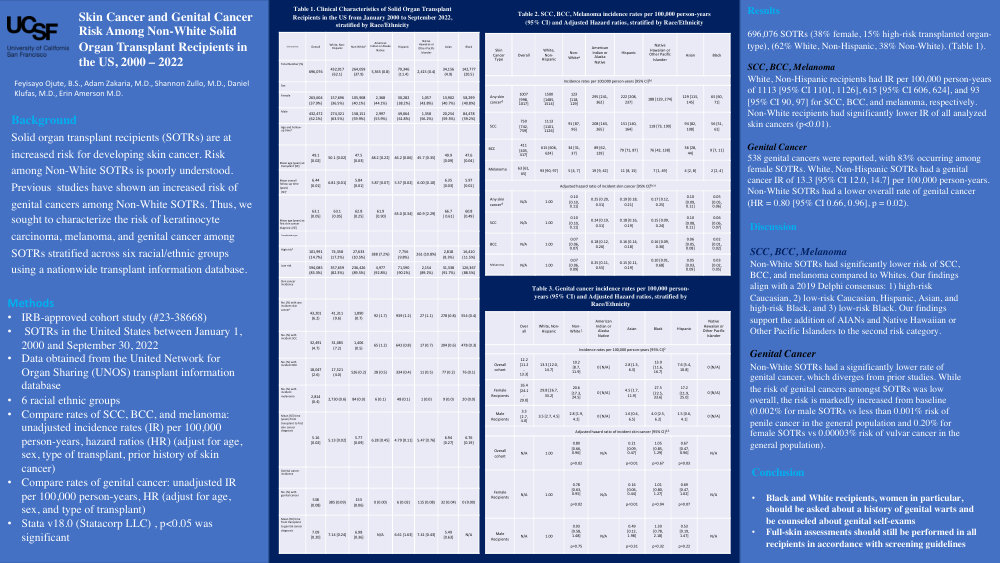
Introduction: The risk of squamous cell carcinoma (SCC), basal cell carcinoma (BCC), melanoma, and genital cancer among Non-White solid-organ transplant recipients (SOTRs) is poorly understood.
Aims: We sought to further characterize the risk of keratinocyte carcinoma, melanoma, and genital cancer among SOTRs stratified across six racial/ethnic groups using a nationwide transplant information database.
Methods: This cohort study utilized the national Organ Procurement and Transplantation Network database to assess risk of skin cancer and genital cancer for all SOTRs in the United States from January 2000 to September 2022. Patients were stratified into 6 race/ethnicity categories. Risk of post-transplant skin cancer and death attributable to skin cancer was compared between race/ethnicity categories after adjusting for transplant type, age, and sex.
Results: White, Non-Hispanic recipients had IR per 100,000 person-years of 1113 [95% CI 1101, 1126], 615 [95% CI 606, 624], and 93 [95% CI 90, 97] for SCC, BCC, and melanoma, respectively. Non-White recipients had significantly lower IR of all analyzed skin cancers (p<0.01). Post-transplant death attributable to skin cancer occurred in 0.08% of White, Non-Hispanic patients compared to 0.00% of patients in other race/ethnicity groups (p<0.01).
538 genital cancers were reported, with 83% occurring among female SOTRs. White, Non-Hispanic SOTRs had a genital cancer IR of 13.3 [95% CI 12.0, 14.7] per 100,000 person-years. Non-White SOTRs had a lower overall rate of genital cancer (HR = 0.80 [95% CI 0.66, 0.96], p = 0.02).
Discussion: Non-White SOTRs had significantly lower risk of SCC, BCC, and melanoma compared to Whites. Our findings align with a 2019 Delphi consensus that factors race into risk stratification for skin cancer screening: 1) high-risk Caucasian, 2) low-risk Caucasian, Hispanic, Asian, and high-risk Black, and 3) low-risk Black. Our findings support the addition of AIANs* and Native Hawaiian or Other Pacific Islanders to the second risk category. Non-White SOTRs had a significantly lower rate of genital cancer, which diverges from prior studies. While the risk of genital cancers amongst SOTRs was low overall, the risk is markedly increased compared to the general population for both males and females. We found a higher risk of genital cancer amongst females than males, which also diverges from prior studies.
Limitation: Data could be subject to self-report bias.
Conclusion: Black and White recipients, women in particular, should be asked about a history of genital warts and be counseled about genital self-exams. Full-skin assessments should still be performed in all recipients in accordance with screening guidelines.
*AIANs- American Indian or Alaska Natives