127 posters, 10 topics, 20 sessions, 127 authors
ePostersLive by SciGen Technologies S.A. All rights reserved.
UCSF 2024 Inquiry Symposium
Conference ePosters

P112
A Nested Case-Control Study of Hepatitis C Virus Re-infection in Incarcerated Patients in California Receiving Medication for Opioid Use Disorder
Poster Presenter
Authors
Part of Topic
Population Science & Epidemiology
Title: A Nested Case-Control Study of Hepatitis C Virus Re-infection in Incarcerated Patients in California Receiving Medication for Opioid Use Disorder
Authors: Joey Shemuel, BA1; Kimberley Lucas, MPH2ⴕ; Amy Krawiec, MD2; Sherry Lopez, DO2; Donna Kalauokalani, MD MPH2
Affiliations:
1: School of Medicine, University of California, San Francisco; San Francisco, CA 2: California Correctional Health Care Services; Elk Grove, CA
ⴕ Corresponding author: Kimberley.lucas@cdcr.ca.gov
Abstract:
Introduction: Incarcerated people have disproportionately high rates of hepatitis C virus (HCV) prevalence and are at elevated risk of HCV re-infection following treatment. Medication for opioid use disorder (MOUD) has been shown to reduce HCV infection and re-infection.
Research is lacking on patient-level factors associated with re-infection in incarcerated populations in the United States receiving MOUD.
Question: Which demographic, clinical, and behavioral characteristics are associated with HCV re-infection in incarcerated patients who have been treated for HCV and are receiving MOUD?
Methods: We conducted a case-control study among people incarcerated in California state prisons who initiated HCV treatment between January 1, 2020 and January 1, 2022, achieved sustained virologic response (SVR), initiated MOUD before SVR, and became re-infected within one year. Controls were patients also on MOUD who were treated for HCV during the same interval and remained HCV-negative at one year. Chart review was performed manually and using structured query language software. We calculated unadjusted odds ratios, Wilcoxon Rank Sums for continuous variables, and a multivariate regression model.
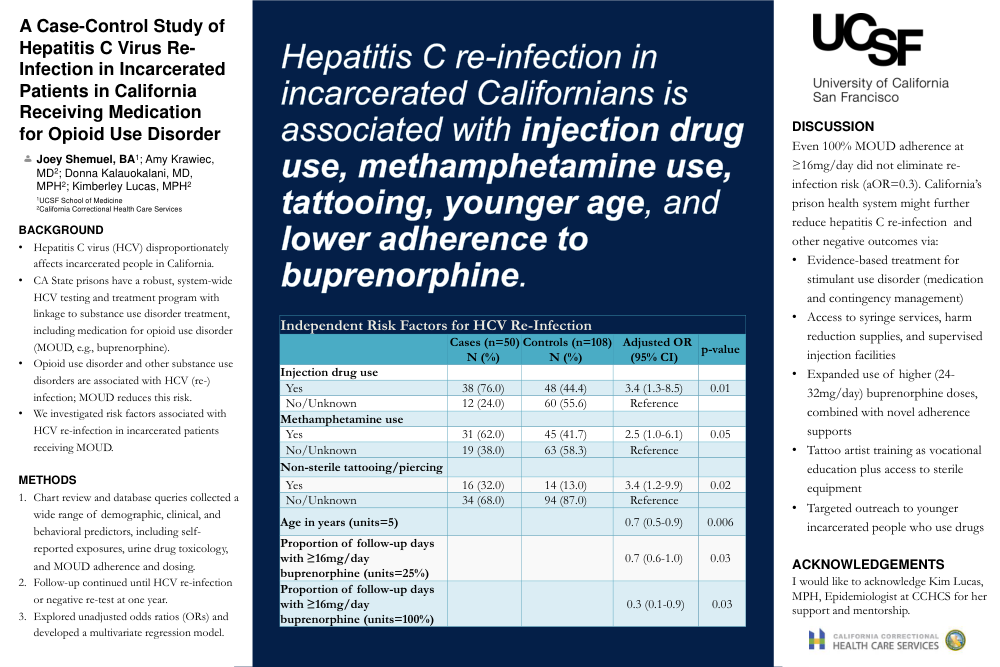
Results: 50 cases and 108 controls met inclusion criteria. Participants were mostly male (96.2%) and Latinx (62.7%) or White (29.1%), with a median age at SVR of 36 years. All patients received sublingual buprenorphine. In the multivariate model, HCV re-infection within one year of SVR
was significantly associated with injection drug use (aOR=3.4; 95% CI 1.3-8.5), tattooing or piercing (aOR=3.4; 95% CI 1.2-9.9), methamphetamine use (aOR=2.5; 95% CI 1.0-6.1), younger age (aOR=0.7 for each additional 5 years of age; 95% CI 0.5-0.9), and lower adherence to adequately dosed buprenorphine, which we defined as ≥16mg/day (aOR=0.7 for each additional 25% of days of follow-up with adherence; 95% CI 0.6-1.0).
Discussion: We observed several modifiable risk factors associated with HCV re-infection in this population. To our knowledge, these are the first published findings associating HCV re- infection with buprenorphine adherence and dosage. The latter may be addressed by development of additional adherence supports and expanded use of buprenorphine doses above 16mg/day, consistent with recent work on MOUD efficacy in an era of widespread adulteration of the street opioid supply with fentanyl. Our findings also draw attention to the role that injection drug use and methamphetamine use play in re-infection, which prompt further consideration of syringe services programs, safe injection facilities, and evidence-based pharmacologic and behavioral treatment for stimulant use disorder. More research is needed to understand the specific dynamics of drug equipment sharing within California prisons as well as how to optimize the acceptability and safety of harm reduction interventions among incarcerated people who use drugs. Finally, this work supplements the growing academic and popular discourse calling for fundamental changes in prison culture to improve the conditions that drive elevated substance use rates in the carceral environment in the first place.