127 posters, 10 topics, 20 sessions, 127 authors
ePostersLive by SciGen Technologies S.A. All rights reserved.
UCSF 2024 Inquiry Symposium
Conference ePosters

P119
Spatial Variation in the Effect of Extreme Heat Events on Warm Season Pediatric Acute Care Utilization: A Small-Area Assessment of Multiple Health Conditions and Environmental Justice Implications in California (2005-2019)
Poster Presenter
Authors
Part of Topic
Population Science & Epidemiology
Title: Spatial Variation in the Effect of Extreme Heat Events on Warm Season Pediatric Acute Care Utilization: A Small-Area Assessment of Multiple Health Conditions and Environmental Justice Implications in California (2005-2019)
Introduction: The increasing frequency and severity of extreme heat events due to climate change presents unique risks to children and adolescents. There is a lack of evidence regarding how heat’s impacts on pediatric patients vary spatially and how structural and sociodemographic factors drive this heterogeneity.
Aims: We examined the association between extreme heat events and pediatric acute care utilization in California for 19 distinct health conditions. We then assessed how extreme heat’s consequences varied at the zip code level and identified environmental justice metrics that modulated children’s vulnerability to extreme heat.
Methods: This study analyzed 7.2 million unscheduled hospitalizations and emergency department visits for children < 19 years old in California between May and September from 2005 to 2019. We first utilized a time-stratified case crossover design to generate statewide estimates for the association between extreme heat events and care utilization. We then implemented a within-community matched design coupled with a Bayesian hierarchal model to generate spatially varying effect estimates. Finally, we conducted a random effects meta-regression to examine how community-level characteristics modified heat’s impacts across zip codes.
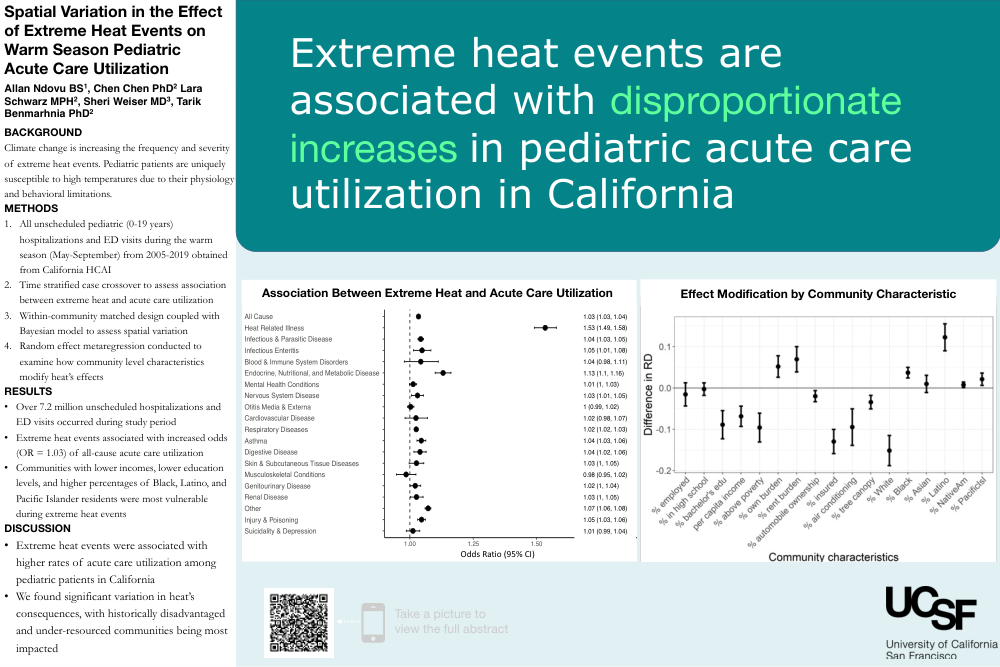
Results: Extreme heat events were associated with substantial increases in acute care utilization for all causes (OR = 1.03, 95% CI: 1.03 to 1.04) and were attributable for over 30,000 excess acute care utilizations during the study period. Extreme heat events were also associated with increases in heat-related illness (OR = 1.53, 95% CI: 1.49 to 1.58), endocrine, nutritional, and metabolic disorders (OR = 1.13, 95% CI: 1.1 to 1.16), other signs and symptoms (OR = 1.07, 95% CI: 1.06 to 1.08), and injury and poisoning (OR = 1.05, 95% CI 1.03 to 1.06). There was substantial spatial heterogeneity in extreme heat events effects, especially in coastal metropolitan areas. Communities with lower incomes and education levels, less access to insurance and air conditioning, and higher percentages of Black, Latino, and Pacific Islander residents were most vulnerable during extreme heat events.
Conclusions: Extreme heat events in California are associated with increased pediatric care utilization. There is significant variation in heat’s consequences, and historically disadvantaged and under resourced communities are most impacted. These findings suggest that interventions designed to improve heat resilience should be targeted to protect vulnerable children.