127 posters, 10 topics, 20 sessions, 127 authors
ePostersLive by SciGen Technologies S.A. All rights reserved.
UCSF 2024 Inquiry Symposium
Conference ePosters

P104
Diagnostic accuracy of clinic-based loop-mediated isothermal amplification and quantitative PCR for fungal and Acanthamoeba keratitis
Part of Topic
Population Science & Epidemiology
Title: Diagnostic accuracy of clinic-based loop-mediated isothermal amplification and quantitative PCR for fungal and Acanthamoeba keratitis
Binh Cao,1 Chi Hoang Viet Vu,2 Cung Xuan Le,2 Tuan Hoang Anh,2 Dong Pham Ngoc,2 Hiep Nguyen Xuan,2 Thu Anh Tran,2 Dionna M. Wittberg,1 Krisianne M. Aromin,1 Cindi Chen,1 Thuy Doan,1,3 Jeremy D. Keenan1,3
1 Francis I Proctor Foundation, University of California, San Francisco, USA
2 Vietnam National Eye Hospital, Hanoi, Vietnam
3 Department of Ophthalmology, University of California, San Francisco, USA
ABSTRACT
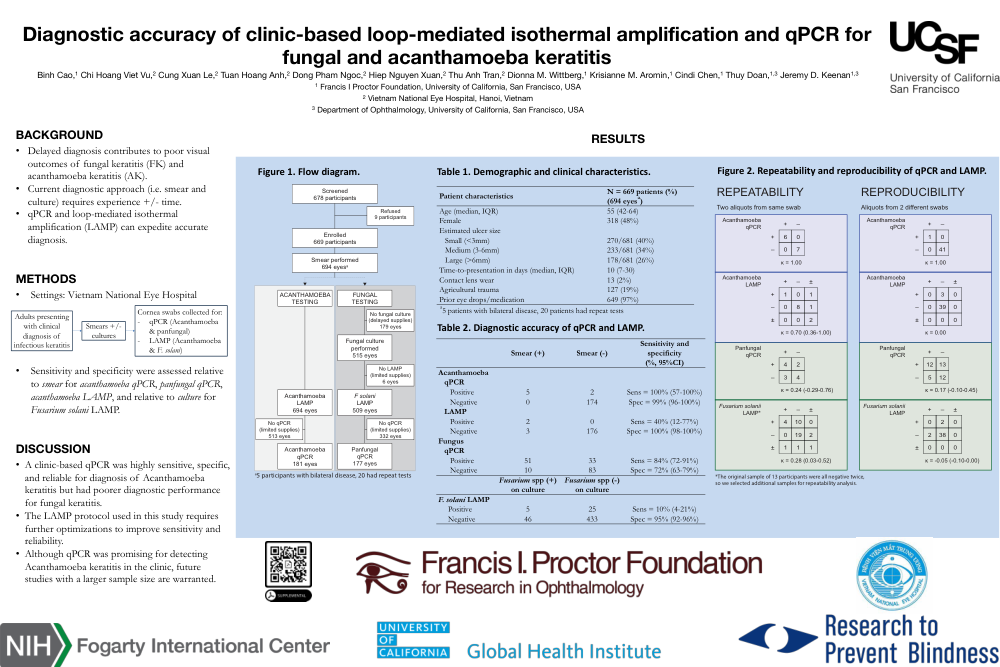
Background/Aims: Current microbiologic diagnostic paradigm (i.e. smear and culture) leads to a delay in diagnosis and thus poor visual outcomes for fungal and Acanthamoeba keratitis, especially in resource-limited settings. This study evaluated the diagnostic accuracy of loop- mediated isothermal amplification (LAMP) and quantitative PCR (qPCR) for fungal and Acanthamoeba keratitis when performed on simple clinic-based platforms.
Methods: 694 eyes from 669 patients ³18 years old diagnosed with presumed infectious keratitis at Vietnam National Eye Hospital had corneal scrapings collected. Smear was performed per routine by the microbiology laboratory. Clinic-based LAMP and qPCR testing for Acanthamoeba and fungal targets was performed by a trained technician. The diagnostic accuracy of acanthamoeba LAMP, acanthamoeba qPCR, and panfungal qPCR was assessed relative to smear; accuracy of a Fusarium solani LAMP assay was assessed relative to culture.
Results: Of 181 cornea swabs tested with LAMP and qPCR for acanthamoeba, 5 were smear- positive for acanthamoeba. Sensitivity was 40% (95%CI 12-77%) for acanthamoeba LAMP and 100% (95%CI 57-100%) for acanthamoeba qPCR, and specificities were 100% (95%CI 98-
100%) and 99% (95%CI 96-100%), respectively. Of 177 swabs tested with panfungal qPCR, 61 had a smear positive for fungus. Panfungal qPCR had a sensitivity of 84% (95%CI 72-91%) and specificity of 72% (95%CI 63-79%). Of 509 swabs tested with F. solani LAMP, 51 had a culture positive for Fusarium spp. Sensitivity for F. solani LAMP was 10% (4-21) and specificity was 95% (92-96).
Conclusions: A clinic-based qPCR was highly sensitive and specific for diagnosis of Acanthamoeba keratitis but had poorer diagnostic performance for fungal keratitis. The LAMP protocol used in this study requires optimizations to improve sensitivity and reliability.