127 posters, 10 topics, 20 sessions, 127 authors
ePostersLive by SciGen Technologies S.A. All rights reserved.
UCSF 2024 Inquiry Symposium
Conference ePosters

P102
A population-based cohort study of sodium consumption and psoriasis
Poster Presenter
Authors
Part of Topic
Population Science & Epidemiology
Abstract
Title: A population-based cohort study of sodium consumption and psoriasis
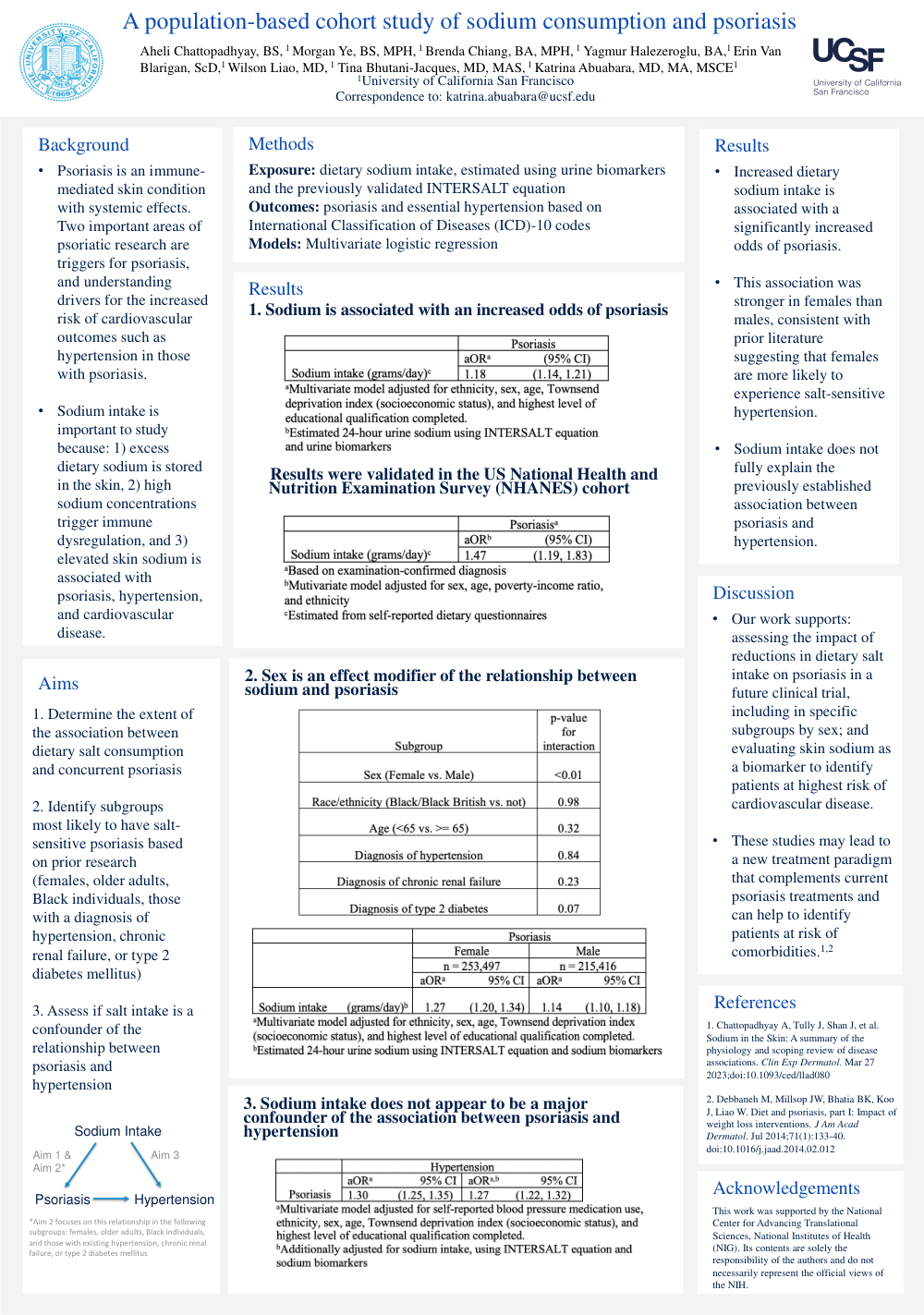
Introduction: Despite advances in new immunomodulatory treatments, a limited understanding of psoriasis triggers remains a major barrier to disease management. One possible trigger that requires further investigation is sodium intake: prior research suggests that excess dietary sodium is stored in the skin, skin sodium is elevated in patients with psoriasis compared to healthy controls, and sodium can activate inflammatory pathways involved in psoriasis pathogenesis. However, the relationship between dietary sodium and psoriasis within a large population-based sample has not been investigated.
Question/Aims: To identify whether dietary sodium intake is associated with psoriasis, and whether there are subgroups of individuals more likely to have salt-sensitive psoriasis.
Methods: This cross-sectional, population-based study evaluated a UK Biobank cohort of nearly 500,000 participants in the 2006-2010 period, and a US-based National Health and Nutrition Examination Survey (NHANES) validation cohort of 2,393 participants in the 2003-2004 period.
Dietary sodium intake, the exposure, was estimated using urine biomarkers and the previously validated INTERSALT equation. Psoriasis outcome was assessed by the presence of ICD-10 code L40.
Results: In the UK Biobank, of the 468,913 included participants, 54% were female, and mean (standard deviation) age at recruitment was 57 (8) years. Multivariable logistic regression models revealed that every 1 gram (g) increase in estimated 24-hour urine sodium was associated with an 18% increase in odds of psoriasis (OR 1.18, 95% CI: 1.14-1.21) after adjustment for sex, age, race/ethnicity, education, and socioeconomic status. Effect modification by sex was present (p<0.001); females and males had a 27% (OR: 1.27, 95% CI: 1.20-1.34) and 14% (OR: 1.14, 95% CI: 1.10-1.18) increase in adjusted odds of psoriasis, respectively, for every 1 g increase in estimated 24-hour urine sodium. In NHANES, each additional gram of self-reported dietary sodium intake was also associated with increased odds of examination-confirmed psoriasis (OR: 1.47, 95% CI: 1.19-1.83).
Conclusions: Increased sodium intake was associated with increased odds of psoriasis in two population-based cohorts. The results of this epidemiologic study support future longitudinal studies and clinical trials to assess the impact of changes in sodium intake on psoriasis.