145 posters, 12 topics, 25 sessions, 145 authors
ePostersLive by SciGen Technologies S.A. All rights reserved.
UCSF 2023 Inquiry Symposium
10 May | University of San Francisco

P098
Tissue-specific roles of ESCRT machinery component VPS25 in craniofacial morphogenesis
Poster Presenter
Authors
Part of Topic
Biomedical Sciences
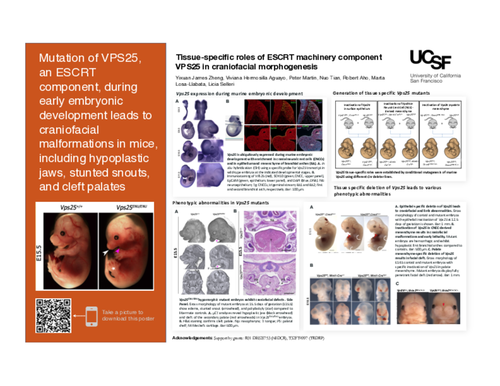
Introduction: Craniofacial defects account for one-third of all congenital abnormalities, ranging from cosmetic defects to malformations that interfere with normal functions. Using ENUinduced mutagenesis, we isolated a mouse line with craniofacial malformations characteristic of distinct human congenital syndromes. Homozygous mutant embryos harbor a hypomorphic mutation of Vps25 (Vps25ENU/ENU). Vps25 encodes a component of the ESCRT (Endosomal Sorting Complexes Required for Transport) machinery, a protein assembly required for endosomal trafficking and lysosomal degradation of activated membrane receptors. Unlike mouse lines with constitutive loss of ESCRT-encoding genes, Vps25ENU/ENU embryos exhibit late embryonic lethality, providing the first evidence for critical roles of the ESCRT machinery in craniofacial morphogenesis.
Hypothesis: The purpose of this study is to understand the roles of the ESCRT machinery component VPS25, especially with regard to craniofacial morphogenesis.
Aims: We aim to describe Vps25 expression during murine embryonic development and identify phenotypic changes to Vps25 mutant mice embryos. We aim to uncover tissue-specific roles of Vps25.
Methods: Expression of Vps25 as well as other ESCRT components was assessed by wholemount in situ hybridization (ISH) and immunofluorescence. Phenotypic changes were assessed with high resolution imaging of whole embryos, micro CT, and H&E staining of sections. Vps25 tissue-specific roles were established by conditional mutagenesis of murine Vps25 using different Cre deleter lines.
Results: ESCRT-encoding genes, including Vps25, are ubiquitously expressed during development, although enriched in head and limbs. Vps25ENU/ENU embryos display hypoplastic jaw, stunted snout, and cleft palate. Craniofacial epithelium- or mesenchyme-specific Vps25 inactivation results in dysmorphic features that partially mimic those of Vps25ENU/ENU embryos.
Discussion and Conclusion: This is the first study providing definitive evidence that ESCRT machinery plays a critical role in craniofacial morphogenesis through the use of a ENU-induced mutagenic mouse model, which allowed for observation of phenotypic changes due to late embryonic lethality. Through establishing VPS25 tissue-specific roles during craniofacial morphogenesis, this research illuminates ESCRT machinery’s obscure functions in mammalian development. Limitations include current lack of mechanistic data. Further attention should be paid toward other ESCRT components as well as investigation into the signaling pathways dependent upon ESCRT-mediated endolysosomal degradation.