145 posters, 12 topics, 25 sessions, 145 authors
ePostersLive by SciGen Technologies S.A. All rights reserved.
UCSF 2023 Inquiry Symposium
10 May | University of San Francisco

P067
Does access to an online educational resource change practice for orthopaedic surgeons in low- and middle-income countries (LMICs)?
Poster Presenter
Authors
Part of Topic
Biomedical Sciences
Introduction: Education is essential to both the initial and ongoing training of orthopaedic
surgeons around the world. Orthopaedic surgery education resources with the most
relevant information are now available online. Despite the ubiquity of the internet,
orthopaedic surgeons and trainees in many LMICs are unable to access peer-reviewed
scientific resources due to a number of barriers. This prospective study aims to evaluate
the use and impact of US-based online resources by orthopaedic surgeons and trainees
in LMICs.
Hypothesis: This study evaluates whether access to online resources improves clinical
care and outcomes among orthopaedic surgeons.
Aims: (1) Assess the current usage and perspectives of learning resources, including
offline and online resources, of orthopaedic surgeons and trainees at ten international
institutions in LMICs (2) After providing half of participants access to the Orthopaedic
Trauma Association (OTA) online learning platform for 12-months, compare participant’s
perceptions of the impact access to the OTA online learning platform had on their clinical
practice and the effectiveness of this particular learning resource.
Methods: Participants included orthopaedic surgery trainees and attendings recruited
from ten pre-selected institutions, each of which is an orthopaedic surgery residency
program with orthopaedic faculty. The study began with a 10-minute Qualtrics pre-
intervention survey sent to all participants asking them to detail their use of learning
resources and their desire for additional resources that they feel would augment their
education and help their practice. Participants were then split into two groups, separated
by institution. One group consisted of five institutions that received access to OTA Online,
which is a website tailored specifically to orthopaedic surgeons, while the other group,
also consisting of five institutions, did not receive access to this resource. We planned to
enroll a minimum of 50 voluntary participants, 25 in each of the two study groups. Access
was granted for 12-months and required the participant to register with OTA online. After
12-months, participants from both groups received another survey, sent by our research
team through the training program director and chair of department, again asking which
resources they used and which they would like to have access to. If applicable, they were
asked about their usage of OTA and its effect on their practice.
Results: 82 participants completed the pre-intervention survey. 4% (3) of the participants
were medical officers, 23% (19) were junior residents, 46% (38) were senior residents,
9% (7) were attendings with five or less years of practice, 13% (11) were attendings with
more than five years of practice, and 5% (4) identified as other. In terms of geography,
10% (8) of participants were from West Africa, 50% (41) from East Africa, 6% (5) from
Southeast Asia, and 34% (28) from Afghanistan. Participants reported digital books as
the most utilized educational resource during their medical training and at the time of
survey completion. 37% of participants said they selected educational resources based
on accessibility, while 20% said they selected resources based on quality. Online
[1] Doughty K, Rothman L, Johnston L, Le K, Wu J, Howard A. Low-income countries' orthopaedic
information needs: challenges and opportunities. Clin Orthop Relat Res. 2010 Oct;468(10):2598-603. doi:
10.1007/s11999-010-1365-x. PMID: 20431972; PMCID: PMC3049618.
resources were the most desired resources, with OTA, American Academy of
Orthopaedic Surgeons (AAOS), and full-text journal articles being the most frequently
requested. The highest ranked barriers to accessing desired resources, where a score of
1 equates to the greatest barrier, were cost (2.01), location (2.57), and internet access
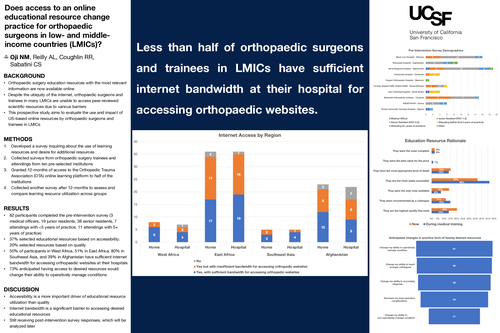
(3.83). With regards to internet access at the hospital, only 50% (4) of participants in West
Africa, 51% (19) in East Africa, 80% (4) in Southeast Asia, and 39% (9) in Afghanistan
reported having sufficient bandwidth for accessing orthopaedic websites. At home, 75%
(6) of participants in West Africa, 46% (17) in East Africa, 60% (3) in Southeast Asia, and
48% (12) in Afghanistan reported having sufficient bandwidth for accessing orthopaedic
websites. 73% (61) of participants anticipated that having access to their desired
resources would change their ability to operatively manage conditions, and 71% (60)
anticipated that access would also change their ability to teach younger colleagues. 55%
reported that having access to online resources would be strongly effective in changing
their practice. Rockwood Green Fractures in Adults/Children, Journal of Orthopaedic
Trauma (JOT), and OTA International were the most utilized OTA online components at
31% (39), 30% (38), and 19% (24) respectively.
Discussion: The results of the pre-intervention survey suggest that accessibility is a more
important driver of educational resource utilization than quality amongst orthopaedic
surgeons and trainees in LMICs. This may limit participants in these countries from
employing the most relevant practices when caring for patients. Cost, location, and
internet access are the most significant barriers to accessing desired educational
resources, which aligns with findings in a prior study evaluating orthopaedic information
needs in low income countries1 . Surprisingly, less than half of participants have reliable
enough internet at their hospital to access orthopaedic websites. This highlights the
importance of implementing technical infrastructure alongside resource access in order
to fully address the needs of orthopaedic surgeons and trainees in LMICs. Our study is
currently limited by the absence of sufficient post-intervention data to compare across the
different groups. However, participants' strong desire to access online resources,
especially the OTA online platform, and their perception that these resources will improve
their operative management and teaching abilities validates the underlying assumptions
of our intervention. We look forward to reviewing this data to enhance the delivery of
evidence-based practices to those that need it most.