145 posters, 12 topics, 25 sessions, 145 authors
ePostersLive by SciGen Technologies S.A. All rights reserved.
UCSF 2023 Inquiry Symposium
10 May | University of San Francisco

P094
Chaperone-Mediated Autophagy and Tau Accumulation in Alzheimer's Disease
Poster Presenter
Authors
Part of Topic
Biomedical Sciences
Introduction: Defective clearance of tau by neuronal autophagy has been implicated in the
accumulation of toxic forms of tau in Alzheimer’s disease (AD). A novel, endogenous activator
of chaperone-mediated autophagy (NCOR1) was identified in cell culture experiments. It is
unclear what role this endogenous CMA-modulator plays in AD.
Hypothesis: We hypothesized that loss of the NCOR1 in neurons could lead to decreased
clearance of abnormal tau monomers, promoting the accumulation of toxic forms of tau.
Aims:
Aim 1: Association between NCOR1 expression and disease stage.
Aim 2: Co-expression of neuronal tau and NCOR1.
Aim 3: Relationship between expression of NCOR1 and clinical dementia rating.
Methods
We used multiplex immunofluorescence (CMA-modulator, NeuN for neurons, 1F3C for acetyl-
tau, AT100 for phospho-tau) on tissue microarrays in postmortem brain tissue from the inferior
temporal gyrus of 17 subjects (Table 1). For each subject we quantified neurons within a gray
matter area of 7.4 - 7.6 mm2 using digital pathology. To analyze the change in percentage of
neurons positive for CMA-modulator across Braak stages, we fit a linear regression model.
Result
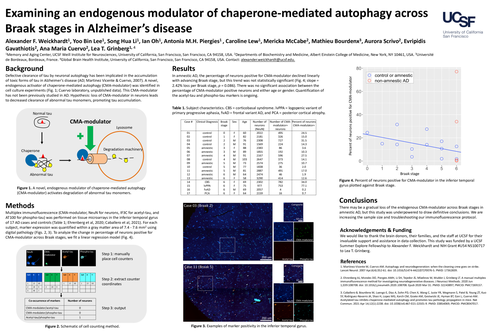
In amnestic AD, the percentage of neurons positive for CMA-modulator declined linearly with
advancing Braak stage, but this trend was not statistically significant (slope = 2.42% loss per
Braak stage, p = 0.086). The predicted percentage of positive neurons was 22.8% at Braak
stage 0 and 8.25% at Braak stage 6 and amnestic presentation. All non-amnestic cases were
Braak stage 6, and the proportion of neurons positive for the CMA-modulator varied greatly from
0.2% to 77.1%. There was no significant association between the percentage of CMA-modulator
positive neurons and either age or gender. Quantification for the acetyl-tau and phospho-tau
markers as well as clinicopathologic correlation is ongoing.
Conclusions
There may be a gradual loss of the endogenous CMA-modulator across Braak stages in
amnestic AD, but this study was underpowered to draw definitive conclusions. We are
increasing the sample size.