145 posters, 12 topics, 25 sessions, 145 authors
ePostersLive by SciGen Technologies S.A. All rights reserved.
UCSF 2023 Inquiry Symposium
10 May | University of San Francisco

P019
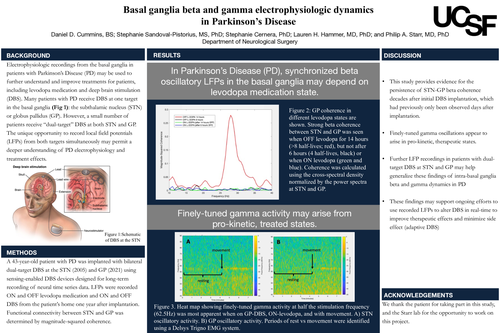
Basal ganglia beta and gamma electrophysiologic dynamics in Parkinson's Disease
Poster Presenter
Authors
Part of Topic
Biomedical Sciences
Introduction:
The subthalamic nucleus (STN) and globus pallidus (GP) of the basal ganglia are the most common targets of deep
brain stimulation (DBS) therapy for Parkinson’s Disease (PD). A body of work has explored the frequency dynamics
of local field potentials (LFPs) at either the STN and GP, revealing an apparent pathologic anti-kinetic role of beta
oscillations (13-30Hz) that may drive cardinal PD symptoms of bradykinesia and rigidity.1–3 At the same time, a
potentially pro-kinetic role of increased gamma oscillations (>40Hz) has been found within the basal ganglia and
cortex in therapeutic states of PD using both levodopa medication and DBS.4,5 Our understanding of STN-GP
coherence (a measure of synchronous oscillations between two brain structures) is limited, with only a few studies in
the perioperative state showing increased STN-GP coherence in the beta frequency range during the untreated PD
state.6 However, the intra-basal ganglia electrophysiologic dynamics between STN and GP in humans beyond the
perioperative state remains to be explored.
Hypothesis:
We hypothesize that levodopa medication and DBS, will reduce beta power and increase gamma power at both the
STN and GP. Specifically, both levodopa and DBS at either target will reduce beta oscillations at both locations.
Aims:
For local field potentials at both STN and GP:
1) Determine the effects of DBS at STN on beta and gamma dynamics.
2) Determine the effects of DBS at GP on beta and gamma dynamics.
3) Determine the effects of levodopa on beta and gamma dynamics.
Project Design:
A 43-year-old male patient with PD due to a PARK2 mutation was implanted with bilateral dual-target DBS at STN
and GP using a bidirectional implantable pulse generator capable of recording LFPs. LFPs were recorded
simultaneously from both targets ON and OFF levodopa and with single-target STN-DBS, single-target GP-DBS,
and dual-target DBS (stimulation at both STN and GP). Stimulation frequency was 125Hz at all targets to minimize
stimulation artifacts. LFPs from each target were assessed and analyzed with aperiodic signal removed.7 Beta
coherence between STN and GP were assessed in varying levodopa states.
Results:
While OFF-levodopa, dual-target DBS and STN-DBS similarly reduced beta power compared to OFF-DBS within
the STN, while GP-DBS only minimally reduced STN beta power. Within the GP, dual-target-DBS consistently
decreased GP beta power compared to OFF-DBS, however to a lesser degree than was observed in the STN. While
ON-levodopa, STN-, GP-, and dual-target-DBS had the same effect on STN beta power as observed OFF-levodopa.
In the GP however, both GP- and dual-target-DBS increased GP beta power compared to OFF-DBS, while STN-
DBS had no effect on GP beta power in the ON-levodopa state. Recordings performed 14 hours after the previous
dose of levodopa revealed robust beta coherence between the STN and GP while OFF-DBS, which was not apparent
at 6 hours from the last dose of levodopa.
STN gamma at 45-60 Hz in the OFF-levodopa state follows a similar trend as STN beta activity, with reduction in
this 45-60 Hz STN gamma in response to STN- and dual-target-DBS compared to OFF-DBS. Within the GP, clear
45-60 Hz gamma activity was not detected in any condition. In the STN, GP- and dual-target-DBS produced a fine-
tuned gamma peak at half the stimulation frequency (62.5 Hz) in the OFF-levodopa state and to a lesser degree in
the ON-levodopa state.
Discussion:
These results are the first to show GP-DBS-induced finely-tuned gamma activity in the STN. These results also
support the view that beta activity in one nucleus (STN or GP) is most sensitive to simulation within that same
nucleus. Finely-tuned gamma is generally thought of as pro-kinetic, which our work supports and, here, we show
that 45-60Hz gamma activity may play a similar anti-kinetic role as beta activity. This work is limited primarily by a
small sample size (one patient) with a limited number of repeated trials. A limitation specific to our analysis of STN-
GP coherence, is that coherence is only observed after long-periods OFF levodopa, which are not relevant
therapeutic timescales as medication doses are often taken within 4-8 hours of each other. Further LFP recordings in
patients with dual-target DBS at STN and GP may help generalize these findings of intra-basal ganglia beta and
gamma dynamics in PD. This work may potentially elucidate divergent mechanisms of GP vs STN DBS and further
shed light on the potentially superior effects of dual target DBS.
References
1. Little S, Pogosyan A, Kuhn AA, Brown P. Beta band stability over time correlates with Parkinsonian rigidity and
bradykinesia. Experimental Neurology. 2012;236(2):383-388. doi:10.1016/j.expneurol.2012.04.024
2. Little S, Brown P. The functional role of beta oscillations in Parkinson’s disease. Parkinsonism Relat Disord.
2014;20 Suppl 1:S44-48. doi:10.1016/S1353-8020(13)70013-0
3. van Wijk BCM, Neumann WJ, Schneider GH, Sander TH, Litvak V, Kühn AA. Low-beta cortico-pallidal
coherence decreases during movement and correlates with overall reaction time. NeuroImage. 2017;159:1-8.
doi:10.1016/j.neuroimage.2017.07.024
4. Swann NC, Hemptinne C de, Miocinovic S, et al. Gamma Oscillations in the Hyperkinetic State Detected with
Chronic Human Brain Recordings in Parkinson’s Disease. J Neurosci. 2016;36(24):6445-6458.
doi:10.1523/JNEUROSCI.1128-16.2016
5. Joundi RA, Jenkinson N, Brittain JS, Aziz TZ, Brown P. Driving Oscillatory Activity in the Human Cortex
Enhances Motor Performance. Current Biology. 2012;22(5):403-407. doi:10.1016/j.cub.2012.01.024
6. Brown P, Oliviero A, Mazzone P, Insola A, Tonali P, Di Lazzaro V. Dopamine dependency of oscillations between
subthalamic nucleus and pallidum in Parkinson's disease. Journal of Neuroscience. 2001 Feb 1;21(3):1033-8.
7. Donoghue T, Haller M, Peterson EJ, et al. Parameterizing neural power spectra into periodic and aperiodic
components. Nat Neurosci. 2020;23(12):1655-1665. doi:10.1038/s41593-020-00744-x