145 posters, 12 topics, 25 sessions, 145 authors
ePostersLive by SciGen Technologies S.A. All rights reserved.
UCSF 2023 Inquiry Symposium
10 May | University of San Francisco

P097
Structural Analysis of Social Medicine at ZSFG
Part of Topic
Systems Science
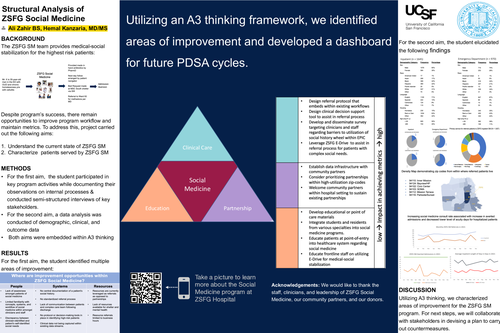
Introduction The ZSFG Social Medicine multidisciplinary team (EDSM) was launched in the ZSFG Emergency Department in 2017. The EDSM consists of multidisciplinary team and numerous partnerships. The efforts of the EDSM team center around engaging patients in their most pressing self-identified needs, supporting ED clinicians in the care with complex behavioral health and social needs, and considering how to best promote the individual patient's health and independence while preserving access to acute care for all patients (Chase et al., 2020). Since the program's inception, the EDSM team has cared for over 6,000 patients, preventing over 800 admissions and readmissions. A report from 2020 demonstrated that the EDSM team successfully reduced social admissions while increasing successful referrals to medical-social stabilization for the highest risk patients every month (Chase et al., 2020). Despite the program's success, there remain areas for improvement to address the numerous social inequities that exist within the ZSFG ED patient population and maintain the previously designated EDSM program’s targeted goals and metrics.
Aims: Aim 1. Understand the current state of Social Medicine at ZSFG Aim 2. To characterize sociodemographic and clinical characteristics of EDSM participants
Methods: The proposed study will utilize an exploratory sequential mixed-methods design within an A3-thinking framework. In this design, the initial qualitative phase will identify concepts and relationships of interest to stakeholders. These categories or relationships are then used to direct the research questions and data analysis used in the second quantitative phase Throughout both phases, the student utilized A3-thinking to identify areas of improvement and create a dashboard to organize information gleaned from both phases of the project.
Results: For the first aim, we interviewed 17 stakeholders consisting of Program leadership, care coordinators, social workers, nurses, pharmacists, inpatient medicine and emergency medicine physicians. The interviews focused on the following themes: Inquiry of existing datasets, strengths of the social medicine program, perceived gaps in social medicine care model, and challenges facing each individual or ZSFG SM as a program. Most participants were interested in understanding more about outcomes data and demographic and clinical characterization of the patient population. The areas of improvement identified were stratified into those involving people, systems, and resources. Those areas of improvement concerning people included: Lack of awareness amongst patients of social medicine, limited familiarity with concepts, systems, and workflow of social medicine within amongst clinicians and staff, discrepancy between clinician- identified and patient’s self-identified social needs. Those areas if improvement concerning systems included: no central docuementation of social history, no standardized referral process, and lack of communication between patients and complex care team following discharge. Areas of improvement concerning resources included: lack of resources avialalbe for shelter and mental health, resources limited to only being available during business hours. The program strengths were centered on the multidisciplinary care model, efficient resource utilization, and leadership. For the second aim, we analyzed a dataset of patients referred to social medicine in the emergency department (N=970) and inpatient setting (n= 1645) for the year 2021. We found that patients evaluated in the ED were more likely to identify as Black, Homeless, were overall younger and/or had higher rates of substance use in comparison to the population in the inpatient setting. The most common referring services inpatient setting were internal medicine, family medicine, orthopedic surgery, and trauma surgery. Patients being referred to the social medicine program were more likely to live in Bayview Hunter’s Point, Outer Mission, SOMA, and Parkside. There was limited clinical data available for patients, but the most common diagnostic codes of patient’s referred to social medicine were altered mental status, falls, shortness of breath, seizure, ischemic stroke, failure to thrive, sepsis, and skin and soft tissue infection. For outcomes data, we found that increasing social medicine consult rate was associated with an in increase in averted admission and decreased lower level of acuity for hospitalized patients (B= 0.4, p= 0.03). Considering the above findings, we developed a dashboard that centered around providing countermeasures centered around clinical care, education, and community partnership.
Discussion In this current analysis of a program aimed at addressing health disparities and reducing social admissions for among the most vulnerable patients within the ZSFG system we elucidated several findings. Through the first aim, we highlighted the strengths of the program while also discovering multiple areas of improvement for ensuring continual performance of the program. These areas of improvement concerned those involving people, systems, and resources. In the second aim, we uncovered unique clinical and demographic characteristics regarding both the inpatient and emergency department patients referred to social medicine. Given these distinct characteristics we recommended targeted countermeasures.