145 posters, 12 topics, 25 sessions, 145 authors
ePostersLive by SciGen Technologies S.A. All rights reserved.
UCSF 2023 Inquiry Symposium
10 May | University of San Francisco

P030
A novel electronic handoff tool in ICU-to-ward transitions of care: A pre-implementation exploration of barriers and facilitators.
Poster Presenter
Authors
Part of Topic
Systems Science
Introduction:
The transition of a patient from the intensive care unit (ICU) to the inpatient ward is inherently
high-risk due to diagnostic complexity, reduced monitoring capacity, and changes in clinical care
teams. The period after transfer has been associated with adverse events due to the
miscommunication or omission of essential information. Standardized handoff practices have
been shown to reduce communication errors and adverse events in other clinical environments
(Starmer et al, 2014), but are understudied at the ICU-ward interface. We previously developed
an electronic ICU-ward transfer tool (ICU-PAUSE) that embeds a diagnostic pause to facilitate a
safe transfer of care at ICU discharge (Santhosh et al, 2022). Between April 2022 and September
2022, ten academic medical centers were recruited to implement the ICU-PAUSE tool at their
institution. This study aims to assess the perceived barriers and facilitators to ICU-PAUSE
implementation.
Aims:
This study aims to explore perceptions of ICU-PAUSE among intensivists prior to
implementation efforts at geographically diverse academic medical centers.
Methods:
This is a multi-center qualitative study of semi-structured interviews with intensivists from ten
academic medical centers. All participants are attending physicians in the medical ICU setting.
Semi-structured interviews were conducted via videoconference and included five open-ended
questions related to specific areas of interest: (1) background and current handoff activities, (2)
perceived usefulness of the ICU-PAUSE tool, (3) resource needs and constraints, and (4) barriers
to and facilitators for implementation. The Sittig-Singh sociotechnical model was employed as
an underlying theoretical framework for thematic analysis. This model includes eight
interconnected dimensions along which to assess health information technologies (Sittig and
Singh, 2010). Interview transcripts were analyzed through an iterative process consistent with
grounded theory methods. Excerpts of relevant quotations were extracted to highlight the themes.
Results:
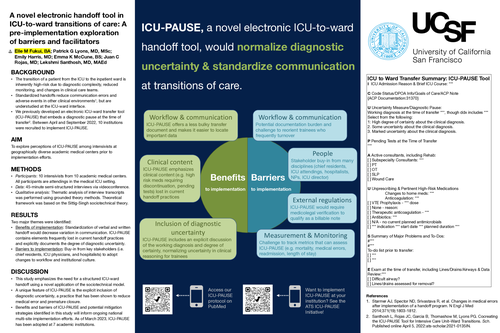
We identified major benefits and barriers to potential implementation. Participants agreed that
the standardization of verbal and written handoff with ICU-PAUSE would decrease variation in
the communication of important information. The clinical content of ICU-PAUSE was
recognized as a key benefit, particularly the incorporation of diagnostic uncertainty. The main
barriers to implementation fell within the domains of workflow, institutional culture, people,
measurement, and assessment. Participants recognized the need for buy-in from key stakeholders
to overcome the perceived barriers.
Discussion and Conclusion:
This study demonstrates a novel application of the Sittig-Singh model in the assessment of an
electronic handoff tool in the ICU-to-ward transition. Consistent with existing literature, the
findings emphasize the need for a structured ICU-ward handoff process and the challenges to
practically implement such a tool in the ICU setting. A unique feature of ICU-PAUSE is the
explicit acknowledgement of diagnostic uncertainty, a practice that has been shown to reduce
medical error and prevent premature closure. The benefits and barriers to ICU-PAUSE
implementation and potential mitigation strategies identified in this study will inform ongoing
national multi-site implementation efforts. As of March 2023, ICU-PAUSE has been adopted
into the ICU transfer workflow at seven academic institutions, with nine additional sites
intending to implement ICU-PAUSE.