145 posters, 12 topics, 25 sessions, 145 authors
ePostersLive by SciGen Technologies S.A. All rights reserved.
UCSF 2023 Inquiry Symposium
10 May | University of San Francisco

P041
Assessing perceived competence in and incorporation of gender and trans-inclusive and affirming care at Zuckerberg San Francisco General Hospital's Obstetrics, Midwifery, and Gynecology clinic
Poster Presenter
Authors
Part of Topic
Systems Science
Introduction:
There is ample evidence that gender diverse individuals experience discrimination in health care settings.
Obstetrics and gynecology (ObGyn) settings have unique features that contribute to discrimination. For
example, ObGyn care is often referred to as “women’s health”, research in the field has centered cis-
women, and reproductive health screening needs are often assumed based on gender presentation. Studies
have also demonstrated that providers have knowledge gaps when providing transgender men and gender
non-binary individuals contraceptive or pregnancy care. Lastly, medical training programs have been
shown to underprepare trainees to serve transgender patients.
Aims:
This project aimed to do the following at Zuckerberg San Francisco General Hospital’s Obstetrics,
Midwifery, and Gynecology (ZSFGH’s OMG) clinic: (1) describe providers’ and staff’s perceived
importance of and perceived competence in providing gender and trans-inclusive care and (2) assess
clinicians’ perspectives on importance of including gender and trans-inclusive and affirming care skills at
ZSFGH’s OMG clinic and within their own scope of practice at the clinic.
Methods:
We recruited clinicians and staff that interact directly with patients at ZSFGH’s OMG clinic between
November and December 2022. We emailed 125 eligible individuals to participate and placed flyers in
the clinic. Interested participants completed a demographic survey and a comprehensive survey covering
domains of gender inclusive and affirming care, including language use, discussing care options, and
procedural skills. We performed descriptive analyses using Stata.
Results:
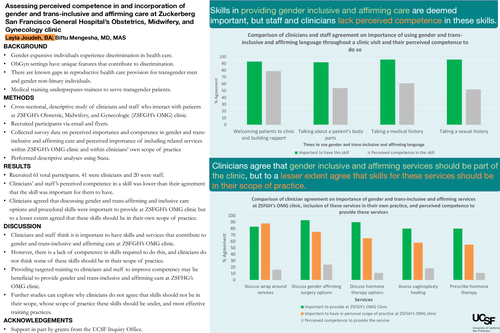
We recruited 61 participants, of which 41 were clinicians and 20 were staff. Clinicians’ perceived
competence in a skill was lower than their agreement that the skill was important for them to have. For
example, most participants agreed that it was important to use inclusive and affirming language when
welcoming patients and building rapport with them (n=57, 93%), talking about body parts (n=56, 92%),
and conducting a medical (n=55, 96%) and sexual history (n=52, 96%). However, fewer participants had
competency in these skills, with respective competence for those skills being 79% (n=48), 54% (n=33),
61% (n=35), 52% (n=28). Clinicians also agreed that discussing care options and procedural skills are
important to provide at ZSFGH’s OMG clinic but to a lesser extent agreed that these skills should be in
their own scope of practice. For example, 80% (n=32) of clinicians thought it was important for the clinic
to have the capacity to assess vaginoplasty healing, while only 58% (n=23) found it important to have this
skill in their scope of practice.
Conclusion:
The study highlights that while clinicians and staff think skills in providing gender and trans-inclusive
and affirming care are important, they do not have perceived competence to perform these skills.
Furthermore, while some clinicians perceive certain skills as being important to have at ZSFG’s OMG
clinic, they do not necessarily think it should be in their scope of practice. Our results provide evidence
that providing targeted training to clinicians and staff to improve competency may be beneficial to
provide gender and trans-inclusive and affirming care at ZSFHG’s OMG clinic. The limitation of this
project is that we did not assess why people did not feel competent or what professional development
activities participants have already participated in, which could contribute to more targeted interventions.