145 posters, 12 topics, 25 sessions, 145 authors
ePostersLive by SciGen Technologies S.A. All rights reserved.
UCSF 2023 Inquiry Symposium
10 May | University of San Francisco

P010
Disparities in Patients who Leave Without Being Seen from the UCSF Parnassus Emergency Department
Poster Presenter
Authors
Part of Topic
Systems Science
Introduction. Patients who present to the Emergency Department (ED) but Leave Without
Being Seen (LWBS) are at risk for adverse outcomes. Nationwide, 2% 1 of patients triaged by a
hospital’s ED LWBS, though county hospitals and large academic institutions in metropolitan
areas report LWBS rates of up to 10% 2
. One oft-cited explanation is that LWBS patients are
appropriately self-triaging non-urgent complaints in the face of long wait times, however studies
show that up to 70% 3 of these patients seek further medical attention and 15% return to the ED
within a week 4
. LWBS patients represent a population of concern.
Hypothesis/Question. Does leaving without being seen (LWBS) disproportionately impact
specific demographic subsets of ED patients?
Aims. This study seeks to characterize the LWBS patient population at UCSF and identify
groups of patients that are most likely to LWBS.
Methods. We conducted a cross-sectional, retrospective review of all adult patient visits at the
UCSF Parnassus ED from 2017-2021. Demographic and clinical data were extracted from the
electronic medical record, and patients were classified as seen or LWBS. We used chi-squared
tests to compare LWBS patients by race/ethnicity (selected by patients upon registration),
language, expected payor, and estimated severity index (ESI) assigned at triage.
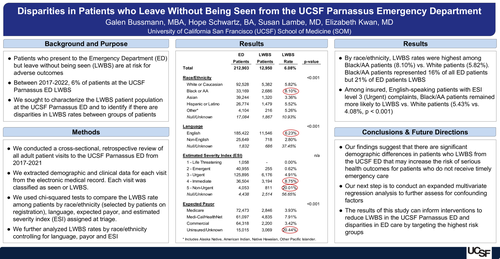
Results. From 2017 to 2021, 212,903 patients presented to the ED and 12,950 (6.08%) LWBS.
By race, Black patients were most likely to LWBS (8.10%) vs. White (5.82%), Hispanic/Latino
(5.52%) or Asian (3.36%) patients. English-speaking patients were most likely to LWBS
compared to non-English speaking patients (6.23% vs 2.80%). By payor, Uninsured/Unknown
patients were most likely to LWBS (20.44%), followed by Medi-Cal (7.91%), Medicare (3.93%)
and commercially-insured patients (3.42%). By ESI, LWBS rates increased as acuity of
complaint decreased, with 0.00% of ESI 1 (life-threatening) patients LWBS compared with
4.91% of ESI 3 (urgent) and 20.01% of ESI 5 (non-urgent) patients. We performed sensitivity
analyses excluding patients with missing demographic data, which did not change the
significance of our results. Given the difference observed in LWBS rate by Race/Ethnicity, we
analyzed LWBS by Race/Ethnicity controlling for language, payor and ESI. Among English-
speaking patients with ESI level 3 (Urgent) who did not have Uninsured/Unknown payor, Black
patients remained more likely to LWBS vs. White patients (5.43% vs. 4.08%, p < 0.001).
Discussion/Conclusions. Our study demonstrates significant demographic differences in
patients who LWBS from the UCSF Health Adult ED, which might increase the risk of serious
health outcomes for patients who do not receive timely emergency care. Our next step is to
conduct an expanded multivariate regression analysis to further assess for confounding factors.
The results of this study can inform interventions to reduce LWBS in the UCSF ED and
disparities in ED care by targeting the highest-risk groups.
References
1. Timely & effective care | Provider Data Catalog. Accessed March 17, 2022.
https://data.cms.gov/provider-data/topics/hospitals/timely-effective-care#emergency-
department-care
2. Rathlev NK, Visintainer P, Schmidt J, Hettler J, Albert V, Li H. Patient Characteristics and
Clinical Process Predictors of Patients Leaving Without Being Seen from the Emergency
Department. West J Emerg Med. 2020;21(5):1218-1226. doi:10.5811/westjem.2020.6.47084
3. Li DR, Brennan JJ, Kreshak AA, Castillo EM, Vilke GM. Patients Who Leave the Emergency
Department Without Being Seen and Their Follow-Up Behavior: A Retrospective Descriptive
Analysis. J Emerg Med. 2019;57(1):106-113. doi:10.1016/j.jemermed.2019.03.051
4. D K, Wolfe Richard, D’Onofrio Gail, et al. Emergency Department Crowding: The Canary in
the Health Care System. NEJM Catal Innov Care Deliv. Published online September 28,
2021. Accessed March 17, 2022. https://catalyst.nejm.org/doi/full/10.1056/CAT.21.0217