145 posters, 12 topics, 25 sessions, 145 authors
ePostersLive by SciGen Technologies S.A. All rights reserved.
UCSF 2023 Inquiry Symposium
10 May | University of San Francisco

P047
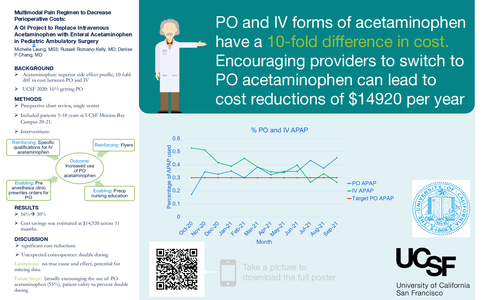
Multimodal Pain Regimen to Decrease Perioperative Costs: A Quality Improvement Project to Replace Intravenous Acetaminophen with Enteral Acetaminophen in Pediatric Ambulatory Surgery
Poster Presenter
Authors
Part of Topic
Systems Science
Introduction:
Acetaminophen is a favored non-opioid analgesic given its superior side effect profile to opioids.
Both enteral and parenteral formulations are available with no clinical difference in efficacy in
both the adult and pediatric population, but a 10-fold difference in cost where enteral
acetaminophen is significantly less expensive. Barriers to utilizing oral acetaminophen for
perioperative pain control may include provider time constraints, lack of access to enteral
formulations, and patient refusal. An initial analysis at a single academic healthcare institution in
summer 2020 found that only 16% of patients undergoing scheduled elective ambulatory surgery
received enteral acetaminophen in the perioperative period. A multimodal perioperative pain
regimen utilizing PO acetaminophen in place of IV acetaminophen thus represents a significant
cost reduction to the aforementioned healthcare system.
Aims:
The goals of this project were to reduce costs with a multimodal pain control regimen by
reaching 30% PO acetaminophen administration.
Study Design:
Members of the pediatric anesthesia department at the UCSF Mission Bay hospital performed a
single center prospective chart review to study the effect of several interventions. The
investigators developed a protocol for the use of enteral acetaminophen for perioperative pain
management in pediatric ambulatory surgery. This protocol included: 1) targeting providers in
pre-anesthesia clinic to write day of surgery orders for enteral acetaminophen to be administered
by the pre-operative nurse on the day of surgery 2) attempting to reserve intravenous
acetaminophen for select patients 3) encouraging providers to use enteral acetaminophen via
flyers, and 4) preoperative nursing education for this new workflow. The protocol included
patients 5 to 18 years of age receiving ambulatory surgery at the studied hospital from October
2020 to September 2021. Data was collected from the electronic medical record and medicine
administration record and analyzed using Excel. Usage of enteral and parenteral formulations
were assessed from pharmacy records for every month during the study period.
Population Studied:
Inclusion criteria included 2,895 patients from the ages of 5 to 18 presenting for ambulatory
surgery at the studied single center pediatric hospital during the period of October 2020 to
September 2021.
Results:
Monthly oral acetaminophen administration was increased to above 30% in elective ambulatory
pediatric surgeries post-protocol implementation from a baseline of 16%. The proportion of
enteral acetaminophen used was approximately 45% of all perioperatively administered doses
within the inclusion criteria. Cost savings was estimated at $14,920 across 11 months.
Conclusion/implications for practice:
Encouraging anesthesia providers to use enteral acetaminophen, when possible, for perioperative
pain management significantly cuts down healthcare costs for the patient and hospital system.
Our program demonstrates that pediatric anesthesia providers are uniquely positioned to make
medication choices that can achieve cost reductions of up to $687,000 per year. Given this is a
prospective chart review, a limitation is that there is no true cause and effect, and potential for
missing data. The next steps in expanding this project might include broadly encouraging the use
of perioperative enteral acetaminophen over parenteral acetaminophen, for a goal of 50%
administration of the enteral formulation, or an estimated cost savings of $24,866. Switching to
enteral acetaminophen from intravenous acetaminophen is a practice that can also be more
broadly applied to patient populations and result in significant cost reductions.