145 posters, 12 topics, 25 sessions, 145 authors
ePostersLive by SciGen Technologies S.A. All rights reserved.
UCSF 2023 Inquiry Symposium
10 May | University of San Francisco

P008
Palliative Care for People living with Dementia and Their Caregivers: Needs, Challenges, and Ideas to Improve Care
Poster Presenter
Authors
Part of Topic
Social & Behavioral Sciences
Introduction: Dementia syndromes are progressive, degenerative conditions that often pose significant challenges to patients and their loved ones. Several studies conducted with care partners and providers suggest patients and their loved ones would benefit from greater and earlier access to palliative care. Recently, the UCSF Memory and Aging Center, UCSF Division of Palliative Care, and UCSF Division of Geriatrics have been working to build out palliative care services for this population.
Questions: (1) How is UCSF palliative care positively or negatively impacting patients living with dementia (PLWD) and their care partners, and how we can improve the care we provide? (2) What are the educational, structural, and socioemotional needs of palliative care providers with respect to caring for PLWD?
Aims: (1) To evaluate the impact of care provided by the UCSF palliative care service on patients living with dementia and their loved ones and (2) to assess the needs of interdisciplinary palliative care providers caring for this population to identify opportunities to improve care.
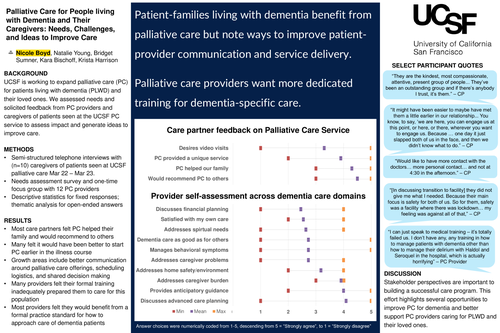
Project Design: We conducted qualitative telephone interviews with care partners of people living with dementia (PLWD) seen by the outpatient UCSF palliative care service between March 2022 to March 2023 for the primary concern of dementia or dementia-related symptoms (n=10). Participants were asked a mix of structured, Likert-style questions about the impact of palliative care as well as semi-structured questions soliciting feedback about the service. We also conducted an anonymous 13-item needs assessment with 12 interdisciplinary palliative care providers, followed by a one-time focus group via zoom to discuss the questions and view aggregate responses. With both study populations, fixed responses and demographics were analyzed using descriptive statistics. Open-ended items were analyzed using thematic content analysis.
Results: Care Partners We screened 46 patients with palliative care referrals for neurologic conditions, 29 of whom were eligible to participate. Main reasons for screen fail included patients that were referred but never seen (n=9) and patients that were deceased and out of window (n=4). We contacted care partners of all eligible patients by phone and were able to reach 13, ten of whom consented to participate. The average age of participant was 67 and most were primarily English speaking (90%). About half identified as female (60%) and/or identified as a race other than Non-Hispanic White (40%). The majority (70%) were spouses to the PLWD, while the remainder were other family members. The majority (70%) live with the PLWD and many currently work full time (40%). Most participants endorsed ongoing financial stress (90%). The mean number of visits with an interdisciplinary PC provider was 5.4 (range 2-20). Four participants cared for loved ones with a MCI, Alzheimer Disease, or an unspecified dementia; two for patients with Parkinson Disease Dementia or Lewy Body Dementia, two with PSP, and two with primary progressive aphasia. Participants felt that care provided by the Palliative Care Service helped their family feel more supported to cope with their loved one's illness. (average response of 4.3 on a scale of 1- 5, descending from 5 = “strongly agree” to 1 = “strongly disagree”, minimum response 3, or neutral). Most also strongly felt they would recommend palliative care to other families coping with a serious illness (average 4.5, minimum response 3). Some disagreed that the palliative care service provided care not otherwise available to them, however (n=2). Participants were most mixed about whether they would like to continue palliative care with video visits (average 3.3), with two participants disagreeing or strongly disagreeing while the remaining agreed or strongly agreed (n=4). Many felt it would have been better to start PC earlier in the illness course. Other suggestions included offering a greater variety of in-person visit options, better communication around what palliative care is and what it offers, and more support and partnership around care partners making decisions against the recommendations of the palliative care team. Some examples of this included care partners feeling the team was disappointed or not supportive of the care partner’s decision to transition to local care or decline the PC team’s recommendation to transition loved one to a facility.
Results: Providers The focus group discussion was attended by 12 interdisciplinary PC providers, seven of whom completed the survey pre-session, and two after the discussion concluded. Two additional providers opened the survey but did not complete it. Some providers felt uncomfortable with dementia-specific needs, such as managing behavioral issues in the context of cognitive decline, providing meaningful support to patients with advanced dementia, or navigating financial challenges unique to dementia. Some also acknowledged feeling overwhelmed and inadequate in the face of patient-family needs, which often seemed “insurmountable”. Many providers felt their formal training inadequately prepared them to care for this population: “I can just speak to medical training – it’s totally failed us. I don’t have any, any training in how to manage patients with dementia other than how to manage their delirium with Haldol and Seroquel in the hospital, which is actually horrifying.” The domains in which providers most felt they would benefit from additional training were: behavior management, caregiver support, disease-specific guidance and prognostication, and diseasespecific resources and assessments. Most participants (n=10) felt some sort of formal practice standard for how to approach care of these patients would be beneficial.
Discussion: The results of this study serve to enrich our understanding of the palliative care landscape for PLWD and their care partners, as well as providers. The finding that many patient-families benefit from PC services and would actually benefit from earlier palliative care intervention was expected, and having additional evidence to support that need in our population can be used to advocate for greater funding and support for the ongoing neuropalliative care initiative. Similarly expected was the finding that providers feel their training is inadequate and would benefit from greater training and formalized practice standards. The details from this study provide a crucial foundation on which to beginning building out those resources for providers and patients. What the research team had not anticipated was the finding that some care partners felt communication around difficult decisions, such as when to transition to a facility, sometimes left the care partner feeling unsupported. These findings, as well as the other ways in which care partners felt their care with the PC service could be improved, provides an important blueprint for items that would benefit from targeted intervention. There were several limitations of this study, including the single, specific population served by UCSF, as practice variations and demographic differences against this Bay Area population may limit generalizability. Not all care partners were reachable by phone, and the study may have selected for participants who were more positively disposed toward the service and therefore more wiling to participate. We also only had one participant who is primarily nonEnglish speaking, which limited our ability to assess whether we are meeting the needs of similar patient-families. Future avenues for research include collecting patient as well as additional care partner perspectives, with a focus on non-English and historically marginalized patients, as well as the development of targeted interventions aimed at addressing the gaps identified in this work.