145 posters, 12 topics, 25 sessions, 145 authors
ePostersLive by SciGen Technologies S.A. All rights reserved.
UCSF 2023 Inquiry Symposium
10 May | University of San Francisco

P004
Exploring Patient Activation through Photovoice and Photo-Sharing in the Primary Care Setting among Older Adults with Multiple Chronic Conditions and Food Insecurity
Poster Presenter
Authors
Part of Topic
Social & Behavioral Sciences
Introduction
Older adults with multiple chronic conditions (MCC), which is defined as a diagnosis of two or more
chronic diseases, tend to have worse health outcomes, including higher rates of hospitalizations, adverse
drug events, disability, and mortality. Improving patient activation (PA), which is the knowledge, skills,
beliefs, and behaviors a patient needs to manage their chronic conditions, has been linked with improved
health outcomes such as normal clinical measurements (i.e. hemoglobin A1c, cholesterol, and body mass
index (BMI)) as well as higher engagement in preventative behaviors, adherence to treatment regimens,
and participation in self-management skills. Health coaching and goal setting are some of the approaches
used to improve PA; however, few of these methods directly consider the complexities of patients’ lives,
such as socio-economic, cultural, and environmental factors. Photovoice is a community based
participatory methodology where individuals share photos of their lived experience, enabling a unique
insight into one’s narrative, health behavior, and socioeconomic factors. Implementation of Photovoice
components into the clinical setting where patients share health-related photos they have taken with their
primary clinician, has been shown to be feasible and acceptable and could help promote PA while also
eliciting the social and medical complexities that influence patient care plans.
Purpose
To explore facets of PA in older adults with medical and social complexity through Photovoice and a
photo-based communication intervention in the primary care setting by conducting a secondary
qualitative analysis using data from a parent study focused on older adults with MCC and food insecurity.
Aims
The goals of the project were in a cohort of patients to (a) examine narratives of PA in Photovoice-guided
interviews (b) explore narratives of PA in audio-recorded primary care visits in which photos were shared
by patients with their primary clinicians followed by separate exit interviews with patient and their
primary clinician; and (c) explore how photos taken by patients could depict and support PA.
Project Design
Participants were recruited from a telephone survey focused on MCC and food insecurity at an urban
academic primary care practice. Inclusion criteria for participants included (1) age 60 years or older (2)
spoke English, Cantonese, Mandarin, or Spanish (3) diagnosed with at least two chronic conditions from
the Elixhauser Comorbidity Index (4) a U.S. Adult Food Security Survey Model (FSSM) 10-item score of
1 or higher (5) able to use a disposable camera or smart phone and (6) had at least one primary care visit
at the clinic site in the past 12 months. Participants were trained to take photos with their smartphone or
on the provided disposable camera. They were instructed to take 1-2 photos over 7-14 days based on the
prompt “What aspects of your everyday life affect what you eat and how much you have to eat?” Patients
then shared the photos and discussed them with a research assistant to complete the Photovoice-guided
interview. Patients then shared the same photos with their primary clinician at an audio-recorded clinic
visit followed by separate semi-structured audio-recorded interviews with patient and primary clinician.
The interviews and clinical encounters were transcribed verbatim and translated, if necessary. With a
constructivist-grounded theory approach, the transcripts were reviewed to identify parts of the discussion
related to PA. Photos shared during the Photovoice-guided interview and the clinic visit were identified
and analyzed using a two-step systematic process developed by our team to code the foreground and
background for visual depictions related to PA. The photos and transcripts were assigned codes using a
qualitative data analysis software called Dedoose. A codebook with definitions was developed after
reviewing the codes to find themes related to PA. The transcripts and photos were iteratively reviewed
and discussed with the research team until no new themes were identified.
Results
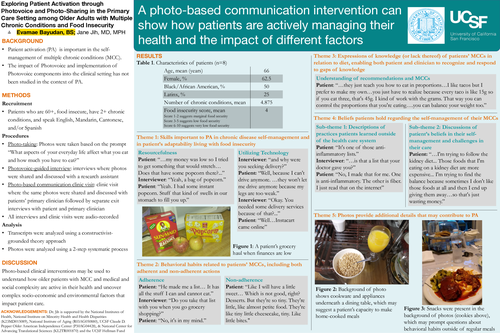
A total of eight patients completed the study activities. Of the eight patients, one patient did not complete
the photo-based clinical intervention with their primary clinician on the audio recording. The mean age
was 66 years old (standard deviation: 3.4) and 62.5% identified as female. Fifty percent of patients
identified as Black/African American and 25% identified as Latinx. The most common language spoken
at home was English (87.5%) followed by Spanish (12.5%). Five patients reported being retired while
three reported to be disabled. Of all the patients, 62.5% had 2-4 MCCs, 25% had 5-7 MCCs, and 12.5%
had 8-10 MCCs. The most common chronic conditions were hypertension (87.5%), cancer (50%), obesity
(50%), diabetes (37.5%), and liver disease (37.5%). Among the patients, 37.5% reported marginal food
security, 37.5% reported low food security, and 25% reported very low food security. Half of the patients
reported living alone and half of patients also reported a household income less than $20,000.
While analyzing transcripts of the Photovoice guided interview, clinic visit, and exit interviews, we
identified different aspects of PA, specifically coding for themes of knowledge, skills, beliefs, and
behaviors. In terms of skills, patients demonstrated the different ways in which being food insecure and
having MCC impact their lives and the skills they developed to adapt to their situation. Common skills
that were demonstrated include resourcefulness, self-discipline, planning ahead, utilizing technology, and
accessing community programs. Regarding the category of behaviors, patients described habits they
developed in relation to diet and their MCCs. Most patients described behaviors that were adherent to the
recommendations made by their primary clinician. However, some patients described actions that did not
follow their clinician’s suggestions such as having larger meals portions, getting food at restaurants, or
eating foods not on their diet list. This enabled some primary clinicians to assess the patient’s nutritional
intake and tailor their recommendations based on the context of the discussion. In the theme of
knowledge, patients discussed their understanding of their MCC in relation to diet. These discussions
have allowed both parties to identify gaps in a patient’s knowledge, giving patients a chance to ask
specific dietary questions. Some providers took this opportunity to address questions and share
educational information with the patient. In regard to beliefs, patients shared practices they believed were
healthy or unhealthy based on information they gathered on their own from word-of-mouth or online
research. Patients also shared their beliefs in their care and evaluated their progress managing their MCC.
Some patients ended up making suggestions themselves for the next steps in their care. For other patients,
there was further dialogue into the challenges of managing their MCCs, such as financial constraints,
limiting health conditions, and social situations.
While the analysis of the photos did not directly show facets of PA, it shared additional insights into
patients’ lives that may contribute to PA. For instance, although it was not a topic of discussion during the
interviews or clinic visits, a variety of snack foods were present in the background of many photos. This
may indicate behavioral habits outside of regular meals. In addition, many photos showed patients’
kitchen spaces, cookware, and appliances, demonstrating a patient’s capacity (or lack thereof) to make
home-cooked meals. Lastly, photos depicting free meal delivery services or off-brand grocery items can
give insight into a patient’s financial situation.
Conclusion
This study demonstrated photo-sharing as a potential tool to better understand how older patients with
MCC and food insecurity engage in their care and to uncover the complex socio-economic and
environmental factors that relate to patient care. While discussions can directly assess for PA, the photos
can add additional insights that may prompt further dialogue and contribute to patient-provider
communication. Limitations include a small sample size, a solo and secondary analysis, and the lack of a
formal measurement of PA. Further studies may consider the use of photo-sharing to increase patient
activation or explore this intervention in different aspects of patients’ lives such as medication
management and home environment.