145 posters, 12 topics, 25 sessions, 145 authors
ePostersLive by SciGen Technologies S.A. All rights reserved.
UCSF 2023 Inquiry Symposium
10 May | University of San Francisco

P014
Pregnant People's Behaviors and Perspectives Surrounding Wildfire Smoke
Poster Presenter
Authors
Part of Topic
Social & Behavioral Sciences
Introduction: In just California in 2021, 7,396 wildfires burned over 2.5 million acres of land.1 Wildfires threaten human health through fire-related injuries, loss of life and property, and exposure to smoke containing toxic gases, volatile compounds, and particulate matter (PM).3 Due to exacerbation of climate change, wildfires are a growing, important health hazard. Pregnant people are even more vulnerable to the effects of wildfire smoke due to several physiological changes such as increased respiratory rate, cardiac output, and physiologic stress on the body. From our knowledge, there is currently no literature on what behavioral changes pregnant people undertake during a wildfire and scarce literature on the interventions that pregnant people can use during wildfires, how well these interventions work, and what information pregnant people want regarding their health and wildfires.
Aim: To elucidate pregnant people’s behavioral modifications during wildfires, perspectives on wildfire smoke effects on pregnancy, and priorities regarding wildfire safety and information.
Project Design: In this prospective cohort study, we enrolled English or Spanish-speaking pregnant people potentially exposed to the 2021 California Caldor fire who delivered at UCSF from December 2021 to May 2022. Active smokers and multiple gestations were excluded. Participants were surveyed about their experience with wildfires at 3 times during pregnancy and after delivery using Redcap. Percentages and other analyses were calculated using StataMP (version 16) to better visualize and compare data.
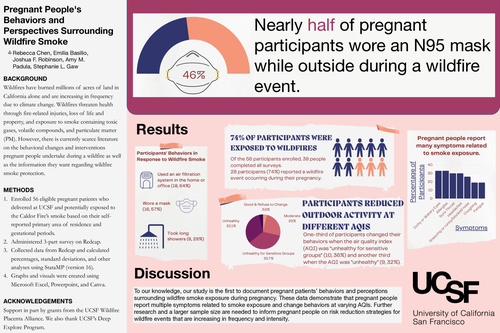
Results: Of the 56 participants enrolled, 38 people completed all surveys. 28 participants (74%) reported a wildfire event occurring during their pregnancy. One third of participants changed their behaviors when the air quality index (AQI) was “unhealthy for sensitive groups” (10, 36%) and another third when the AQI was “unhealthy” (9, 32%). Participants reduced outdoor activity in response to wildfires by mean 1.8 days ± 1.7 (SD). Others used an air filtration system in the home/office (18, 64%), wore a mask (16, 57%), and/or took long showers (8, 29%). Nearly half of participants wore an N95 mask (12, 46%) while outside during wildfire events. Symptoms included: itchy/watery eyes and allergies by 32% (9); sore throat and headaches by 29% (8); and, sneezing or a runny/blocked nose by 25% (7). The majority of participants wanted more information on how to protect their children from wildfire smoke (21, 78%), wildfire smoke’s potential health risks to themselves (15, 56%), and more information about neighborhood air quality (17, 61%).
Discussion and Conclusions: To our knowledge, our study is the first to document pregnant patients’ behaviors and perceptions surrounding wildfire smoke exposure during pregnancy. These data demonstrate that pregnant people report multiple symptoms related to smoke exposure and desire more knowledge on how to protect themselves and their children from wildfire smoke. A major limitation of this study was the skewed and small sample of patients. Further research is needed to elucidate the causes of wildfire smoke protection knowledge gaps and inform pregnant people on risk reduction strategies for wildfire events that are increasing in frequency and intensity.