145 posters, 12 topics, 25 sessions, 145 authors
ePostersLive by SciGen Technologies S.A. All rights reserved.
UCSF 2023 Inquiry Symposium
10 May | University of San Francisco

P021
The Carceral Health Context and it’s Implications on the Provider- Patient Relationship: A Case Study of OB/GYN Care in California Women’s Prisons
Poster Presenter
Authors
Part of Topic
Social & Behavioral Sciences
Introduction & Aim: There is a longstanding history of medical negligence and substandard care in prisons and jails in the U.S resulting in excess morbidity and mortality. California is no exception and in fact has been at the center of several scandals including the discovery of 144 forced sterilizations within California women’s prisons between 2005-2013 despite explicit legislation at the time banning sterilizing procedures. This figure does not account for the dozens of women who had sterilizing procedures with incomplete or incorrect informed consent documentation, further highlighting the potential scale of medical negligence and unethical care. Research on healthcare in women’s prisons is limited and has rarely focused on the structural and institutional factors that affect health care decision making and informed consent. This qualitative project seeks to address that gap by using reproductive care as a case study to understand how the carceral health context interacts with patients and providers to influence care, decision-making, and relationships in reproductive care.
Project Design/Methods: Findings presented here come from a larger community-based ethnographic study of reproductive health and justice in California prisons. We conducted open-ended interviews with formerly incarcerated individuals who received reproductive and gynecological care while incarcerated in a California women’s prison and semi-structured interviews with healthcare providers who serve this population. Participants were recruited using a purposive sampling strategy, in partnership with a community-based organization. Interviews were recorded, transcribed verbatim and analyzed using techniques based in grounded theory. Team members conducted open coding on interview transcripts, followed by focused coding on themes related to choice, autonomy, decision making and structures of care to develop a conceptual theory.
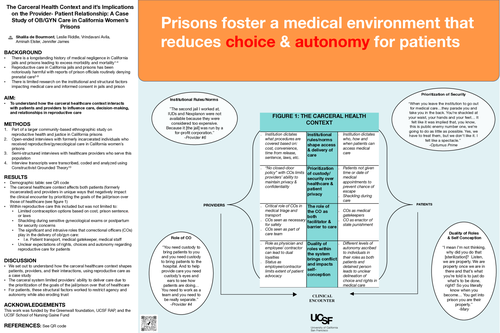
Findings: 25 individuals (10 providers and 15 previously incarcerated individuals) participated. Among previously incarcerated individuals, two (13%) identified as transgender men, thirteen (87%) identified as women and the average incarceration time was 23 years in prison. Among providers, all were MDs, nine (90%) identified as women and average time working with incarcerated patients was 9.9 years. Interviews with providers and previously incarcerated individuals (hereafter referred to as patients) highlighted the ways in which the carceral health context affects both patients and providers in ways that can negatively impact the clinical encounter. Aspects of the carceral health context that were highlighted by participants as playing a significant role in medical care included: 1) Jail/prison rules and norms shape the access to and delivery of care. 2) Concerns over security and custody can take priority over healthcare and patient privacy. 3) Correctional officers (CO) play a central part in the delivery of carceral healthcare but can also act as a barrier to care. 4) The duality of roles that patients and providers have within the carceral health system can bring internal conflict and impact self-conception. Reproductive healthcare highlights the ways in which these aspects of the carceral health context affect patients and providers and shape the clinical care environment. For example, providers were limited in what birth control options they could offer due to jail/prison policies, patients were regularly shackled by COs during sensitive gynecological exams or postpartum for security concerns, and the restriction of autonomy ascribed to a patient’s role as incarcerated person led to unclear expectations of rights, choices, and autonomy when it came to reproductive care such as the right to an abortion.
Discussion & Limitations: This qualitative study aimed to understand how the carceral health context interacts with providers and patients to impact medical care using reproductive care as a case study. We found several factors through which the carceral system limited providers’ ability to deliver care and prioritized the goals of the jail/prison over that of healthcare. For patients, these structural factors worked to restrict agency and autonomy while also eroding trust. This study had several limitations including that it focused solely on California and includes experiences in both jails and prisons, and medical care that occurred both within a correctional institution and at an outside medical center. Future studies should focus on the experiences of currently incarcerated individuals as well as on other forms of carceral healthcare beyond reproductive care.