145 posters, 12 topics, 25 sessions, 145 authors
ePostersLive by SciGen Technologies S.A. All rights reserved.
UCSF 2023 Inquiry Symposium
10 May | University of San Francisco

P031
Perioperative Clinician Experiences with Limited English Proficiency Patients
Poster Presenter
Authors
Part of Topic
Social & Behavioral Sciences
Introduction: In the US, more than 20% of the population reports speaking a language other than English at home. Limited English proficiency (LEP) and language discordance has been linked with lower quality of care and paBent saBsfacBon, and worse health outcomes in the outpatient and hospital settings. In the perioperative setting, communication and decision making are complex, and shared decision making depends on high-quality communication between healthcare providers and the healthcare recipients, and is central to patient safety. It is important to explore the complexities of working with LEP patients in the perioperative settings in order to identify barriers that may be addressed and facilitators that can promote patient centered care.
Aims: The purpose of this study is to explore the barriers and facilitators identified by anesthesia care providers for working with limited English proficiency patients within the perioperative setting.
Project Design/Methods: This is a qualitative study that will utilize in-depth semi-structured interviews to collect experience and perception data from providers, and a phenomenology to better understand the experiences of working with LEP patients. Data collection will be based on the principles of thematic sufficiency whereby collection of new data does not yield new concepts or information on the subject under investigation. Interviews will be coded to identify themes, and we will use anecdotes to tell illustrative stories of provider experiences.
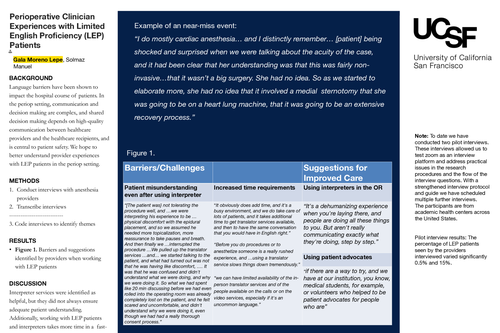
Results/Product: To date we have conducted two pilot interviews. These interviews allowed us to test zoom as an interview platform and address practical issues in the research procedures and the flow of the interview questions. With a strengthened interview protocol and guide we have scheduled multiple further interviews. The participants are from academic health centers across the United States.
Pilot interview results: The percentage of LEP patients seen by the providers interviewed varied significantly 0.5% and 15%. Challenges that were identified when working with LEP patients in the perioperative setting included lack of understanding of the procedure even after an interpreter was used, misinterpretation of patient body language, and being in a fast-paced environment. Practices in place that facilitated interaction with LEP patients included having translators (phone, iPads, in-person), and having a designation in the chart for patients that prefer a translator.
Discussion/Conclusion: There are many challenges and facilitators identified by anesthesia providers when working with LEP patients. While having interpreter services available was identified as helpful, they did not always ensure adequate patient understanding of the procedure. Additionally, reaching a translator could take minutes or hours, and using translators slows things down in the fast- paced perioperative environment. Providers shared their suggestions for improving LEP patient experiences in the perioperative setting, which included having dedicated patient advocates for LEP patients and using a translator in the OR during a pre-incision timeout that includes the patient. Given our small sample size, we have not reached thematic saturation. We need to continue to conduct interviews to better understand provider experiences with LEP patients.