145 posters, 12 topics, 25 sessions, 145 authors
ePostersLive by SciGen Technologies S.A. All rights reserved.
UCSF 2023 Inquiry Symposium
10 May | University of San Francisco

P082
Patient and provider perspectives on barriers and facilitators to reproductive healthcare access for women experiencing homelessness with substance use disorders in San Francisco
Poster Presenter
Authors
Part of Topic
Social & Behavioral Sciences
Introduction: Women and girls comprise the fastest growing group of unstably housed individuals in the United States.1 Women experiencing homelessness face distinct and complex barriers to accessing reproductive healthcare, resulting in decreased use of services compared to their housed peers.2,3 High rates of co-occurring substance use disorders further complicate access to reproductive care for women experiencing homelessness.4,5 As the number of women experiencing homelessness with substance use disorders rises, improving access to reproductive healthcare for patients who desire these services is increasingly important.
Hypothesis or question: This purpose of this study was to explore the reproductive aspirations of women experiencing homelessness with substance use disorders, as well as the barriers to accessing reproductive services from the perspectives of affected individuals, and the healthcare providers who serve them.
Aims: We conducted this mixed-methods study to explore (1) the reproductive aspirations of women affected by homelessness and substance use, and (2) patient and provider perspectives on barriers to accessing reproductive health services. By incorporating provider and patient perspectives, this study compares patient and provider priorities, with the goal of facilitating future interventions to improve access to high-quality, person-centered reproductive care.
Project Design/Methods: We conducted surveys and semi-structured interviews with women experiencing homeless with substance use disorders recruited from opiate treatment programs and homeless encampments in San Francisco, California in 2018. We also conducted interviews and focus groups with San Francisco-based healthcare providers working in reproductive health and substance-use treatment settings. Interviews were recorded, transcribed, and analyzed using a combination of deductive and inductive coding with a thematic analysis approach. Descriptive statistics of survey results were performed.
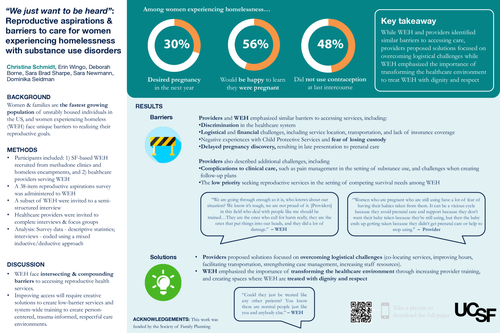
Results/Product: Twenty-eight women completed surveys, 96% of whom reported current substance use. Ten women participated in interviews. One-third (9/28) reported desiring pregnancy in the next year; over half (16/28) reported they would be somewhat or very happy to learn they were pregnant. A majority used no contraception at last intercourse (14/28). Twenty-six healthcare providers participated in interviews (n=15) and focus groups (n=2). Patients and providers identified similar barriers to care access, including discrimination, logistical and financial challenges, and delayed pregnancy awareness. While providers proposed solutions focused on overcoming logistical challenges, patients emphasized the importance of transforming the healthcare environment to treat patients affected by substance use and homelessness with dignity and respect.
Discussion/Conclusion: Women experiencing homelessness with substance use disorders face intersecting and compounding barriers to accessing reproductive health services. While dominant narratives assume that women affected by homelessness and substance use do not desire pregnancy and underutilize family planning services due to lack of access, our study reveals that the reproductive aspirations of this population are diverse. Although patients and providers in this study acknowledged similar barriers to accessing reproductive services, the solutions that they proposed differed significantly. For patients, the impacts of decreasing stigma and bias on treatment experiences were particularly salient, while providers emphasized removing logistical barriers to accessing care.
Study limitations include a small sample size in one city. The views of study participants cannot be presumed to reflect the greater population of women experiencing homelessness with substance use disorders in San Francisco. Our use of snowball sampling is an additional limitation, as this form of participant recruitment may result in a clustering of experiences from members within the same community and limit the diversity of responses. Additionally, San Francisco invests heavily in public health, and access to services and commitment to supporting the reproductive health and well-being of this patient population may differ across locations. The results of this study must be considered within the context of our study location.
As we seek to improve access to reproductive health services for women experiencing homelessness with substance use disorders, the results of this study suggest that solutions focused exclusively on eliminating logistical barriers to accessing reproductive health services are insufficient. Without investment in changing provider attitudes and fostering healing care environments, improved access to person-centered reproductive health services for women affected by homelessness and substance use will not be fully realized.
References 1. The U.S. Department of Housing and Urban. The 2020 Annual Homeless Assessment Report (AHAR) to Congress. :102. 2. Teruya C, Longshore D, Andersen RM, et al. Health and Health Care Disparities among Homeless Women. Women Health. 2010;50(8):719-736. doi:10.1080/03630242.2010.532754 3. Gelberg L, Browner CH, Lejano E, Arangua L. Access to women’s health care: a qualitative study of barriers perceived by homeless women. Women Health. 2004;40(2):87-100. doi:10.1300/J013v40n02_06 4. Riley ED, Shumway M, Knight KR, Guzman D, Cohen J, Weiser SD. Risk factors for stimulant use among homeless and unstably housed adult women. Drug and Alcohol Dependence. 2015;153:173-179. doi:10.1016/j.drugalcdep.2015.05.023 5. Upshur CC, Jenkins D, Weinreb L, Gelberg L, Orvek EA. Prevalence and Predictors of Substance Use Disorders Among Homeless Women Seeking Primary Care: An 11 Site Survey. Am J Addict. 2017;26(7):680-688. doi:10.1111/ajad.12582