145 posters, 12 topics, 25 sessions, 145 authors
ePostersLive by SciGen Technologies S.A. All rights reserved.
UCSF 2023 Inquiry Symposium
10 May | University of San Francisco

P076
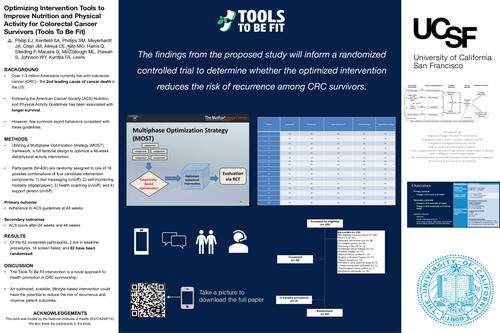
Optimization of a nutrition and physical activity intervention for colorectal cancer survivors: The Tools to Be Fit study
Poster Presenter
Authors
Part of Topic
Social & Behavioral Sciences
Optimization of a nutrition and physical activity intervention for colorectal cancer
survivors: The Tools to Be Fit study
Errol J. Philip, Stacey A. Kenfield, Siobhan M. Phillips, Jeffrey A. Meyerhardt, June M. Chan, MiOk Kim, Chloe Atreya, Sorbarikor Piawah, Alan Venook, Quincy Harris, Paige Steiding, Evelyn
Montenegro, Jane Figueiredo, Marjorie L. McCullough, Nicole Martinez, Shelagh Roberts,
Natalie Stewart, Tracy Yates, Wenora Johnson, Florence Kurtilla, Wendy Lewis, Curt Pesmen,
Yasmeem Watson, Erin L. Van Blarigan
Background: Colorectal cancer (CRC) is the 2nd leading cause of cancer death in the United
States. The American Cancer Society (ACS) Nutrition and Physical Activity Guidelines are
associated with longer survival among CRC survivors, but few report behaviors consistent with
the guidelines.
Methods: We are using the Multiphase Optimization Strategy (MOST) framework to optimize a
remotely delivered behavioral intervention for CRC survivors. In a 48-week (wk.) full-factorial
experiment, we are testing 4 intervention components: 15 health coaching sessions, 4 support
person coaching calls, 4 text messages per wk., and digital health toolkit (activity tracker and
diet tracking app). Our primary outcome is change in ACS score based on physical activity, diet,
and BMI (range: 0-6). Participants are recruited through the University of California San
Francisco; Dana-Farber Cancer Institute; California Cancer Registry; and nationwide using
social media (target N=400). Eligibility criteria include non-metastatic CRC, ≥18 y, English or
Spanish fluency, own a smartphone, completed therapy, and ACS score ≤4. All participants
receive a study booklet and are randomized to 1 of 16 combinations of the intervention
components (on/off) for 48 wks. Outcomes assessed at 24- and 48-wks include change in ACS
score and its components; theoretical constructs (e.g., self-efficacy); and biomarkers of insulin
metabolism, inflammation, and microbiome.
Results: Between October 2021-March 2023, 320 CRC survivors completed the screening
survey. Of these, 114 (36%) were potentially eligible and 206 (64%) were ineligible. Top
reasons for ineligibility include an ACS score >4 (79, 25%), metastatic disease (48, 15%), not
having a support person (38, 12%) and recent use of an activity tracker AND diet app for >1 wk
(36, 11%). Among potentially eligible participants, 82 (72%) have consented. Of the 82
consented participants, 2 are in baseline procedures, and 62 have been randomized.
Conclusions: This study will inform the design of a definitive RCT to help determine if an
optimized behavioral intervention can reduce the risk of CRC recurrence.